

Abu Dhabi to host Atlantic Council energy forum next week

1 / 2
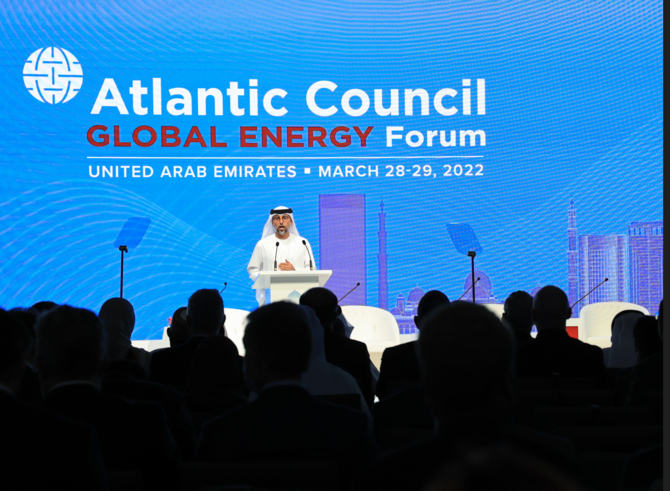
The 2023 forum will have a special focus on the challenge of managing energy security priorities and decarbonization efforts in tandem, amid the continuing impact of the crisis in Ukraine on the energy transition. (Supplied)
2 / 2
The 2023 forum will have a special focus on the challenge of managing energy security priorities and decarbonization efforts in tandem, amid the continuing impact of the crisis in Ukraine on the energy transition. (Supplied)
Short Url
Updated 03 January 2023
Follow

Abu Dhabi to host Atlantic Council energy forum next week

  • This year’s forum held in the lead-up to COP28 in UAE

ABU DHABI: The seventh annual Atlantic Council Global Energy Forum, set to be held in Abu Dhabi on January 14-15, 2023, will set the global energy agenda for the year ahead and examine the longer-term implications of the changing energy system, according to organizers.

This year’s forum will take on particular importance as critical climate and energy strategy issues take center stage in the lead-up to the UN Climate Change Conference of the Parties (COP28), which the UAE will also host at the end of the year. 

Held under the patronage of UAE president Sheikh Mohamed bin Zayed Al-Nahyan, the headliners will include John Kerry, US special presidential envoy for climate and former US secretary of state.

The 2023 forum will have a special focus on the challenge of managing energy security priorities and decarbonization efforts in tandem, amid the continuing impact of the crisis in Ukraine on the energy transition.

The forum will also once again be part of Abu Dhabi Sustainability Week, a global event supporting collaboration on climate action and net-zero pledges.

“As host of COP28, we are honored to welcome attendees of the Global Energy Forum to the United Arab Emirates to discuss the ongoing energy transition, Suhail bin Mohammed Al-Mazrouei, UAE minister of Energy and Infrastructure, said. 

“The UAE has adopted a wide range of energy initiatives to achieve global sustainable development goals and combat the devastating effects of climate change.

“This year’s forum provides a unique opportunity to not only talk about the energy agenda of the year ahead, but also begin the conversation for the United Nations Climate Change Conference now,” he added.

Frederick Kempe, Atlantic Council president and CEO, also said: “The dual challenges of energy security and climate change have elevated the energy transition to the top of global leaders’ list of urgent priorities.” 

He continued: “The 2023 Atlantic Council Global Energy Forum once again will provide a critically important platform for policymakers to meet those challenges, this is an opportunity to bring together leaders from around the world to set the 2023 energy agenda and build upon the past meetings’ success.”


Post-break return of students drives surge in education spending, SAMA data shows

Updated 10 sec ago
Follow

Post-break return of students drives surge in education spending, SAMA data shows

RIYADH: Spending on education in Saudi Arabia increased by 141.1 percent for the week ending Jan. 24, as students returned to the classroom after the mid-year break.

This was accompanied by a 7 percent increase in spending on books and stationery, which reached SR146.17 million ($38.9 million).

According to the latest data from the Saudi Central Bank, the over POS value dropped 10.6 percent to SR12.52 billion, with transactions representing a 9.7 percent week-on-week decrease to 213.62 million.

This week saw negative changes across all the remaining sectors. Spending on bakeries and pastries saw an 18.4 percent decline to SR229.71 million, while gas stations saw an 11 percent drop. Professional and business services decreased by 11.6 percent.

Expenditure on apparel and clothing fell by 19.7 percent to SR985.94 million, followed by a 2.8 percent drop in spending on jewelry.

Spending on car rentals in the Kingdom fell by 14.7 percent, while airlines saw a 9.3 percent decrease to SR38.16 million.

Expenditure on food and beverages saw a 7.9 percent decline to SR1.88 billion, claiming the largest share of the POS. Restaurants and cafes retained the second position despite an 18.5 percent decrease to SR1.50 billion.

Geographically, Riyadh accounted for the largest share of total POS spending, but still saw a 6 percent dip to SR4.46 billion, down from SR4.74 billion the previous week. The number of transactions in the capital settled at 69.07 million, down 6.8 percent week on week.

In Jeddah, transaction values decreased by 13.6 percent to SR1.75 billion, while Dammam reported a 4.8 percent decrease to SR640.59 million.

POS data, tracked weekly by SAMA, provides an indicator of consumer spending trends and the ongoing growth of digital payments in Saudi Arabia. 

The data also highlights the expanding reach of POS infrastructure, extending beyond major retail hubs to smaller cities and service sectors, supporting broader digital inclusion initiatives. 

The growth of digital payment technologies aligns with the Kingdom’s Vision 2030 objectives, promoting electronic transactions and contributing to the Kingdom’s broader digital economy.