

Germany signs €71 million deal with Pakistan to uplift renewable energy sector, assist flood-hit people

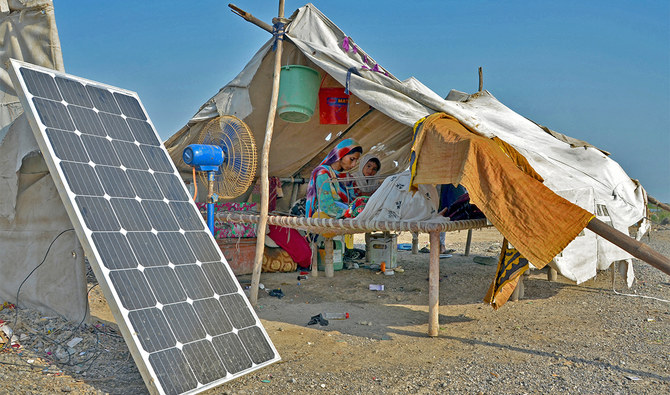
Internally displaced flood-affected people sit in their makeshift shelter in a flood-hit area following heavy rains in Dera Allah Yar town of Jaffarabad district in Balochistan province, Pakistan, on September 7, 2022. (AFP)
Short Url
Updated 29 December 2022
Follow

Germany signs €71 million deal with Pakistan to uplift renewable energy sector, assist flood-hit people

  • Under agreement,  €46.2 have been allocated for construction of a 500-kilovolt grid station in Chakwal
  • Germany allocates €25 to support people displaced by recent floods, which affected 33 million people

ISLAMABAD: Pakistan and Germany on Thursday signed a €71 million agreement to improve power supply in parts of the South Asian country, and to support people displaced by devastating floods this summer, Berlin's envoy to Islamabad said.

The deal was brokered with the help of Germany’s KfW Development Bank, which closely cooperates with European Union institutions on behalf of the German Federal Government to increase the effectiveness of European development cooperation (DC).

Under the deal, which the German bank signed with the Pakistani government’s Economic Affairs Divison and the National Transmission and Despatch Company Limited (NTDC), €46.2 have been allocated for the construction of a 500-kilovolt grid station in Chakwal, a city in Rawalpindi division of the eastern province of Punjab.

Once constructed, the grid station would improve power supply not only to the industrial sector in Punjab but also to electric supply companies in Islamabad and Faisalabad.

Alfred Grannas, the German Ambassador to Pakistan, announced in a Twitter post on Thursday morning:

.
He said out of the total of €71 million, €25 would be allocated to alleviate the condition of people displaced by recent floods, which claimed more than 1,700 lives, affected 33 million people, and incurred losses worth $30 billion, according to government estimates.

Grannas said Germany would also provide Pakistan an additional sum of €16.5 million to invest in solar energy projects to tackle climate change.

According to KfW’s Development Bank’s website, in line with the agreements signed between Pakistan and Germany to uplift the renewable energy sector, the bank co-funded both of Pakistan's main hydropower projects in Tarbela and Ghazi Barotha.


Islamabad says surge in aircraft orders after India standoff could end IMF reliance

Updated 22 min 17 sec ago
Follow

Islamabad says surge in aircraft orders after India standoff could end IMF reliance

  • Pakistani jets came into the limelight after Islamabad claimed to have shot down six Indian aircraft during a standoff in May last year
  • Many countries have since stepped up engagement with Pakistan, while others have proposed learning from PAF’s multi-domain capabilities

ISLAMABAD: Defense Minister Khawaja Asif on Tuesday said Pakistan has witnessed a surge in aircraft orders after a four-day military standoff with India last year and, if materialized, they could end the country’s reliance on the International Monetary Fund (IMF).

The statement came hours after a high-level Bangladeshi defense delegation met Pakistan’s Air Chief Marshal Zaheer Ahmed Baber Sidhu to discuss a potential sale of JF-17 Thunder aircraft, a multi-role fighter jointly developed by China and Pakistan that has become the backbone of the Pakistan Air Force (PAF) over the past decade.

Fighter jets used by Pakistan came into the limelight after Islamabad claimed to have shot down six Indian aircraft, including French-made Rafale jets, during the military conflict with India in May last year. India acknowledged losses in the aerial combat but did not specify a number.

Many countries have since stepped up defense engagement with Pakistan, while delegations from multiple other nations have proposed learning from Pakistan Air Force’s multi-domain air warfare capabilities that successfully advanced Chinese military technology performs against Western hardware.

“Right now, the number of orders we are receiving after reaching this point is significant because our aircraft have been tested,” Defense Minister Asif told a Pakistan’s Geo News channel.

“We are receiving those orders, and it is possible that after six months we may not even need the IMF.”

Pakistan markets the Chinese co-developed JF-17 as a lower-cost multi-role fighter and has positioned itself as a supplier able to offer aircraft, training and maintenance outside Western supply chains.

“I am saying this to you with full confidence,” Asif continued. “If, after six months, all these orders materialize, we will not need the IMF.”

Pakistan has repeatedly turned to the IMF for financial assistance to stabilize its economy. These loans come with strict conditions including fiscal reforms, subsidy cuts and measures to increase revenue that Pakistan must implement to secure disbursements.

In Sept. 2024, the IMF approved a $7 billion bailout for Pakistan under its Extended Fund Facility (EFF) program and a separate $1.4 billion loan under its climate resilience fund in May 2025, aimed at strengthening the country’s economic and climate resilience.

Pakistan has long been striving to expand defense exports by leveraging its decades of counter-insurgency experience and a domestic industry that produces aircraft, armored vehicles, munitions and other equipment.

The South Asian country reached a deal worth over $4 billion to sell military equipment to the Libyan National Army, Reuters report last month, citing Pakistani officials. The deal, one of Pakistan’s largest-ever weapons sales, included the sale of 16 JF-17 fighter jets and 12 Super Mushak trainer aircraft for basic pilot training.