

Pakistani capital on ‘high-alert’ for security after suicide bombing last week

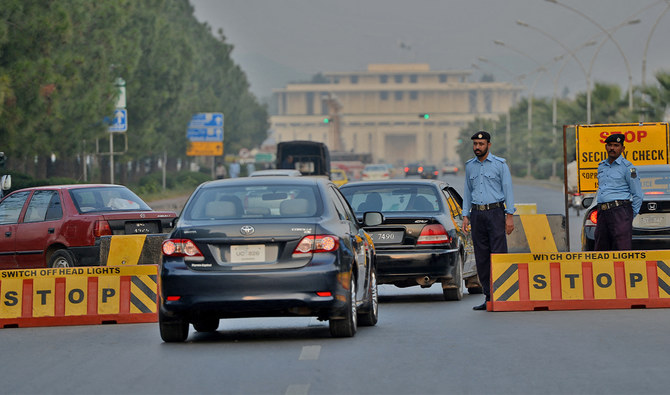
Pakistani policemen inspect vehicles at a checkpoint on the capital's constitution avenue in Islamabad, Pakistan, on October 29, 2013. (AFP/File)
Short Url
Updated 26 December 2022
Follow

Pakistani capital on ‘high-alert’ for security after suicide bombing last week

  • Pakistani Taliban have stepped up attacks since November when they unilaterally ended a cease-fire with the government
  • On Monday, police said they had received intelligence reports militants could try to hit ‘high-value’ targets in Islamabad

ISLAMABAD: Islamabad police said on Monday authorities had beefed up security in the Pakistani capital, deploying additional troops in sensitive areas and increasing patrolling operations across the city following a suicide bombing last week in which a police constable and a taxi driver were killed.

A powerful car bomb detonated in a residential area in Islamabad on Friday, raising fears that militants had established a presence in one of the country’s safest cities.

Pakistani Taliban have stepped up attacks on security forces since November, when they unilaterally ended a months-long cease-fire with the country’s government.

On Monday, police said they had received intelligence reports that militants could try to hit ‘high-value’ targets in the capital.

“We have put security on high alert to deal with any terror threat,” Taqi Jawad, a spokesperson for Islamabad Police, told Arab News. “We cannot identify any specific terror threat at the moment, but we are ready to deal with any situation.”

Jawad said Islamabad Police had enhanced checking at all entry and exit points to the city’s Red Zone which houses important government buildings, including Parliament House, the Supreme Court and the Prime Minister and President Offices. The Red Zone also leads into the Diplomatic Enclave where important embassies and ambassadors’ residences are located.

“Citizens are advised to carry their identity cards during travel and cooperate with the security personnel at checkpoints,” the spokesperson said, adding that police would avoid creating any “unnecessary panic” among the public but would remain vigilant.

Additional troops had been appointed in the city and patrolling had been enhanced, Jawad said.

On Sunday, the US embassy in Islamabad directed its staff to refrain from visiting a top hotel in the federal capital due to fears of a terror attack.

“The US government is aware of information that unknown individuals are possibly plotting to attack Americans at the Marriott Hotel in Islamabad sometime during the holidays,” the embassy said in a statement. “Effective immediately, the Embassy in Islamabad is prohibiting all American staff from visiting Islamabad’s Marriott Hotel.”
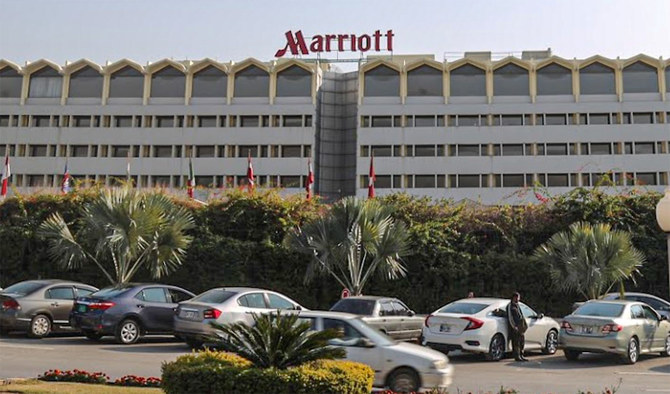


This undated file photo shows a general view of the Marriot Hotel in Islamabad, Pakistan. (Photo courtesy: social media)

The Islamabad police spokesperson declined to comment on the embassy’s security alert, saying: “We should not focus on the speculations instead believe in capabilities of the security personnel to defeat all nefarious designs of our detractors.”


Pakistan alleges India behind Balochistan attacks that killed 18 civilians, 15 troops

Updated 6 sec ago
Follow

Pakistan alleges India behind Balochistan attacks that killed 18 civilians, 15 troops

  • Interior Minister Mohsin Naqvi accuses India of planning coordinated attacks across Balochistan this week 
  • Military says it killed 133 militants on Friday and Saturday in separate operations across various areas in Balochistan

ISLAMABAD: Pakistan’s Interior Minister Mohsin Naqvi this week alleged that India was behind the recent coordinated attacks in the southwestern Balochistan province that the military says killed 18 civilians and 15 troops, vowing to go after those responsible for the violence. 

Pakistan’s military said on Saturday that it had killed 133 militants in the past two days in separate operations in Balochistan. The Inter-Services Public Relations (ISPR) said 41 militants were killed in operations in Panjgur and Harnai areas on Friday while 92 militants, including three suicide bombers, were killed on Saturday as security forces repelled coordinated attacks on civilians and law enforcement personnel in Quetta, Gwadar, Mastung, Nushki, Dalbandin, Kharan, Panjgur, Tump and Pasni areas. 

It added that 18 civilians, including women, children, elderly people and laborers, were killed in the attacks in Gwadar and Kharan, while 15 security personnel were also killed during clearance operations and armed standoffs.

“India is behind these attacks,” Naqvi said during a joint press conference in Quetta late Saturday night with Balochistan Chief Minister Sarfraz Bugti. “I can tell you for sure that India planned these attacks along with these terrorists.”

He vowed that Islamabad would go after the militants who carried out these attacks and their “masters.”

“At this time it is very necessary that the world knows that the main country that is behind terrorism is India, who not only financially supports terrorists but also supports them in their planning and strategy as well,” the minister said. 

In its statement on Saturday, the ISPR said the attacks were launched by “Indian sponsored Fitna al Hindustan,” a reference the military frequently uses for the separatist Balochistan Liberation Army (BLA) militant group. 

The BLA also issued a statement on Saturday, saying it had launched what it called “Operation Herof 2.0,” claiming responsibility for attacks in multiple locations across Balochistan. 

The military had said intelligence reports have confirmed the attacks were orchestrated and directed by militant leaders operating from outside Pakistan who were in direct communication with attackers during the assaults.

Pakistan has frequently blamed India for supporting militant attacks in Balochistan and its northwestern Khyber Pakhtunkhwa (KP) provinces, charges that New Delhi has vehemently denied. 

Balochistan, which borders Iran and Afghanistan, has faced a decades-long insurgency by separatist militant groups, with Pakistani authorities frequently accusing foreign actors of backing the violence. India has repeatedly denied such allegations.