

Calls mount on Indonesia to rescue hundreds of Rohingya stranded at sea

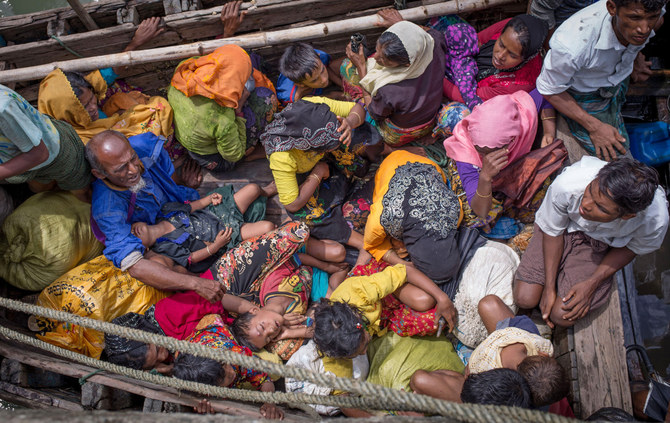
This photo taken on September 12, 2017 shows Rohingya refugees arriving by boat at Shah Parir Dwip on the Bangladesh side of the Naf River after fleeing violence in Myanmar. (AFP)
Short Url
Updated 24 December 2022
Follow

Calls mount on Indonesia to rescue hundreds of Rohingya stranded at sea

  • Five boats left Bangladesh in late November, activists say
  • Two vessels have reportedly been sighted near Indonesian waters

JAKARTA/NEW DELHI: Activists called on the Indonesian government on Saturday to rescue hundreds of Rohingya refugees who have been adrift for weeks on boats in the Indian Ocean, amid reports of the passengers dying onboard broken vessels.

Two boats carrying refugees, including women and children, entered Indonesian waters near the northernmost province of Aceh on Friday evening, according to Amnesty International, which urged the government to allow them to safely disembark.

“Reports said that both boats are carrying children. No rescue efforts have been made as of Saturday at noon. One refugee from one of the boats allegedly died from hunger,” the group said in a statement.

“Many people, in Indonesia, Australia, and all around the world, are just ready to celebrate Christmas. The spirit of humanity that shows during Christmas must prevail in time like this…We urge the government of Indonesia to rescue the boats and allow them to safely disembark.”

The boats are believed to be two of the five that left the coast of Cox’s Bazar, the largest Rohingya refugee settlement in Bangladesh, in late November, attempting to cross the Andaman Sea to another host country.

FASTFACT

Two boats carrying refugees, including women and children, entered Indonesian waters near the northernmost province of Aceh on Friday evening, according to Amnesty International, which urged the government to allow them to safely disembark.

In early December, 154 refugees on one of the boats were rescued by a Vietnamese offshore company and handed over to the Myanmar navy, while 104 people onboard another vessel were rescued by the Sri Lanka navy on Dec. 18.

The UN Refugee Agency cited on Saturday unconfirmed reports that at least 20 people on one of the missing boats were already dead, as it urged countries in the region to “help save lives.”

Mohammed Rezuwan Khan, a Rohingya activist in Cox’s Bazar whose sister and niece are onboard one of the vessels in near the Indonesian waters, said in a broadcast message sent to journalists that the boat was “towed to the Indonesian waters by the Indian navy.”

“We ask the Indonesian government to let them disembark urgently,” Khan told Arab News.

“It’s very important for them to reach any land, to disembark on any land, because they have been at sea for almost one month, so it’s a very dire situation at the moment.”

The boat, he said, had 160 people onboard, and has been adrift off the coasts of Thailand, Malaysia, Indonesia and India since early December, when its engines broke down.

Though appeals for help are growing increasingly desperate, countries in southern Asia have yet to dispatch official help or give any indication that they intend to, according to activists.

Wisnu Pramandita, a spokesman from the Indonesian Maritime Security Agency, told Arab News that authorities have yet to locate any vessel in the country’s maritime territory.

Reza Maulana from Geutanyoe, an Aceh-based humanitarian organization that works with Rohingya refugees in Indonesia, said that technical or political issues must not be used as arguments to avoid humanitarian action.

“It is beyond all technicalities,” he said. “Rescuing endangered refugees is a must, no matter what.”

Priyali Sur, founder of the Azadi Project, a Chennai-based organization that supports refugees, said she had received a photo of a young boy aboard one of the boats who had reportedly drowned along with his family.

“All these countries have left an entire population to just fend for themselves and pretty much die at sea,” Sur said.

Arab News was unable to immediately verify the photo or reports that the boat had sunk.

In 2017, more than 730,000 Rohingya fled to neighboring Bangladesh following a brutal crackdown by the Myanmar military that the UN says amounted to genocide.

In squalid and overcrowded camps in Cox’s Bazar, Rohingya refugees have been facing increasingly complex uncertainties that have prompted them to take risky journeys in the hopes of a better life.

“I think there should be a global outreach to figure out what we can do in terms of resettlement for this community,” Sur said.

“When Ukrainian refugees started coming in, a lot of countries openly accepted them. Why isn’t that the case with the Rohingya?”


2025 among world’s three hottest years on record, WMO says

Updated 14 January 2026
Follow

2025 among world’s three hottest years on record, WMO says

  • All eight datasets confirmed that the last three years were the planet’s three hottest since records began, the WMO said
  • The slight differences in the datasets’ rankings reflect their different methodologies and types of measurements

BRUSSELS: Last year was among the planet’s three warmest on record, the World Meteorological Organization said on Wednesday, as EU scientists also confirmed average temperatures have now exceeded 1.5 degrees Celsius of global warming for the longest since records began.
The WMO, which consolidates eight climate datasets from around the world, said six of them — including the European Union’s European Center for Medium-Range Weather Forecasts (ECMWF) and the British national weather service — had ranked 2025 as the third warmest, while two placed it as the second warmest in the 176-year record.
All eight datasets confirmed that the last three years were the planet’s three hottest since records began, the WMO said. The warmest year on record was 2024.

THREE-YEAR PERIOD ABOVE 1.5 C AVERAGE ⁠WARMING LEVEL
The slight differences in the datasets’ rankings reflect their different methodologies and types of measurements — which include satellite data and readings from weather stations.
ECMWF said 2025 also rounded out the first three-year period in which the average global temperature was 1.5 C above the pre-industrial era — the limit beyond which scientists expect global warming will unleash severe impacts, some of them irreversible.
“1.5 C is not a cliff edge. However, we know that every fraction of a degree matters, particularly for worsening extreme weather events,” said Samantha Burgess, strategic ⁠lead for climate at ECMWF.
Burgess said she expected 2026 to be among the planet’s five warmest years.

CHOICE OF HOW TO MANAGE TEMPERATURE OVERSHOOT
Governments pledged under the 2015 Paris Agreement to try to avoid exceeding 1.5 C of global warming, measured as a decades-long average temperature compared with pre-industrial temperatures.
But their failure to reduce greenhouse gas emissions means that target could now be breached before 2030 — a decade earlier than had been predicted when the Paris accord was signed in 2015, ECMWF said. “We are bound to pass it,” said Carlo Buontempo, director of the EU’s Copernicus Climate Change Service. “The choice we now have is how to best manage the inevitable overshoot and its consequences on societies and natural systems.”
Currently, the world’s long-term warming level is about 1.4 C above the pre-industrial era, ECMWF said. Measured on a short-term ⁠basis, average annual temperatures breached 1.5 C for the first time in 2024.

EXTREME WEATHER
Exceeding the long-term 1.5 C limit would lead to more extreme and widespread impacts, including hotter and longer heatwaves, and more powerful storms and floods. Already in 2025, wildfires in Europe produced the highest total emissions on record, while scientific studies confirmed specific weather events were made worse by climate change, including Hurricane Melissa in the Caribbean and monsoon rains in Pakistan which killed more than 1,000 people in floods.
Despite these worsening impacts, climate science is facing political pushback. US President Donald Trump, who has called climate change “the greatest con job,” last week withdrew from dozens of UN entities including the scientific Intergovernmental Panel on Climate Change.
The long-established consensus among the world’s scientists is that climate change is real, mostly caused by humans, and getting worse. Its main cause is greenhouse gas emissions from burning fossil fuels like coal, oil and gas, which trap heat in the atmosphere.