

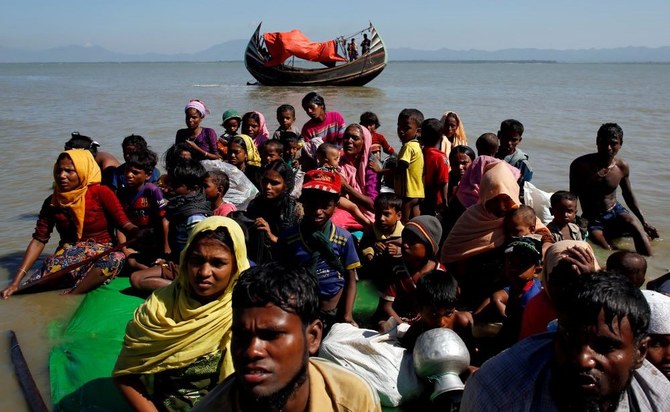

KUALA LUMPUR: Calls are mounting on Malaysia’s government to allow the safe disembarkation of Rohingya stranded on a boat within its waters, amid concerns that a number of them have already died from starvation and dehydration.
The boat carrying 160 people, including 120 women and children, sailed from Cox’s Bazar in southeastern Bangladesh on Nov. 25.
The coastal region has since 2017 become the world’s largest refugee settlement, as Bangladesh accepted nearly 1 million members of the Muslim Rohingya minority fleeing a widespread and systematic assault by security forces in neighboring Myanmar.
The conditions inside the squalid, overcrowded camps in Cox’s Bazar are desperate and the UN Refugee Agency has been reporting an increase in the number of Rohingya making risky journeys by the Andaman Sea to relocate to another host country.
The boat stranded in Malaysian waters has been adrift since its engines broke down on Dec. 1.
Mohammed Rezuwan Khan, a Rohingya activist in Cox’s Bazar whose sister and niece are onboard the boat, told Arab News on Sunday that they had nothing to eat or drink for the past few days.
“The rate of deaths in the boat is going to increase very quickly if there is no rescue by today or tomorrow,” he said. “It’s reached more than eight deaths already.”
Arab News could not independently verify the numbers, but Doctors Without Borders issued a statement on Saturday saying that “some people onboard have reportedly died due to lack of food or water.” It called on the Malaysian government to “urgently allow the safe disembarkation of refugees suffering the effects of a regional humanitarian crisis and fleeing to seek safety.”
Similar calls on Malaysia and other governments in the region were made over the weekend by the Asia Pacific Refugee Rights Network and Amnesty International.
The Malaysian government has not yet responded to the appeals. The Malaysian Ministry of Home Affairs and the Royal Malaysian Navy were unavailable for comment despite repeated attempts by Arab News.
The number of people attempting to cross the Andaman Sea from Bangladesh and Myanmar has increased sixfold since 2020, according to a UNHCR alert from early December.
This year alone, at least 119 people have been reported dead or missing on those journeys. Most of those risking their lives were Rohingya refugees.
“Tragedy and suffering in the camp forced them to choose to risk their lives, even die under the water. It’s like suicide,” Khan said.
“The international community must come forward and find a solution for the Rohingya refugees living in the world’s largest refugee camp. It’s getting too late.”


