

Adnan Syed hired by Georgetown’s prison reform initiative

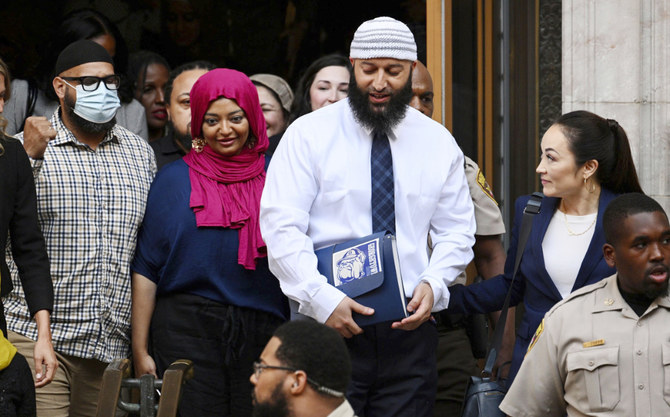
Adnan Syed, center right, leaves the courthouse after a hearing on Sept. 19, 2022, in Baltimore. (AP)
Short Url
Updated 24 December 2022
Follow

Adnan Syed hired by Georgetown’s prison reform initiative

  • Syed had been one of 25 incarcerated students at Georgetown’s inaugural Bachelor of Liberal Arts program at the Patuxent Institute in Jessup, Maryland, during the year leading up to his release, the university said

ANNAPOLIS, Md.: Adnan Syed, who was released from a Maryland prison this year after his case was the focus of the true-crime podcast “Serial,” has been hired by Georgetown University as a program associate for the university’s Prisons and Justice Initiative, the university said.
Syed started working this month for the initiative, which advocates for others in the criminal legal system, the university tweeted Wednesday.
In his new role, Syed will support Georgetown’s “Making an Exoneree” class, in which students reinvestigate decades-old wrongful convictions, create short documentaries about the cases and work to help bring innocent people home from prison, the university wrote in an online announcement.
“PJI’s team and programming has so much to gain from Adnan’s experience, insight, and commitment to serving incarcerated people and returning citizens,” the organization tweeted.
Syed had been one of 25 incarcerated students at Georgetown’s inaugural Bachelor of Liberal Arts program at the Patuxent Institute in Jessup, Maryland, during the year leading up to his release, the university said.
“To go from prison to being a Georgetown student and then to actually be on campus on a pathway to work for Georgetown at the Prisons and Justice Initiative, it’s a full circle moment,” Syed said in the university’s announcement. “PJI changed my life. It changed my family’s life. Hopefully I can have the same kind of impact on others.”
Syed, 41, hopes to continue his Georgetown education and eventually go to law school.
After spending 23 years in prison, he walked out of a Baltimore courthouse in September after a judge overturned his conviction for the 1999 murder of high school student Hae Min Lee, Syed’s ex-girlfriend.
Baltimore Circuit Court Judge Melissa Phinn ordered his release at the behest of prosecutors who said they had recently uncovered new evidence.
Prosecutors said a reinvestigation of the case revealed evidence regarding the possible involvement of two alternate suspects. The two suspects may have been involved individually or together, the state’s attorney’s office said.
The suspects were known persons at the time of the original investigation and were not properly ruled out nor disclosed to the defense, prosecutors said.
Baltimore State’s Attorney Marilyn Mosby’s office also cited new results from DNA testing that was conducted using a more modern technique than when evidence in the case was first tested. The recent testing excluded Syed as a suspect, prosecutors said.
Syed always maintained his innocence. His case captured the attention of millions in 2014 when the debut season of “Serial” focused on Lee’s killing and raised doubts about some of the evidence prosecutors had used. The program shattered podcast-streaming and downloading records.


EU should consider forming combined military force: defense chief

Updated 4 sec ago
Follow

EU should consider forming combined military force: defense chief

  • Kubilius floated creating a “powerful, standing ‘European military force’ of 100,000 troops” that could eventually replace US forces
  • Trump has heightened fears among NATO allies over Washington’s reliability by insisting he wants to take over Greenland

BRUSSELS: EU countries should weigh whether to set up a combined military force that could eventually replace US troops in Europe, the bloc’s defense chief said Sunday.
EU defense commissioner Andrius Kubilius floated creating a “powerful, standing ‘European military force’ of 100,000 troops” as a possible option to better protect the continent.
“How will we replace the 100,000-strong American standing military force, which is the back-bone military force in Europe?” he asked in a speech in Sweden.
The suggestion comes as US President Donald Trump has heightened fears among NATO allies over Washington’s reliability by insisting he wants to take over Greenland.
Worries over Trump’s commitment to Europe have already spurred countries to step up efforts to bolster their militaries in the face of the threat posed by Russia.
Ideas about establishing a central European army have floated around for years but have largely failed to gain traction as nations are wary of relinquishing control over their militaries.
The US has pushed its European allies to increasingly take over responsibility for their own security, and raised the prospect it could shift forces from Europe to focus on China.
“In such times, we should not run away from the most pressing questions on our institutional defense readiness,” said Kubilius, a former Lithuanian prime minister.
In his speech Kubilius also advocated for the creation of a “European Security Council” of key powers — including potentially Britain — that could help the continent take decisions over its own defense quicker.
“The European Security Council could be composed of key permanent members, along with several rotational members,” he said.
“In total around 10-12 members, with the task to discuss the most important issues in defense.”
He said the first focus of such a body should be trying to change the dynamics in the war in Ukraine to ensure that Kyiv does not end up losing.
“We need to have a clear answer — how is the EU going to change that scenario?,” he said.
“This is the reason why we need to have a European Security Council now!“