

Three soldiers, 25 militants killed in operation to retake police center — Pakistan army

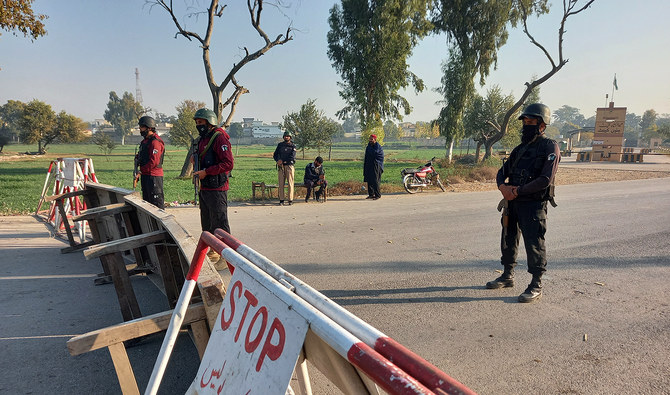
Pakistani soldiers stand guard on a road leading to the cantonment area in Bannu, Pakistan December 20, 2022. (Photo courtesy: REUTERS)
Short Url
Updated 21 December 2022
Follow

Three soldiers, 25 militants killed in operation to retake police center — Pakistan army

  • Counterterrorism facility seized two days ago by Taliban detainees who overpowered guards, took hostages
  • After two days of talks, Pakistan army commandos stormed the facility, killed the militants and freed hostage

ISLAMABAD: Three soldiers and 25 militants were killed on Tuesday during an operation to regain control of a counterterrorism department (CTD) facility that Pakistani Taliban (TTP) militants had taken over two days earlier, the head of the army’s media wing said.

The CTD facility in the northwestern town of Bannu was seized on Sunday by TTP militants who overpowered guards and took hostages. An operation to take back the center was launched early on Tuesday afternoon after two days of negotiations failed. Pakistan Army Special Service Group or SSG commandos subsequently stormed the center, located inside a military cantonment.

“During the operation three soldiers, including Subedar Major Khurshid Akram, Sepoy Saeed, and Sepoy Babar, embraced martyrdom, while security officials killed 25 terrorists,” the Director-General of the Inter-Services Public Relations (ISPR), Major General Ahmed Sharif, said in a late-night television interview.

Ten soldiers, including three officers, were injured in the action.

Providing details of the standoff, Sharif said a “terrorist” detained in the CTD complex overpowered a constable on duty on December 18, snatched his weapon and freed 34 other detainees.

“As soon as the terrorists were freed, they took hold of more weapons from the armory and opened fire, killing one CTD constable and injuring another,” Sharif said, adding that the injured constable later died.

“The terrorists then took hostage a junior commissioned officer for interrogation. Meanwhile, upon hearing the sound of gunshots, security forces from Bannu cantonment immediately reached the CTD facility and cordoned off the area,” he said.

The DG ISPR added that immediately after surrounding the CTD complex on December 18, security forces killed two militants and arrested three, while two security forces personnel sustained injuries during exchanges of fire.

“Effective encirclement of the complex by security forces foiled every escape attempt of the terrorists and, for the next two days, efforts were employed to force the terrorists to surrender unconditionally,” he added.

“The terrorists demanded a safe passage to Afghanistan, but it was made clear to them that their demands would not be met. Consequently, on December 20, security forces initiated an operation against them after they refused to surrender, and during a fierce exchange of fire between terrorists and security forces, 25 terrorists were killed while three of our valiant soldiers laid their lives in the line of duty.”

“The Pakistani security forces are determined to uphold the writ of the state and are committed to rooting out terrorism from the country,” the general said. “The great sacrifices of our brave martyred soldiers have strengthened this determination.”

The TTP, which has stepped up attacks since it announced the end of an Afghan Taliban-brokered cease-fire with the government last month, has long used violence in a bid to take over Pakistan and enforce its own harsh brand of Islam.

The TTP’s siege of the CTD center on Sunday came on the same day four Pakistani police officers were killed and another four critically wounded when suspected militants attacked a police station in Lakki Marwat district in the country’s northwest.

On Monday, a suicide bombing killed at least two passersby and a soldier in the northwestern region of North Waziristan. On Tuesday, the TTP said in a statement it had attacked a police station in Wana city in South Waziristan and killed two policemen and captured weapons but police said only one officer had been wounded.

Prime Minister Shehbaz Sharif condemned militant attacks in Bannu and other parts of the country, promising to crush the “wicked effort” of create chaos in the country through “terrorism.”

“The state will not bow before any terrorist group and terrorists will be dealt with according to the constitution and the law,” the prime minister said in a statement.

“Terrorism is a sensitive national security issue, which requires collective mindset and strategy.”

He said the federation will work together with provinces to fight “terrorism.”

“The federation will assist provinces in capacity-building of counterterrorism force and department,” PM Sharif said.

“[We] will work on restructuring of Khyber Pakhtunkhwa counterterrorism department and will fulfill all requirements of our forces.”


T20 World Cup: ICC deputy chief in Lahore for talks after Pakistan boycotts India match

Updated 8 sec ago
Follow

T20 World Cup: ICC deputy chief in Lahore for talks after Pakistan boycotts India match

  • Islamabad’s boycott over Bangladesh’s exclusion has threatened the tournament’s most lucrative game
  • Bangladesh Cricket Board chief has also arrived in Pakistan and is expected to participate in meetings

ISLAMABAD: International Cricket Council (ICC) Deputy Chairman Imran Khwaja arrived in Lahore on Sunday for talks with Pakistan Cricket Board (PCB) officials, the PCB said, as the sport’s governing body strives to save a high-stakes T20 World Cup clash between arch-rivals Pakistan and India.

The development follows Islamabad’s decision to boycott the Feb. 15 Pakistan-India match in Colombo, a move to protest the ICC’s exclusion of Bangladesh from the ongoing T20 World Cup.

The controversy over Pakistan’s participation erupted after the ICC replaced Bangladesh with Scotland, following Bangladesh’s decision to not play matches in India owing to security fears.

The ICC has since requested the Pakistan Cricket Board to reconsider the decision to boycott their match against India in Colombo or they will have to forfeit the marquee game of the tournament.

“ICC Deputy Chairman Imran Khwaja arrived in Lahore,” the PCB said on Sunday, adding that he was received at the airport by the PCB chairman’s adviser, Aamir Mir.

Prior to Khwaja’s arrival in Lahore, where the PCB is headquartered, Pakistan welcomed Bangladesh Cricket Board (BCB) President Aminul Islam, who was received by PCB CEO Salman Naseer.

The two visiting officials are scheduled to meet PCB Chairman Mohsin Naqvi.

“Bangladesh Cricket Board President Aminul Islam will also take part in other meetings,” the PCB said in a statement, hinting that he will be part of the meeting with ICC’s Khwaja.

The dispute stems from the ICC’s decision to replace Bangladesh with Scotland last month after Bangladesh refused to play tournament matches in India. Dhaka’s decision followed the removal of Mustafizur Rahman from the Indian Premier League (IPL). He was bought for $1 million by the IPL’s Kolkata Knight Riders, but on Jan. 3 the Board of Control for Cricket in India (BCCI) ordered Kolkata to release Mustafizur without a public explanation but amid regional tensions.

Pakistan have boycotted the 27th match of the tournament against India, due to take place at R. Premadasa Stadium in Colombo. An India-Pakistan fixture is the sport’s most lucrative asset, generating a massive share of global broadcasting and sponsorship revenue.

The PCB has remained defiant amid reports of potential sanctions. On Saturday, the board rejected claims by Indian media that it had initiated a dialogue with the ICC to find a way out of the standoff.

“I categorically reject the claim by Indian sports journalist Vikrant Gupta that PCB approached the ICC,” PCB’s Mir said in a statement. “As usual, sections of Indian media are busy circulating fiction. A little patience and time will clearly show who actually went knocking and who didn’t.”

The standoff highlights the growing friction within the sport’s governance.

Pakistan has accused India’s cricket board of influencing the ICC’s decisions.

Defense Minister Khawaja Asif this week called for the formation of a new cricket governing body, saying the ICC, currently chaired by Jay Shah, son of India’s Home Minister Amit Shah, was being held “hostage” to “Indian political interests.”

India generates the largest share of cricket’s commercial revenue and hence enjoys considerable influence over the sport. Critics argue that this financial contribution translates into decisive leverage within the ICC.

A large part of that revenue comes from the Indian Premier League (IPL), the sport’s most lucrative T20 cricket competition, which is run by the Board of Control for Cricket in India (BCCI). Between 2024 and 2027, the IPL is projected to earn $1.15 billion, nearly 39 percent of the ICC’s total annual revenue, according to international media reports.

While the Pakistani government cleared the team to participate in the rest of the tournament, Prime Minister Shehbaz Sharif maintained that the boycott of the India game was necessary to protest the “unjust” treatment of Bangladesh.