

Saudi energy minister: OPEC+ decision turned out to be right for market stability

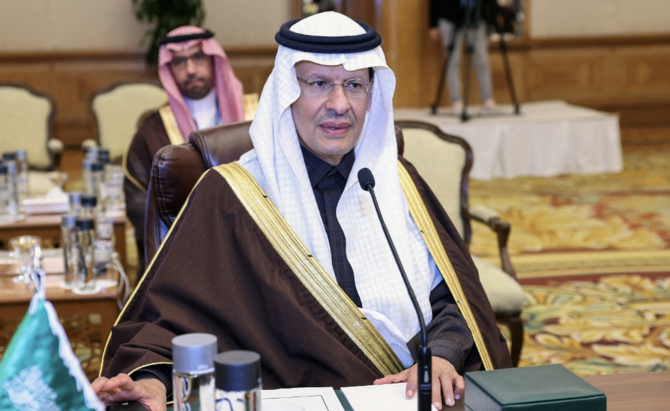
Saudi Energy Minister Abdulaziz bin Salman attends the 109th meeting of OAPEC in Kuwait City. (File/AFP)
Short Url
Updated 20 December 2022
Follow

Saudi energy minister: OPEC+ decision turned out to be right for market stability

  • OPEC+ leaves politics out of the decision-making process, out of assessments and forecasting, and focuses solely on market fundamentals: Energy minister

RIYADH: An OPEC+ decision taken in October to cut oil production by 2 million barrels a day turned out to be the right one for supporting the stability of the oil market despite being described as “very risky” and “unfortunate” at the time, Saudi Arabia’s energy minister said on Tuesday.

Speaking to the Saudi Press Agency, Prince Abdulaziz bin Salman said there were suggestions that the decision was driven by political motivations, would tip the global economy into recession, and would cause harm to developing countries.

“In retrospect, the OPEC+ decision turned out to be the right one for supporting the stability of the market and the industry,” he said. 

He added that the oil cartel leaves politics out of the “decision-making process, out of assessments and forecasting, and focuses solely on market fundamentals. This enables us to assess situations in a more objective manner and with much more clarity and this in turn enhances our credibility.” 

This could be seen at the beginning of the Ukraine conflict when some predicted large supply losses of more than 3 million bpd, which caused panic and contributed to extreme volatilities, the minister said.

“At that time, many accused OPEC+ of being behind the curve and not responding to a crisis in a timely manner. But these projected losses did not materialize,” he said.

Prince Abdulaziz added: “The problem with politicizing statistics and forecasting and using them to discredit OPEC+ and its stabilizing role is that it agitates consumers and creates confusion in the market and gives rise to anomalies and misguided interpretations, all of which contribute to unnecessary volatility.”

Playing politics with statistics and forecasting and not maintaining objectivity often tend to backfire and result in loss of credibility, the minister said.

He said the oil cartel would not hesitate to handle any market situation.

“The more credible we are, the easier our task is in bringing stability to markets, and the more stability we bring, the greater our credibility is cemented and recognized. This is a virtuous cycle that OPEC+ intends to maintain through objective and high-quality analysis and through keeping its focus on market fundamentals,” he said.


Oman money supply rises 6.4% to $68.6bn in November 

Updated 4 sec ago
Follow

Oman money supply rises 6.4% to $68.6bn in November 

JEDDAH: Oman’s money supply climbed 6.4 percent to 26.4 billion Omani rials ($68.6 billion) in November, signaling solid liquidity conditions and continued growth in bank deposits, official data showed.  

The increase in broad money — a measure that includes cash in circulation and bank deposits — was driven by a 12.2 percent rise in cash and demand deposits, alongside a 4.1 percent increase in savings and time deposits, the Oman News Agency reported. 

The latest reading follows steady gains earlier in 2025, with money supply up 6.1 percent in the three months through August. This was supported by a 6.9 percent rise in narrow money and a 5.8 percent increase in quasi-money. The trend reflects sustained liquidity conditions and stronger deposit growth across the banking system. 

The expansion in monetary aggregates points to continued liquidity and policy support for private-sector lending, as Oman advances fiscal and economic reforms under its Vision 2040 strategy. 

“During the same period, currency in circulation increased 1.9  percent, while demand deposits rose 14.1 percent,” the ONA report stated. 

At conventional commercial banks, the weighted average deposit rate in Omani rials declined to 2.50 percent in November from 2.73 percent a year earlier, while the weighted average lending rate eased to 5.45 percent from 5.67 percent over the same period. 

The overnight interbank lending rate averaged 3.92 percent in November, down from 4.56 percent a year earlier, reflecting a decline in the weighted average repo rate to 4.5 percent from 5.30 percent, influenced by US Federal Reserve policy shifts. 

Meanwhile, total assets of Islamic banks and windows reached about 9.3 billion Omani rials by the end of November, accounting for 19.4 percent of the Gulf state’s total banking sector assets.  

“This marks a 12.3 percent increase compared with the same period in 2024,” ONA reported, citing data from the Central Bank of Oman. 

Total financing by Islamic banking units rose 10.3 percent to around 7.5 billion rials, while deposits increased 10.9 percent to approximately 7.3 billion rials by the end of November. 

The November data follows the International Monetary Fund’s 2025 Article IV consultation report, released earlier this month, which highlighted the continued resilience of Oman’s economy amid global uncertainty. 

The IMF cited steady growth in non-hydrocarbon sectors, low inflation, and broadly sound fiscal and external positions, underscoring the effectiveness of Oman’s coordinated economic and financial policies.