

Operation launched to rescue hostages from militants at police center in Bannu — police

1 / 2
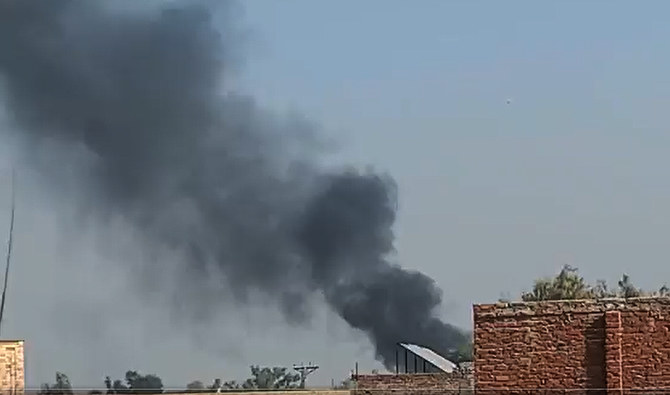
This screengrab taken on December 20, 2022 shows plumes of smoke rising from the direction of the Bannu military cantonment in Khyber Pakhtunkhwa province. (Courtesy: Twitter/Asfandyar Khan)
2 / 2
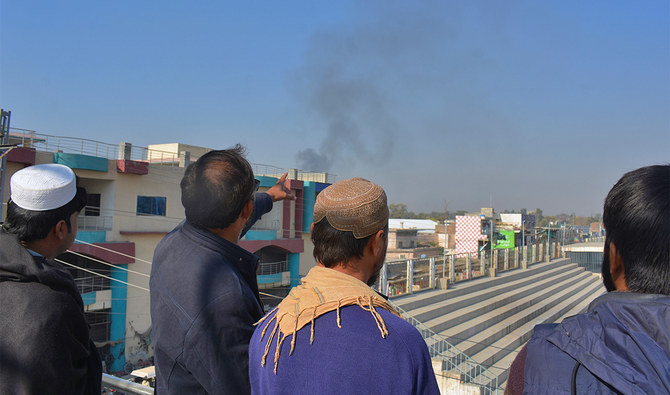
Local residents watch smoke rising from a counter-terrorism center after security forces starting to clear the compound seized earlier by Pakistani Taliban militants in Bannu, a northern district in the Pakistan's Khyber Pakhtunkhwa province, on December 20, 2022. (AP)
Short Url
Updated 20 December 2022
Follow

Operation launched to rescue hostages from militants at police center in Bannu — police

  • It was not immediately clear if the operation was being led by police or the military
  • Videos show smoke rising from Bannu military cantonment area where facility is located

BANNU/MARDAN: A senior police official in the northwestern city of Bannu confirmed on Tuesday an operation had been launched to free hostages from local Taliban militants holding up a counterterrorism department (CTD) facility since Sunday.

A spokesperson for the provincial Khyber Pakhtunkhwa government said on Monday authorities had opened talks with the Tehreek-e-Taliban Pakistan (TTP) militants inside the CTD center where they had overpowered guards on Sunday evening. But on Tuesday afternoon, local and international media widely reported that an operation to take back the facility had been launched.

It was not immediately clear if the operation was being led by police or the military. Reuters reported the Pakistan army’s elite commando unit, the Special Service Group (SSG), had been called in to carry out the operation but Arab News could not independently confirm this.

“An operation against the Taliban militants at the counterterrorism center has begun,” a senior police official with direct knowledge of the operation told Arab News, declining further details due to “security reasons.”

Video footage shared by an Arab News witness showed plumes of smoke rising from the vicinity of the Bannu military cantonment, where the CTD facility is located. Residents reported hearing firing and loud explosions.

The government announced a “medical emergency” at hospitals in Bannu city, while schools and other educational facilities also remained closed on Tuesday. Barricades were placed on all roads leading up to the military cantonment and the area was completely sealed off to the public and media. The Internet has been shut down for at least two days in the city.

Residents Arab News spoke with expressed fear over the developing situation.

Noor Aslam, village secretary of union counil Mombati Barakzai, said life had come to a standstill in the city.

“Due to mobile phones, all business here has stopped,” he said. “We can’t meet anyone or speak to them.”

“We don’t know when this situation will end,” he said. “I only know that people are worried.”

“DON’T SURRENDER BEFORE THE ENEMY”

A member of the Pakistani Taliban told Reuters on Tuesday the group’s leadership had lost contact with their people in the compound.

“We are told that a military operation has started,” he said.

In a statement released on Monday, the TTP said detainees linked to the group had taken “several military officers and jail staff” hostage at the CTD facility. The group demanded safe passage for its members to Pakistan’s tribal regions of North and South Waziristan.

In a video statement released on Tuesday, TTP chief Mufti Noor Wali Mehsud advised militants inside the CTD center not to “surrender before the enemy under any circumstances.”

“Once (you) have shown honor, sacrifice your life but don’t dishonor the fighters in front of the enemy,” he said in his message. “They [Pakistan government and military] have always deceived us in and out of the jails, [and] have broken their pledge so don’t be deceived by them.”

The TTP, which has stepped up attacks since it announced the end of an Afghan Taliban-brokered cease-fire with the government last month, has long used violence in a bid to take over Pakistan and enforce its own harsh brand of Islam.

The TTP’s siege of the CTD center on Sunday came on the same day four Pakistani police officers were killed and another four critically wounded when suspected militants attacked a police station in Lakki Marwat district in the country’s northwest.

On Monday, a suicide bombing killed at least two passersby and a soldier in the northwestern region of North Waziristan. On Tuesday, the TTP said in a statement it had attacked a police station in Wana city in South Waziristan and killed two policemen and captured weapons but police said only one officer had been wounded.

- Rehmat Mehsud contributed reporting from Peshawar.


Pakistan approves upgrades to national ID cards in push to strengthen digital ecosystem

Updated 24 February 2026
Follow

Pakistan approves upgrades to national ID cards in push to strengthen digital ecosystem

  • The amendments allow for QR-based verification, authentication controls, biometric expansion, and card format updates
  • The measures advance integrated digital governance through National Data Exchange Layer and broader digital ID ecosystem

ISLAMABAD: Pakistan has notified amendments to the National Identity Card and Pakistan Origin Card rules and introduced QR-based verification and stronger fraud controls, the National Database and Regulatory Authority (NADRA) said on Tuesday, amid efforts to strengthen the country’s digital ecosystem.

The amendments modernize Pakistan’s identity document framework by legally embedding QR-based verification, strengthening authentication controls across digital services, expanding biometric recognition and updating card formats for key citizen categories.

A core reform is the statutory introduction of the Quick Response (QR) code as a defined security and verification feature, authorizing the use of “QR code or any other technological feature” in lieu of current microchip enabling NADRA to adopt evolving verification technologies without repeated rule amendments.

This QR-enabled capability directly strengthens Pakistan’s Digital ID ecosystem and supports interoperability through the National Data Exchange Layer, according to the national database regulator.

“This establishes a robust legal basis for quick and secure verification of identity credentials in both offline and online environments,” NADRA said.

“This will also enable all citizens to carry similar card instead of currently prevalent two types of national identity cards one of which is with microchip and the other without.”

Pakistani state media reported in August that the country was developing digital identities of all its citizens to enable secure and efficient payments. The measures came as part of a broader effort to digitize the economy for greater transparency.

QR-based credentials allow rapid front-end validation of identity attributes in service delivery settings, while also enabling back-end systems to confirm authenticity and status through trusted exchanges. This is expected to improve speed, transparency and consistency of identity verification across government entities and regulated sectors, reduce manual handling, and lower the risk of fraud and impersonation, according to NADRA.

The amendments also strengthen the enforcement effect of card suspension. The Rules now clarify that where a card is suspended, all verification, authentication and related services linked to that card shall stand suspended forthwith. This closes a key risk area by ensuring that once a card is suspended, it cannot continue to be used through digital verification channels or institutional authentication processes.

“The amendments also introduce standardized identification for residents of Azad Jammu and Kashmir by requiring an inscription indicating ‘Resident of Azad Jammu and Kashmir’ in the manner specified by the Authority, thereby ensuring uniform geographic identification on the document,” NADRA said.

“Overall, these amendments strengthen the legal and technological foundations of Pakistan’s identity system by enabling secure QR-based verification, reinforcing the integrity of digital authentication services, improving biometric assurance,” it said. “They also advance readiness for integrated digital governance by supporting structured interoperability through the National Data Exchange Layer and a broader Digital ID ecosystem.”