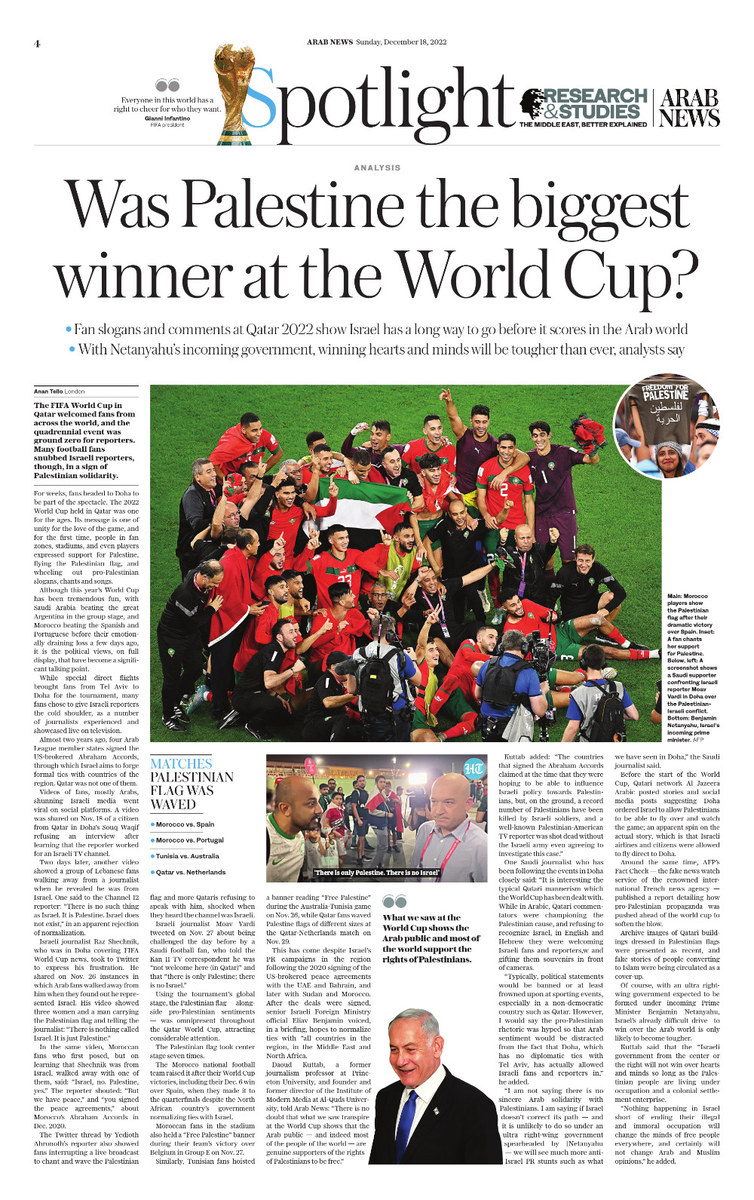

LONDON: This year’s FIFA World Cup welcomed fans from across the world, and the quadrennial event is ground zero for reporters. Many football fans snubbed Israeli reporters, though, in a sign of Palestinian solidarity.
For weeks, fans flocked to Doha to be part of the spectacle. The 2022 World Cup held in Qatar was one for the ages. Its message is one of unity for the love of the game, and for the first time, people in fan zones, stadiums, and even players expressed support for Palestine, flying the Palestinian flag and wheeling out pro-Palestinian slogans, chants and songs.
Although this year’s World Cup has been tremendous fun, with Saudi Arabia beating the great Argentina in the group stage and Morocco beating the Spanish and Portuguese before their emotionally draining loss a few days ago, it is the political views, on full display, that have become a significant talking point.

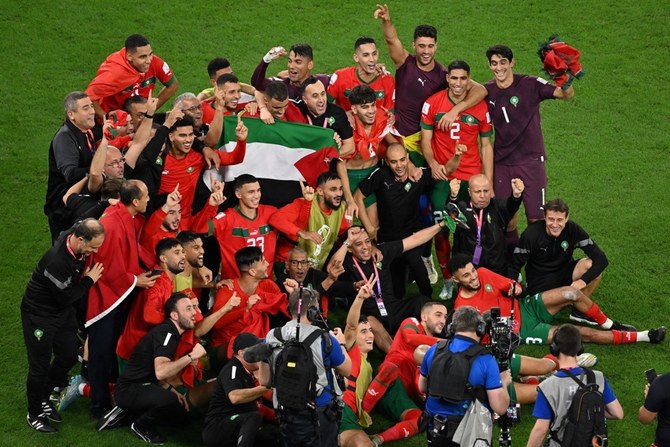
People in fan zones, stadiums, and even players expressed support for Palestine. (AFP)
While special direct flights brought fans from Tel Aviv to Doha for the tournament, many fans chose to give Israeli reporters the cold shoulder, as a number of journalists experienced and showcased live on television.
Almost two years ago, four Arab League member states signed the US-brokered Abraham Accords, through which Israel aims to forge formal ties with countries of the region. Qatar was not one of them.
Videos of fans, mostly Arabs, shunning Israeli media went viral on social platforms. A video was shared on Nov. 18 of a citizen from Qatar in Doha’s Souq Waqif refusing an interview after learning that the reporter worked for an Israeli TV channel.
Two days later, another video showed a group of Lebanese fans walking away from a journalist when he revealed he was from Israel. One of them said to the Channel 12 reporter: “There is no such thing as Israel. It is Palestine. Israel does not exist,” in an apparent rejection of normalization.
Israeli journalist Raz Shechnik, who was in Doha covering FIFA World Cup news, took to Twitter to express his frustration. He shared on Nov. 26 instances in which Arab fans walked away from him when they found out he represented Israel. His video showed three women and a man carrying the Palestinian flag and telling the journalist: “There is nothing called Israel. It is just Palestine.”
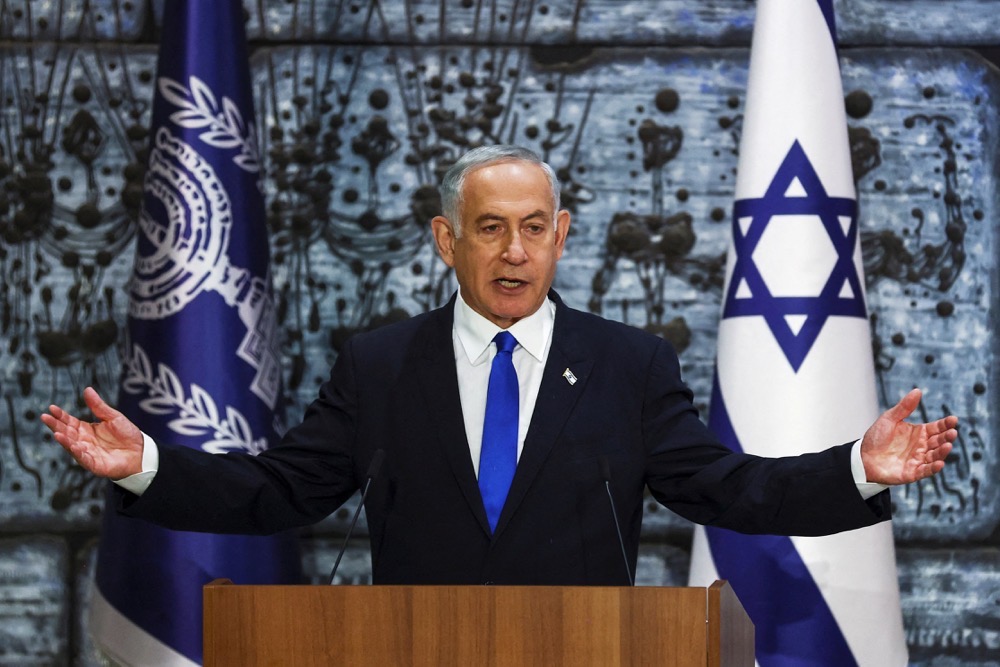
Benjamin Netanyahu, Israel’s incoming prime minister. (Reuters)
In the same video, Moroccan fans, who first posed, but, upon learning that Shechnik was from Israel, walked away with one of them said: “Israel, no. Palestine, yes.” The reporter shouted: “But we have peace,” and “you signed the peace agreements,” about Morocco’s Abraham Accords in Dec. 2020.
The Twitter thread by Yedioth Ahronoth’s reporter also showed fans interrupting a live broadcast to chant and wave the Palestinian flag and more Qataris refusing to speak with him, shocked when they heard the channel was Israeli.
Israeli journalist Moav Vardi tweeted on Nov. 27 about being challenged the day before by a Saudi football fan, who told the Kan 11 TV correspondent he was “not welcome here (in Qatar)” and that “there is only Palestine; there is no Israel.”
Using the tournament’s global stage, the Palestinian flag — alongside pro-Palestinian sentiments — was omnipresent throughout the Qatar World Cup, attracting considerable attention.
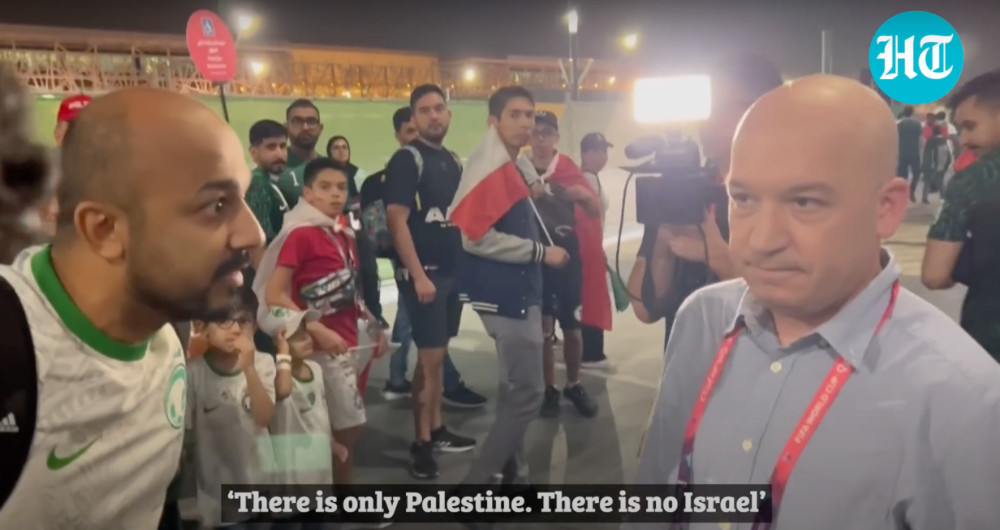
A screenshot shows a Saudi supporter confronting Israeli reporter Moav Vardi in Doha over the Palestinian-Israeli conflict.
The Palestinian flag took center stage seven times.
The Morocco national football team raised it after their World Cup victories, including their Dec. 6 win over Spain, when they made it to the quarterfinals despite the North African country’s government normalizing ties with Israel.
Moroccan fans in the stadium also held a “Free Palestine” banner during their team’s victory over Belgium in Group E on Nov. 27.
Similarly, Tunisian fans hoisted a banner reading “Free Palestine” during the Australia-Tunisia game on Nov. 26, while Qatar fans waved Palestine flags of different sizes at the Qatar-Netherlands match on Nov. 29.
Opinion
This section contains relevant reference points, placed in (Opinion field)
This has come despite Israel’s PR campaigns in the region following the 2020 signing of the US-brokered peace agreements with the UAE and Bahrain, and later with Sudan and Morocco. After the deals were signed, senior Israeli Foreign Ministry official Eliav Benjamin voiced, in a briefing, hopes to normalize ties with “all countries in the region, in the Middle East and North Africa.
Daoud Kuttab, a former journalism professor at Princeton University and founder and former director of the Institute of Modern Media at Al-Quds University, told Arab News: “There is no doubt that what we saw transpire at the World Cup shows beyond a shadow of a doubt that the Arab public — and indeed most of the people of the world — are genuine supporters of the rights of Palestinians to be free.”
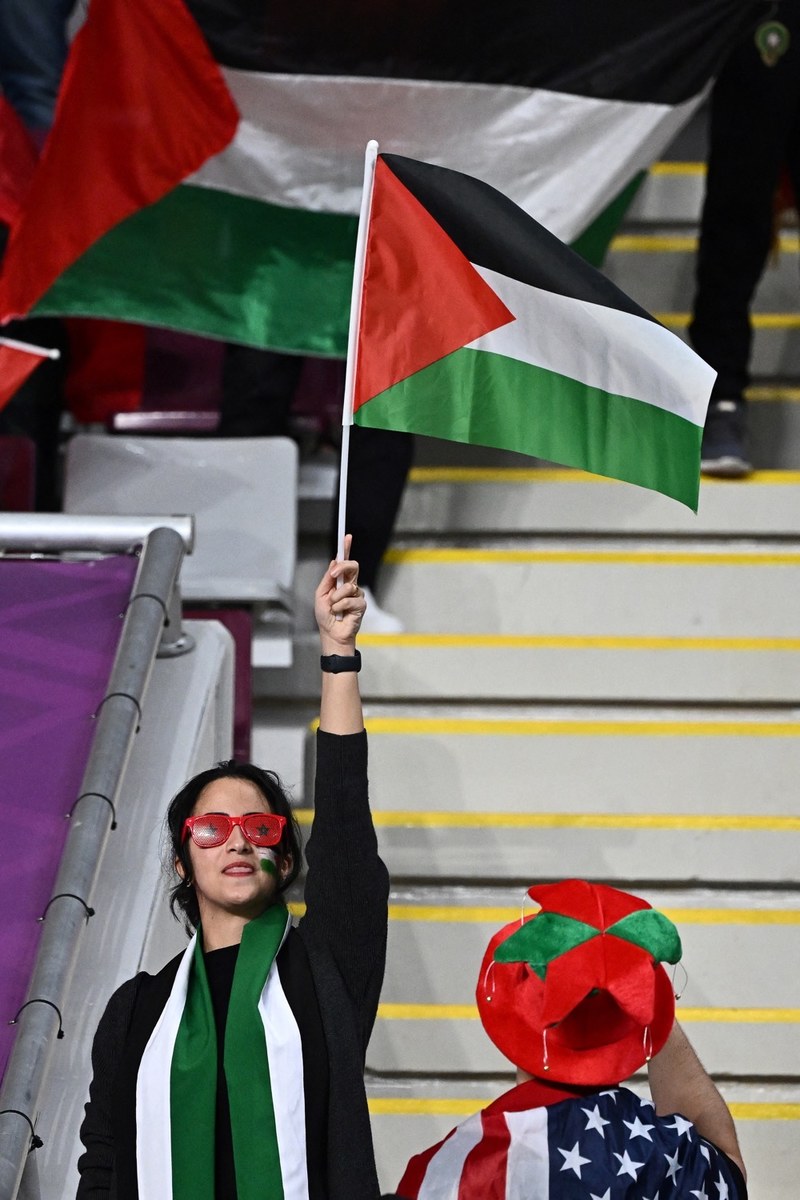
A fan chants her support for Palestine. (AFP)
Kuttab added: “The countries that signed the Abraham Accords claimed at the time that they are hoping to be able to influence Israeli policy towards Palestinians, but, on the ground, a record number of Palestinians have been killed by Israeli soldiers, and a well-known Palestinian-American TV reporter was shot dead without the Israeli army even agreeing to investigate this case.”
One Saudi journalist who is following the events in Doha closely said: “It is interesting the typical Qatari mannerism which the World Cup has been dealt with. While in Arabic, Qatari commentators were championing the Palestinian cause, and refusing to recognize Israel; in English and Hebrew they were welcoming Israeli fans and reporters and gifting them souvenirs in front of cameras.
“Typically, political statements would be banned or at least frowned upon at sporting events, especially in a non-democratic country such as Qatar. However, I would say the pro-Palestinian rhetoric was hyped so that Arab sentiment would be distracted from the fact that actually, Doha which has no diplomatic ties with Tel Aviv has actually allowed Israeli fans and reporters in,” he added.
“I am not saying there is no sincere Arab solidarity with Palestinians. I am saying if Israel doesn’t correct path — and it is unlikely to do so under an ultra right wing government spearheaded by Netanyahu — we will see much more anti-Israel PR stunts such as what we have seen in Doha,” concluded the Saudi journalist.
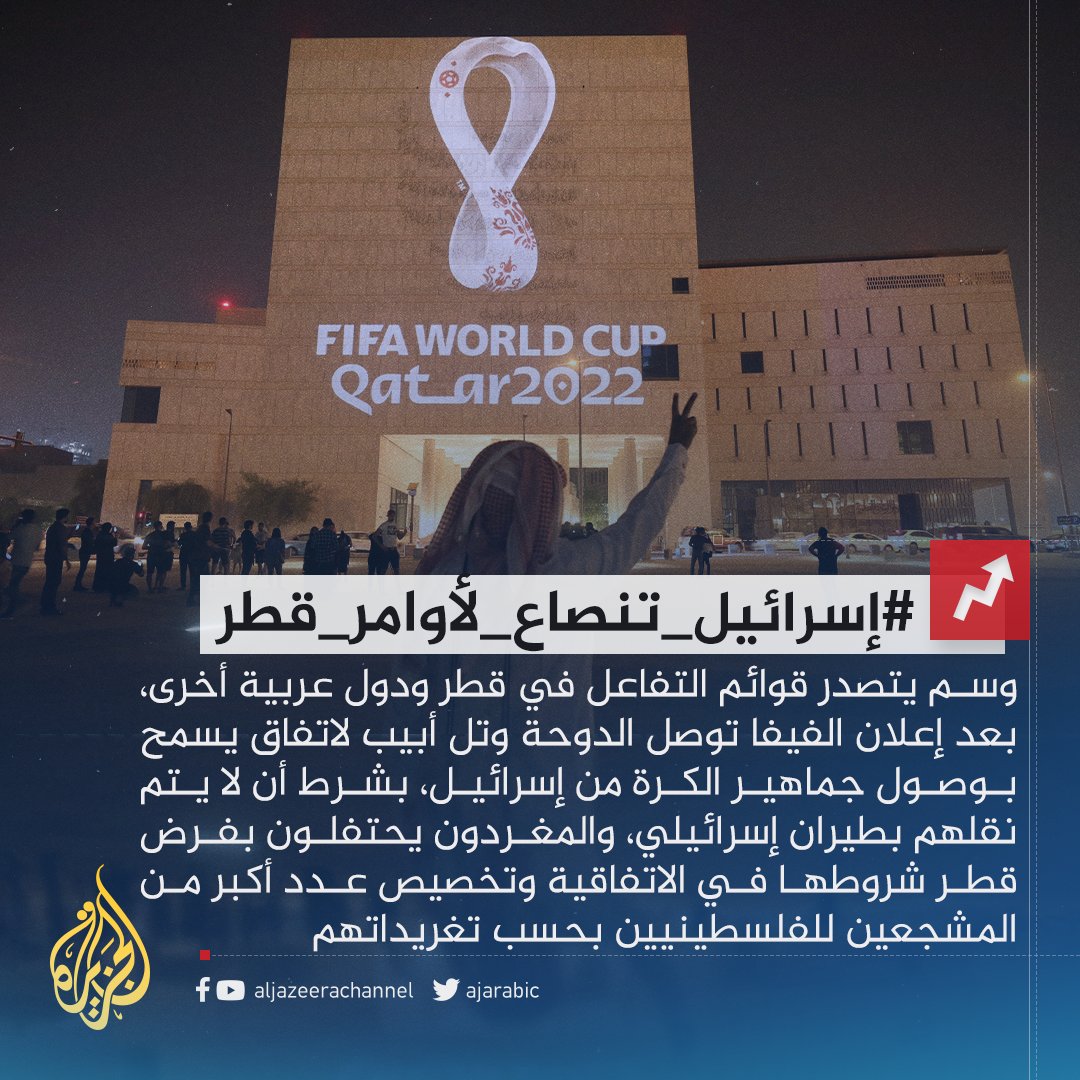
#Israel_obeys_Qatars_orders. The hashtag topped the trending lists in Qatar and other Arab countries after FIFA announced that Doha and Tel Aviv had reached an agreement allowing the arrival of football fans from Israel, provided that they are not transported by Israeli aircraft. Tweeters celebrated Qatar’s success in imposing its conditions, thus allowing more Palestinian fans to enjoy the football matches.
Prior to the commencement of the World Cup, Qatari network Al Jazeera Arabic posted stories and social media posts suggesting Doha ordered Israel to allow Palestinians to be able to fly over and watch the game; an apparent spin on the actual story which is that Israeli airlines and citizens were allowed to fly direct to Doha.
Around the same time, AFP’s Fact Check — the fake news watch service of the renowned international French news agency — published a report detailing how pro-Palestinian propaganda was pushed ahead of the world cup to soften the blow.
Archive images of Qatari buildings dressed in Palestinian flags were presented as recent, and fake stories of people converting to Islam were being circulated as a cover up.
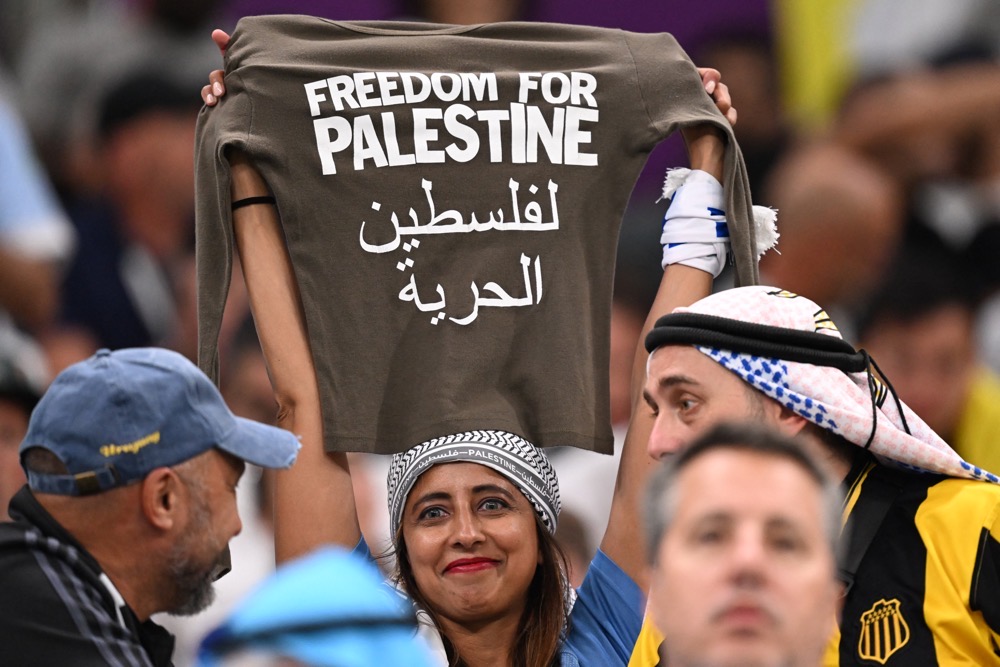
A spectator raises a ‘Freedom for Palestine’ shirt at the World Cup. (AFP)
Of course, with an ultra right-wing government expected to be formed under Prime Minister Designate Benjamin Netenyahu, Israel’s already difficult crusade to win over the Arab world is only likely to become more difficult.
Kuttab stressed that the “Israeli government from the center or the right will not win over the hearts and minds so long as the Palestinian people are living under occupation and colonial settlement enterprise.
“Nothing happening in Israel short of ending their illegal and immoral occupation will change the minds of free people everywhere, and certainly will not change Arab and Muslim opinions,” he added.