

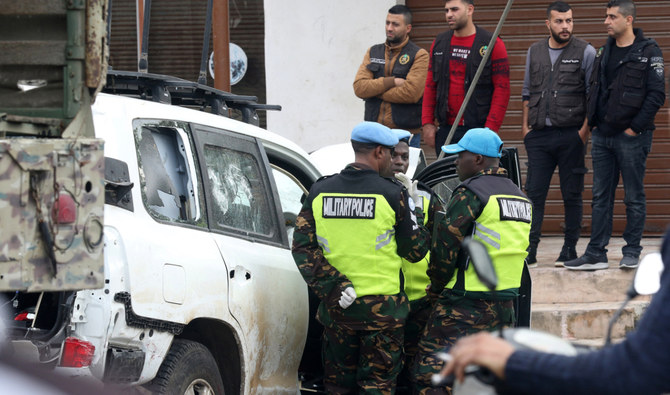

BEIRUT: An Irish soldier working in a UN peacekeeping force in Lebanon was killed when his armored convoy came under fire during clashes with residents in the southern Lebanese town of Al-Aqabiya.
The command of the UN Interim Force in Lebanon confirmed that a member of the Irish peacekeeping unit died and three others were wounded in the incident late on Wednesday.
The development has added to security concerns after the Lebanese parliament on Thursday failed, for the 10th time, to elect a new president.
Al-Aqabiya lies outside the southern Litani region, UNIFIL’s area of operation under Resolution 1701, and the peacekeeping force has no mandate there.
Although the shooting incident is the first of its kind, disputes have previously occurred between UNIFIL and residents of several southern towns after soldiers allegedly entered private property or photographed residential neighborhoods.
Hezbollah supporters frequently object to the peacekeeping force’s activities.
UNIFIL spokesman Andrea Tenenti said: “A peacekeeper was killed last night and three others were injured in an accident that occurred in Al-Aqabiya, near Sarafand, outside UNIFIL’s area of operation in southern Lebanon.”
Some reports of the incident suggest a UNIFIL vehicle rolled over near Al-Aqabiya after coming under fire. Nearby residents had complained about the vehicle using a private road.
Hezbollah’s Al-Manar TV said that the convoy was traveling without a Lebanese escort north of the Litani River, when the Irish soldier’s vehicle deviated from the main approved highway.
The TV report claimed the vehicle struck a group of young people gathered in the street to watch a World Cup game, injuring one person.
“Instead of stopping, it sped up and crashed into other vehicles. It turned over just as it came under fire from light weapons. The Irish soldiers and the citizen who was run over were rushed to the hospital,” the report said.
The Irish Defense Forces confirmed that the soldier was killed “when a convoy of two armored vehicles, carrying eight soldiers and heading toward Beirut, came under light weapons fire.”
One wounded soldier was in a critical condition and underwent surgery after the incident, while two others were treated for minor injuries, it said.
Lebanese officials immediately condemned the incident, while international officials, including the UN Special Coordinator for Lebanon, Joanna Wronecka, called for an investigation.
“Those responsible for the killing of the Irish soldier must be held accountable,” British Ambassador to Lebanon Ian Collard said.
Caretaker Prime Minister Najib Mikati said that authorities must investigate the incident, but urged all parties to show patience.
Wafiq Safa, Hezbollah coordination and liaison officer, said that the security services should be allowed to investigate the incident.
MP Ashraf Rifi said: “The attack on UNIFIL is an additional crime committed by Hezbollah in the name of ‘local residents,’ against Lebanon and its stability.”
He said that those responsible must be brought to justice, “otherwise (this incident) will perpetuate the power of illegal weapons and lead to the final suspension of Resolution 1701, which constitutes a guarantee for Lebanon.”


