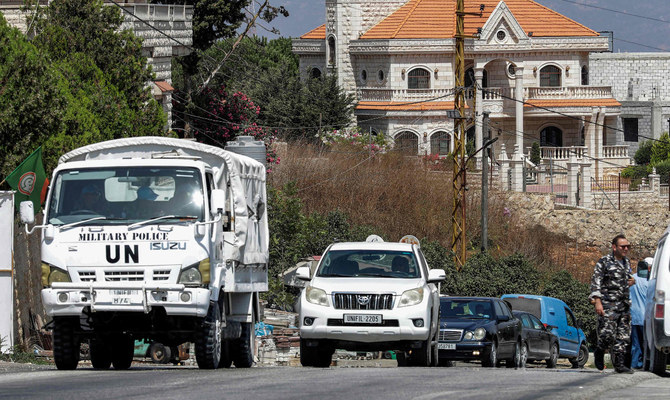

BEIRUT: Lebanon has welcomed the UN Security Council’s unanimous adoption of a resolution to renew UNIFIL’s mandate for another year.
The renewal request was made by the Lebanese government.
Arab News learned that after France submitted a draft of Resolution 2650, Lebanon tried to remove selected passages. However, several countries opposed the changes and insisted on passing it in its entirety.
The Security Council reiterated that the United Nations Interim Force in Lebanon does not require prior authorization or permission from anyone to undertake its mandated tasks and that it is allowed to conduct its operations independently.
It called on all parties to ensure UNIFIL’s freedom of movement, including allowing it to conduct both announced and unannounced patrols.
Previously, peacekeepers have clashed with local people intent on preventing them from entering residential neighborhoods or filming.
In the resolution, the Security Council condemned “the harassment and intimidation of UNIFIL personnel, as well as the use of disinformation campaigns against peacekeepers,” and requested the mission take measures to monitor and counter disinformation.
It also expressed its concern about developments along the Blue Line, noting the recent installation of containers that restrict peacekeepers’ access to, or ability to see, parts of the line.
It condemned “the presence of unauthorized weapons controlled by armed groups in UNIFIL’s area of operations.”
The Security Council requested the Lebanese Armed Forces and UN secretary-general set out precise benchmarks and timelines for the effective and durable deployment of Lebanese forces in the south of the country and in its territorial waters.
It also encouraged the Lebanese government to speed up the deployment of a model LAF regiment in the area of operations. This supports a long-term goal of the mission to eventually hand over all of its tasks and responsibilities to the Lebanese authorities.
In the resolution, the Security Council urged all parties to accelerate efforts to visibly mark the Blue Line in its entirety and move forward on resolving points of contention.
A Lebanese source in contact with UNIFIL told Arab News: “Despite the strongly worded resolution, UNIFIL cannot be above Lebanese law.
“The Lebanese security services cannot enter private properties before obtaining security or judicial permission. Consequently, UNIFIL’s freedom of movement cannot give it the right to enter private properties. Otherwise, UNIFIL will thus become an occupation force in a sense,” the person said.
Lebanese President Michel Aoun said on Thursday that the renewal of the mandate showed the determination of the international community to maintain security and stability on the country’s southern borders.
The Lebanese army and UNIFIL were working together to “properly implement Resolution 1701 in all its aspects, especially the cessation of hostilities committed by Israel,” he said.
Aoun thanked the countries participating in UNIFIL for carrying out the peacekeeping mission along the borders and stressed Lebanon’s commitment to implementing international resolutions.
Commenting on the renewal, caretaker Prime Minister Najib Mikati said: “This will consolidate the stability that southern Lebanon enjoys thanks to the close cooperation between the army and UNIFIL.
“We stress that all measures will be taken to support UNIFIL’s mission and we reiterate Lebanon’s commitment to international legitimacy and UN resolutions.”
Just days before the resolution was passed, a video of Lebanese Social Affairs Minister Hector Hajjar and Energy Minister Walid Fayyad throwing rocks toward Israel during a visit to the southern border went viral on social media.
People were quick to comment.
“The minister of energy is trying to cut off the electricity in occupied Lebanese villages so they will be like the rest of Lebanon,” one person said.
Others joked that throwing rocks would strengthen Lebanon’s negotiating position in the border demarcation negotiations with Israel.
In Resolution 2591 (2021), the Security Council requested UNIFIL take temporary and special measures to assist the Lebanese army with food, fuel, medicine and logistical support.
UNIFIL comprises more than 10,000 military peacekeepers from 48 countries and about 800 civilian staff.
Speaking after the vote, Lana Nusseibeh, the UAE’s permanent representative to the UN, welcomed the renewal of the mandate and commended France’s commitment to reaching a consensual result.
“Lebanon is facing overlapping crises that have burdened the Lebanese with deep social and economic distress, the like of which they have not seen for generations,” she said.
“Thus, this resolution reflects the urgent need for the Security Council to reaffirm its commitment to Lebanon’s sovereignty, independence and territorial integrity.”
Richard M. Mills Jr., the US permanent representative to the UN, also welcomed the renewal of the mandate and thanked France for its “constructive participation.”
With the new mandate, the Security Council had reaffirmed UNIFIL’s authorization to operate independently and conduct both announced and unannounced patrols, he said.
“The proliferation of prefabricated containers placed by Green Without Borders obstructs UNIFIL’s access to the Blue Line and heightens tensions in the area, further demonstrating that this so-called environmental group is acting on Hezbollah’s behalf,” he added.