

Pakistan 'deeply regrets' India turning down visas for blind cricket team

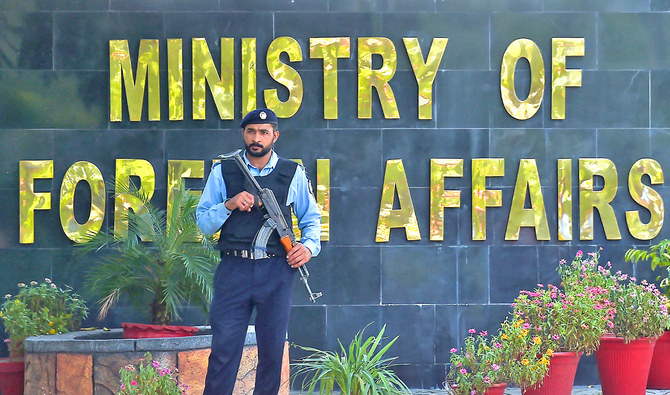
A Pakistani policeman stands guard outside the Pakistan's Foreign Ministry building in Islamabad on September 2, 2019. (AFP/File)
Short Url
Updated 07 December 2022
Follow

Pakistan 'deeply regrets' India turning down visas for blind cricket team

  • Foreign Office says it had conveyed Islamabad's disappointment to India
  • T20 World Cup Cricket for the Blind taking place in India from December 5-17

KARACHI: The foreign office on Tuesday "deeply regretted" India rejecting the visas of the country’s blind cricket team, effectively blocking its participation in the ongoing T20 World Cup Cricket for the Blind.

The tournament is taking place in India from December 5-17.

"As a result of the Indian decision, Pakistani players would be deprived of the opportunity to participate in an international sporting event of special significance," the foreign office said. "This reflects India’s insensitivity towards promotion of sports meant for differently-abled persons."

The sports events must not be politicized, Pakistan said, adding that the foreign office had conveyed Islamabad's disappointment to the Indian side.

Earlier in the day, Syed Sultan Shah, Chairman of the Pakistan Bling Cricket Council, announced that the Indian Ministry of External Affairs had denied the Pakistan Blind Cricket team clearance on "political grounds."

He said Pakistan was a serious contender to win the World Cup as it had been the runner-up twice in the earlier two editions of this format in 2012 and 2017.

“The Pakistani team has also beaten the current T-20 World Champion India five times consecutively in the last five encounters during two tri-nation competitions in 2021 and 2022, respectively."

“It was highly likely that Pakistan and India would have locked horns in the final of the ongoing World Cup and considering the current form of the Green Shirts, Pakistan had a high chance to win the World Cup,” he said.

PBCC “strongly condemned this discriminating act of India,” Shah said.

“Our counterpart Blind Cricket Association in India pleaded with their Govt for Pakistan clearance but nothing was heard,” he added.

Shah said the present Indian government’s “hatred” toward Pakistan also violated the United Nations Charter for Persons with Disabilities (UNCRPD) which induces States to provide equal sports playing opportunities to Persons with Disabilities, he added.

“This discriminating act will have serious consequences on Global Blind Cricket as we at World Blind Cricket will take stern action against them and may not allow India to host future international events.”

The Indian and Pakistani teams were set to face each other at the Siri Fort Ground on December 7.

“We all know it is a challenge to get visas for Pakistan cricketers. The MEA is working on it and we are confident that by the end of the day, they will get their visas,” Mahantesh GK, the president of the Cricket Association for the Blind in India (CABI) had told journalists on December 1.


At UN, Pakistan warns India’s suspension of water-sharing treaty carries security implications

Updated 4 sec ago
Follow

At UN, Pakistan warns India’s suspension of water-sharing treaty carries security implications

  • Brokered in 1960, Indus Waters Treaty divides control of Indus basin rivers between India and Pakistan
  • Pakistan urges UN to ensure prevention of unilateral suspensions, enforcement of international treaties

ISLAMABAD: Pakistan’s UN Ambassador Asim Iftikhar Ahmad warned the international community this week that any unilateral suspension of the Indus Waters Treaty (IWT) by India carries with it humanitarian, peace and security implications.

India last year announced it was holding the IWT, mediated by the World Bank in 1960, “in abeyance” amid increasing political tensions with Islamabad. The IWT divides control of the Indus basin rivers between the two nuclear-armed neighbors.

It grants Pakistan rights to the Indus basin’s western rivers — Indus, Jhelum, and Chenab — for irrigation, drinking, and non-consumptive uses like hydropower, while India controls the eastern rivers — Ravi, Beas, and Sutlej — for unrestricted use but must not significantly alter their flow. India can use the western rivers for limited purposes such as power generation and irrigation, without storing or diverting large volumes, according to the agreement.

Speaking at the “Arria Formula Meeting of the Security Council on Upholding the Sanctity of Treaties for the Maintenance of International Peace and Security” on Saturday, Ahmad noted the IWT was regarded as one of the most resilient water-sharing treaties that had stood the test of time, crises and political tensions. 

“Any unilateral disruption to established water-sharing arrangements carries humanitarian, environmental, and peace-and-security implications, particularly for downstream 240 million people of Pakistan,” he said. 

“When the lifelines of millions are placed under unilateral discretion, the risks are not hypothetical — they are real and immediate.”

The Pakistani envoy reiterated that the treaty was not a “bilateral concern” but a test case for the international system. He said if a treaty designed to prevent disputes or conflicts is disregarded unilaterally, “then no agreement is truly insulated from politics or all kinds of machinations.” 

“Borders, demilitarized zones, trade corridors, and humanitarian arrangements all become more fragile,” Ahmad noted. 

He underscored that the UN and the Security Council have a vital role to play, which includes the prevention of unilateral suspensions and enforcement of treaties. 

“Compliance with treaties must therefore be regarded as a strategic imperative for conflict prevention and resolution,” he said. 

Pakistan has warned India that it will not let New Delhi stop or divert the flow of its rivers. Islamabad said last year it would consider any move on India’s behalf to hinder the flow of its waters as “an act of war.”

The two countries engaged in the worst fighting between them in decades in May last year after India blamed Pakistan for being involved in a militant attack on tourists in Indian-administered Kashmir. Islamabad denied it was involved and called for a credible probe into the incident. 

India and Pakistan pounded each other with missiles, drones, jets and exchanged artillery fire for four days before Washington brokered a ceasefire on May 10.