Iran-backed hackers stage phishing campaign against activists, journalists: HRW

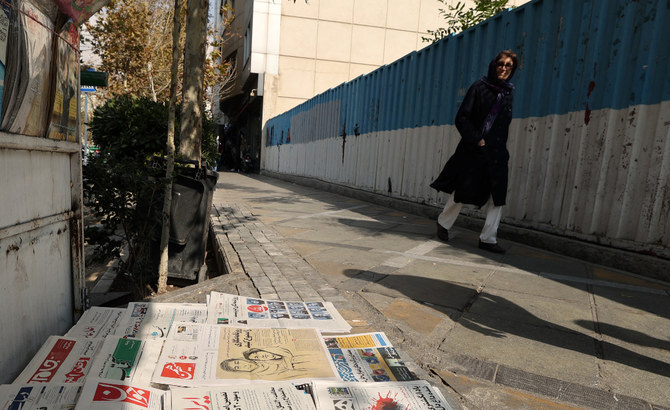
Iran has long engaged in phishing attempts as part of its cyberwarfare strategy. (File/AFP)
Short Url
Updated 05 December 2022
Follow

Iran-backed hackers stage phishing campaign against activists, journalists: HRW

  • Espionage group linked to IRGC gains access to emails of 3 victims

LONDON: Iran-backed hackers have staged a targeted campaign against more than a dozen high-profile human rights activists, journalists, academics and government officials, Human Rights Watch said.

The organization found that a coordinated phishing attack had been launched by an Iran-linked hacking entity known as APT42, believed to be a cyberespionage group.

The HRW report said that two of its employees were targeted, alongside 18 other people, resulting in the hacking of emails belonging to three individuals.

APT42 gained access to the emails, cloud storage, calendars and contacts of a US newspaper correspondent based in the Middle East, a Gulf-based women’s rights activist as well as a refugee advocate in Lebanon.

HRW said that the phishing attack was launched via WhatsApp, with 15 of the targets receiving suspicious messages between September and November this year.

The message, disguised as a conference invitation, allowed APT42 to gain access to the Google accounts of the three victims after they were invited to enter their two-factor authentication details on false pretenses.

Iran has long engaged in phishing attempts as part of its cyberwarfare strategy.

Since 2010, hackers and espionage groups linked to the regime in Tehran have successfully hacked and leaked the data of government, military and business targets around the world.

In September, APT42 members were sanctioned by the US Office of Foreign Assets Control at the Treasury Department.

Google as well as cybersecurity businesses Recorded Future and Proofpoint have said that APT42 operates on behalf of Iranian authorities.

Earlier this year, cybersecurity company Mandiant said that the group’s activities were directed by Iran’s Islamic Revolutionary Guard Corps.

APT42 uses sophisticated social engineering strategies in disguising phishing attempts, HRW said.

In gaining the trust of victims, APT42 members use the real information of conference organizers to create fake accounts and contact high-profile activists and officials.

Previous attacks have seen the group impersonate members of the Munich Security Conference and the G20 Think 20 Summit in Saudi Arabia to contact targets and launch phishing attacks.

Abir Ghattas, information security director at HRW, said: “Iran’s state-backed hackers are aggressively using sophisticated social engineering and credential harvesting tactics to access sensitive information and contacts held by Middle East-focused researchers and civil society groups.

“This significantly increases the risks that journalists and human rights defenders face in Iran and elsewhere in the region.”

She added: “In a Middle East region rife with surveillance threats for activists, it’s essential for digital security researchers to not only publish and promote findings, but also prioritize the protection of the region’s embattled activists, journalists and civil society leaders.”


Iran president confirms talks with US

Updated 7 sec ago
Follow

Iran president confirms talks with US

  • No official confirmation from Tehran on where the talks would be held

Iran’s president confirmed on Tuesday that he had ordered the start of talks with the US following requests “from friendly governments.”

There has been no official confirmation from Iran on where the talks would be held, but an Arab official, speaking on condition of anonymity, told AFP a meeting was likely to take place in Turkiye on Friday, following diplomatic interventions by Ankara, as well as Egypt, Oman and Qatar.
US President Donald Trump  has spoken of potential military action and sent an aircraft carrier group to the Middle East following anti-government protests in Iran that were met with a deadly crackdown last month.

FASTFACT

On Tuesday, Qatar’s Foreign Ministry said diplomacy with Iran was ‘continuing very intensively,’ in ‘tandem with all our neighbors.’

Trump has maintained he is hopeful that Washington will “work something out” with Tehran, but also warned that “bad things would happen” if a deal was not agreed.
Tehran has insisted it wants diplomacy, while promising a decisive response to any aggression.
“I have instructed my Minister of Foreign Affairs, provided that a suitable environment exists — one free from threats and unreasonable expectations — to pursue fair and equitable negotiations,” President Masoud Pezeshkian wrote in a post on X.
He added that the talks followed requests “from friendly governments.”
On Tuesday, Qatar’s Foreign Ministry said diplomacy with Iran was “continuing very intensively,” in “tandem with all our neighbors.”
Earlier, a senior official from the UAE said Iran needed to reach a deal and “rebuild their relationship with the  US.”

I have instructed my Minister of Foreign Affairs, provided that a suitable environment exists to pursue fair and equitable negotiations.

President, Masoud Pezeshkian

“I would like to see direct Iranian-American negotiations leading to understandings so that we don’t have these issues every other day,” said presidential adviser Anwar Gargash.
Iran has repeatedly stressed that any talks should remain focused solely on the nuclear issue, rejecting the possibility of negotiations over its missile program or defense capabilities.
In an interview with CNN broadcast on Monday, Iranian Foreign Minister Abbas Araghchi said Tehran had lost trust in Washington as a negotiating partner but a deal on the nuclear issue remained achievable.
“So I see the possibility of another talk if the US negotiation team follows what President Trump said: to come to a fair and equitable deal to ensure that there is no nuclear weapons,” he said.
Since his return to office in January last year, Trump has reinstated his “maximum pressure” policy of sanctions against Iran, piling additional pain on a floundering economy.
Protests against the rising cost of living broke out in Tehran in December before evolving into wider nationwide anti-government demonstrations that triggered a deadly crackdown by the authorities.
Iranian officials have acknowledged more than 3,000 deaths during the unrest, but insist that most were members of the security forces and innocent bystanders, attributing the violence to “terrorist acts.”
The Human Rights Activists News Agency, a US-based NGO, says it has confirmed 6,854 deaths, mostly protesters killed by security forces, with other rights groups warning the figure is likely far higher.
On Tuesday, the NGO said it had counted at least 50,235 arrests linked to the protests, with further detentions ongoing.
Meanwhile, local media reported that the authorities had detained 139 foreign nationals in central parts of the country during the protests.