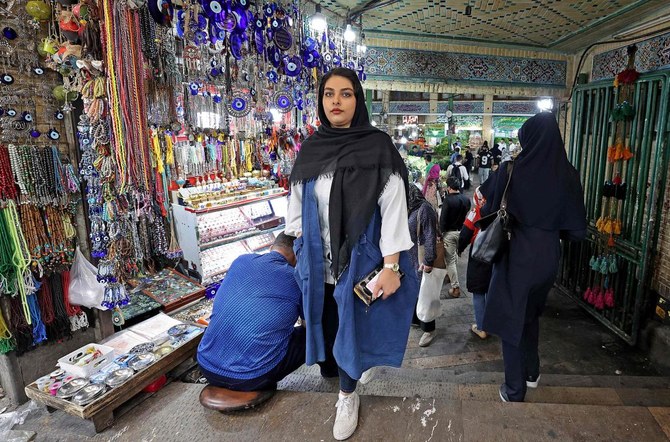
DUBAI: Iranian shops shut their doors in several cities on Monday, following calls for a three-day nationwide general strike from protesters seeking the fall of clerical rulers, with the head of the judiciary blaming “rioters” for threatening shopkeepers.
Iran has been rocked by nationwide unrest following the death of Iranian Kurdish woman Mahsa Amini on Sept. 16 in police custody, posing one of the strongest challenges to the Islamic Republic since the 1979 revolution.
Amini was arrested by Iran’s morality police for flouting the strict hijab policy, which requires women to dress modestly and wear headscarfs.
The semi-official Tasnim news agency reported on Monday that an amusement park at a Tehran shopping center was closed by the judiciary because its operators were not wearing the hijab properly.
The reformist-leaning Hammihan newspaper said that morality police had increased their presence in cities outside Tehran, where the force has been less active over recent weeks.
Iran’s public prosecutor on Saturday was cited by the semi-official Iranian Labour News Agency as saying that the morality police had been disbanded. But there was no confirmation from the Interior Ministry and state media said the public prosecutor was not responsible for overseeing the force.
Last week, Vice President for Women’s Affairs Ensieh Khazali said that the hijab was part of the Islamic Republic’s general law and that it guaranteed women’s social movement and security.
In the shop protests, 1500tasvir, a Twitter account with 380,000 followers focused on the protests, shared videos on Monday of shut stores in key commercial areas, such as Tehran’s Bazaar, and other large cities such as Karaj, Isfahan, Mashhad, Tabriz, and Shiraz.
Reuters could not immediately verify the footage.
The head of Iran’s judiciary, Gholamhossein Mohseni Ejei, said that “rioters” were threatening shopkeepers to close their businesses and added they would be swiftly dealt with by the judiciary and security bodies. Ejei added that protesters condemned to death would soon be executed.
The Revolutionary Guards issued a statement praising the judiciary and calling on it to swiftly and decisively issue a judgment against “defendants accused of crimes against the security of the nation and Islam.”
Security forces would show no mercy toward “rioters, thugs, terrorists,” the semi-official Tasnim news agency quoted the guards as saying.
Witnesses speaking to Reuters said riot police and the Basij militia had been heavily deployed in central Tehran.
The semi-official Fars news agency confirmed that a jewelry shop belonging to former Iranian football legend Ali Daei was sealed by authorities, following its decision to close down for the three days of the general strike.
Similar footage by 1500tasvir and other activist accounts was shared of closed shops in smaller cities like Bojnourd, Kerman, Sabzevar, Ilam, Ardabil and Lahijan.
Kurdish Iranian rights group Hengaw also reported that 19 cities had joined the general strike movement in western Iran, where most of the country’s Kurdish population live.
Hundreds of people have been killed in the unrest since the death of Amini, a 22-year-old woman who was detained by the morality police for flouting hijab rules.


![]()

Iranian city shops shut after strike call, judiciary blames ‘rioters’
Short Url
https://arab.news/rpujg
Iranian city shops shut after strike call, judiciary blames ‘rioters’
- 1500tasvir Twitter account shared videos of shut stores in key commercial areas like Tehran’s Bazaar
- Amusement park in Tehran was earlier closed because its operators were not wearing the hijab properly


Latest updates


© 2026 SAUDI RESEARCH & PUBLISHING COMPANY, All Rights Reserved And subject to Terms of Use Agreement.