

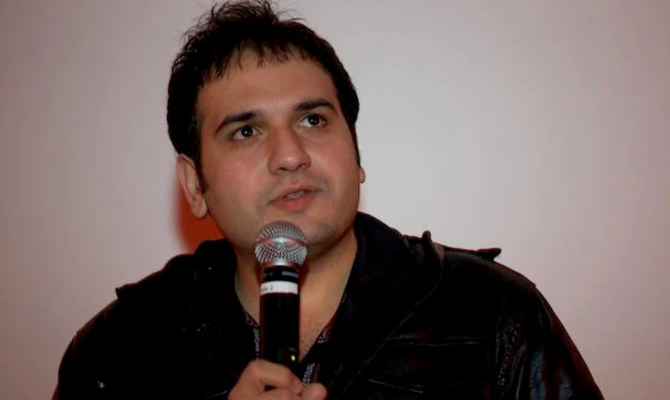
Iranian filmmaker Reza Dormishian barred from travel, passport confiscated

Iran has barred filmmaker Reza Dormishian from leaving the country. (Photo: Facebook)
Short Url
Updated 28 November 2022
Follow

Iranian filmmaker Reza Dormishian barred from travel, passport confiscated

  • Dormishian is only the latest in a long line of filmmakers to face Iran’s arbitrary detention policies

DUBAI: Iran has barred filmmaker Reza Dormishian from leaving the country. 

Dormishian was due to travel to the International Film Festival of India in Goa, where his film “A Minor” was scheduled to play.

On his arrival at the airport, his passport was confiscated. It is unclear if he was arrested and, if so, what the charges will be.

However, it is understood that the authorities’ action is the result of his recent social media posts about the Iranian government.

“Throughout the nationwide protests in Iran, Dormishian shared various posts on his Instagram account to show support for the significant developments,” sources close to him said, according to media reports.

In his most recent post, Dormishian had said: “I would die for a hair strand of Iranian people.

“I would die for the youth who are gone with the wind, from Balochistan to Kurdistan.

“What is my curfew worth?”


Dormishian is only the latest in a long line of filmmakers to face Iran’s arbitrary detention policies.

In July, acclaimed director Jafar Panahi was ordered to serve a six-year jail sentence, handed down a decade ago, after he attempted to find information about fellow filmmakers Mohammad Rasoulof and Mostafa Aleahmad, who had been detained earlier.

Last month, Iranian filmmaker Mani Haghighi was prevented from leaving Iran to attend the BFI London Film Festival, where his latest film “Subtraction” was being screened.

And earlier this month, co-directors Farnaz and Mohammadreza Jurabchian were barred from traveling to the Netherlands for the International Documentary Film Festival where their film “Silent House” had its world premiere.

Directed by Dariush Mehrjui and produced by Dormishian, “A Minor” played in India on Thursday and Friday last week.


Israel arrests 2 Turkish CNN journalists over live broadcast outside IDF HQ

Updated 03 March 2026
Follow

Israel arrests 2 Turkish CNN journalists over live broadcast outside IDF HQ

  • Police said reporter Emrah Cakmak and cameraman Halil Kahraman were detained on suspicion of filming a sensitive security facility
  • Since the Gaza war began, restrictions have expanded significantly, including tighter limits on filming soldiers on duty and sensitive or strategic sites

LONDON: Israeli police have arrested two Turkish CNN journalists who were broadcasting live outside the Israel Defense Forces’ headquarters in Tel Aviv.

Police said the pair were detained on suspicion of filming a sensitive security facility, according to the Israel Police Spokesperson’s Unit.

Reporter Emrah Cakmak and cameraman Halil Kahraman, from the network’s Turkish-language channel, had been reporting near the IDF’s Kirya military headquarters on Tuesday after Iran launched another missile barrage at Tel Aviv and other parts of central Israel.

During the live broadcast, two men believed to be soldiers approached the crew and seized the reporter’s phone, according to initial reports and a video circulating online that could not be independently verified.

Police said officers were dispatched after receiving reports of two people carrying cameras and allegedly broadcasting in real time for a foreign outlet.

Israel’s long-standing military censorship system, overseen by the IDF Military Censor, has long barred journalists and civilians from publishing material deemed harmful to national security.

Since the Gaza war began, restrictions have expanded significantly, including tighter limits on filming soldiers on duty and sensitive or strategic sites.

After a series of similar incidents involving foreign media — most of them Palestinian citizens of Israel working for Arab-language and international media, along with foreign journalists — during the 12-Day War, Israeli police halted live international broadcasts from missile impact sites, citing concerns that exact locations were being revealed.

The Government Press Office later imposed a blanket ban on live coverage from crash and impact areas.

Communications Minister Shlomo Karhi and National Security Minister Itamar Ben-Gvir subsequently ordered that all foreign journalists obtain prior written approval from the military censor before broadcasting — live or recorded — from combat zones or missile strike locations.

Police said that when officers asked the CNN Turk crew to identify themselves, they presented expired press cards and were taken in for questioning.

Burhanettin Duran, head of Turkiye’s Directorate of Communications, condemned the arrests as an attack on the press and said Ankara is working to secure the journalists’ release.