

KSA ‘on track’ to meet 2060 net-zero pledge: Saudi climate chief

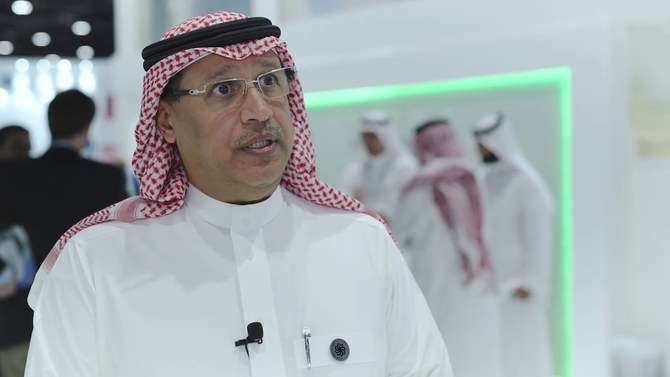
Khalid Abuleif said the Kingdom would be able to fulfil its pledges earlier and meet its 2060 targets if carbon capture and storage. (File Photo)
Short Url
Updated 20 November 2022
Follow

KSA ‘on track’ to meet 2060 net-zero pledge: Saudi climate chief

  • Technology to play key role as Kingdom seeks faster route to targets
  • Khalid Abuleif says his country is investing heavily to make these technologies ready sooner

SHARM EL-SHEIKH, Egypt: Saudi Arabia is on track to meet its net-zero pledge by 2060, even though the global technologies have not fully “matured” yet, the Kingdom’s chief climate change negotiator said.

“We are really in a great situation where Saudi Arabia could really move forward, not only to meet the short-term goals of 2030, but also to meet the 2060 goals,” Khalid Abuleif told Arab News. “But we could do that better and earlier if the technologies are matured earlier than they’re supposed to be.”

Abuleif said the Kingdom would be able to fulfil its pledges earlier and meet its 2060 targets if carbon capture and storage, direct air and removal technologies are fully available sooner.

“Saudi Arabia is investing heavily to make these technologies ready earlier, through two major initiatives,” Abuleif added, citing the Saudi Green Initiative and the Middle East Green Initiative, which were launched by Crown Prince Mohammed bin Salman last year.

He said that studies and reports issued by the Climate Change Impacts Studies Database show that most of these technologies will mature around 2040, “and hopefully we are having these technologies coming earlier.”

He said: “We have so many programs, almost 60 initiatives under that that would really help us move this forward, not only in meeting our obligations, but also making sure that most of these technologies are expedited and hopefully they would be commercially viable by the time we complete them.”

Abuleif, who is also the sustainability adviser to the minister of energy, was speaking on the sidelines of the UN Climate Change Conference (COP27), which kicked off on Nov. 6 in the Egyptian resort city of Sharm El-Sheikh, where delegates on Saturday were finalizing a draft agreement.

He said that during the Kingdom’s hosting of the G20 presidency two years ago, the country demonstrated “the clarity and the approach” of how it will address the goals of the Paris Agreement on climate change.

The Kingdom has a clear ambition to double the nationally determined contribution as part of its 2030 goals, he said, adding that in “2015 our NDC was 130 metric tons, and then only last year, before we got to Glasgow (COP26), we have upgraded that NDC to more than double, which is 278 metric tons of carbon, (and) this represents almost 40 percent of our 2019 emissions.”

Abuleif said: “This year we came back and we also shared with everybody what we have done last year, and what we are going to do next year as some kind of accountability on our side, to show the world that we are really serious and we are moving on the ground; we’re not talking, we are walking the talk.”

Saudi Arabia hosted the second editions of the Saudi and Middle East Green Initiative summits on the sidelines of COP27, which also included a separate pavilion showcasing over 60 programs and schemes that the Kingdom has launched and implemented to promote circular carbon economy, afforestation, wildlife rehabilitation, and sustainability.

“On the sustainability side, the beauty of the circular carbon economy approach is that it is a very inclusive approach. It has everything in it, it has renewable as a priority, and this is the reduced component, it has the abatement component where, from a point source, we collect and reuse, recycle or remove the emissions so that it does not go to the atmosphere.

“And then what’s even more important, if there are any inefficiencies in the system, we can always remove CO2 from the atmosphere through two major efforts; one is the technical nature with direct air capture, and Saudi Arabia is piloting and working on the R&D in that direction.”

Saudi Arabia has already taken “bold goals” with regard to deforestation and vegetation cover, including the SGI plan to plant 10 billion trees by 2030 and the MGI plan to plant 40 billion trees, as well as protecting more than 30 percent of Kingdom’s land and sea, biodiversity, and enhancing green cover.

“If it wasn’t for the region that we have, renewables wouldn’t be as low cost as they are today. So I really think that this region, which is the GCC region, was the region that has made that a reality in really bringing the prices of electricity from renewable that low,” he said.


First EU–Saudi roundtable on critical raw materials reflects shared policy commitment

Updated 16 January 2026
Follow

First EU–Saudi roundtable on critical raw materials reflects shared policy commitment

RIYADH: The EU–Saudi Arabia Business and Investment Dialogue on Advancing Critical Raw Materials Value Chains, held in Riyadh as part of the Future Minerals Forum, brought together senior policymakers, industry leaders, and investors to advance strategic cooperation across critical raw materials value chains.

Organized under a Team Europe approach by the EU–GCC Cooperation on Green Transition Project, in coordination with the EU Delegation to Saudi Arabia, the European Chamber of Commerce in the Kingdom and in close cooperation with FMF, the dialogue provided a high-level platform to explore European actions under the EU Critical Raw Materials Act and ResourceEU alongside the Kingdom’s aspirations for minerals, industrial, and investment priorities.

This is in line with Saudi Vision 2030 and broader regional ambitions across the GCC, MENA, and Africa.

ResourceEU is the EU’s new strategic action plan, launched in late 2025, to secure a reliable supply of critical raw materials like lithium, rare earths, and cobalt, reducing dependency on single suppliers, such as China, by boosting domestic extraction, processing, recycling, stockpiling, and strategic partnerships with resource-rich nations.

The first ever EU–Saudi roundtable on critical raw materials was opened by the bloc’s Ambassador to the Kingdom, Christophe Farnaud, together with Saudi Deputy Minister for Mining Development Turki Al-Babtain, turning policy alignment into concrete cooperation.

Farnaud underlined the central role of international cooperation in the implementation of the EU’s critical raw materials policy framework.

“As the European Union advances the implementation of its Critical Raw Materials policy, international cooperation is indispensable to building secure, diversified, and sustainable value chains. Saudi Arabia is a key partner in this effort. This dialogue reflects our shared commitment to translate policy alignment into concrete business and investment cooperation that supports the green and digital transitions,” said the ambassador.

Discussions focused on strengthening resilient, diversified, and responsible CRM supply chains that are essential to the green and digital transitions.

Participants explored concrete opportunities for EU–Saudi cooperation across the full value chain, including exploration, mining, and processing and refining, as well as recycling, downstream manufacturing, and the mobilization of private investment and sustainable finance, underpinned by high environmental, social, and governance standards.

From the Saudi side, the dialogue was framed as a key contribution to the Kingdom’s industrial transformation and long-term economic diversification agenda under Vision 2030, with a strong focus on responsible resource development and global market integration.

“Developing globally competitive mineral hubs and sustainable value chains is a central pillar of Saudi Vision 2030 and the Kingdom’s industrial transformation. Our engagement with the European Union through this dialogue to strengthen upstream and downstream integration, attract high-quality investment, and advance responsible mining and processing. Enhanced cooperation with the EU, capitalizing on the demand dynamics of the EU Critical Raw Materials Act, will be key to delivering long-term value for both sides,” said Al-Babtain.

Valere Moutarlier, deputy director-general for European industry decarbonization, and directorate-general for the internal market, industry, entrepreneurship and SMEs at European Commission, said the EU Critical Raw Materials Act and ResourceEU provided a clear framework to strengthen Europe’s resilience while deepening its cooperation with international partners.

“Cooperation with Saudi Arabia is essential to advancing secure, sustainable, and diversified critical raw materials value chains. Dialogues such as this play a key role in translating policy ambitions into concrete industrial and investment cooperation,” she added.