

Pakistan traders seek waiver of port charges on Afghan cargo after re-export approval

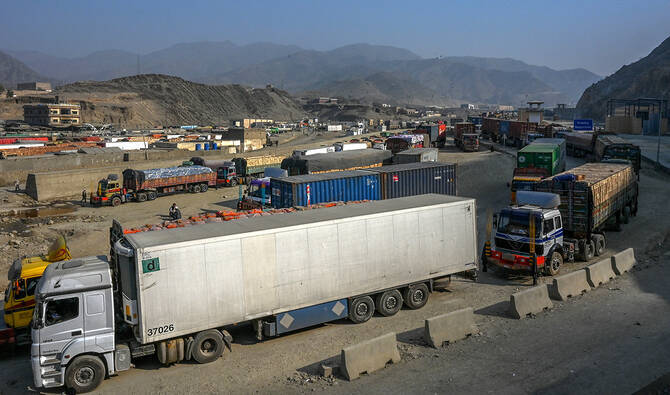
Stranded trucks are pictured near the Pakistan-Afghanistan border in Torkham on January 16, 2024. (AFP/ file)
Short Url
Updated 17 January 2026
Follow

Pakistan traders seek waiver of port charges on Afghan cargo after re-export approval

  • Afghan transit trade stalled after border closure following last year’s skirmishes between the two countries
  • Government’s re-export approval allows stranded Afghan cargo to be shipped out without entering Pakistan

KARACHI: Pakistani traders and logistics operators are calling for waivers and rationalization of detention and demurrage charges incurred on Afghan transit cargo that remained stuck at ports after cross-border trade with Afghanistan came to a halt, according to a trade body statement issued on Saturday.

The appeal follows a government decision earlier this month allowing the re-export of stranded Afghan transit goods, after prolonged border closures prevented cargo from moving onward to Afghanistan, leaving containers immobilized at Pakistani seaports and border crossing points.

Afghan transit trade through Pakistan was disrupted following the closure of the Pakistan-Afghanistan border due to skirmishes between the two countries in October last year, causing congestion at ports and triggering escalating detention and demurrage charges. Industry representatives say the situation imposed a substantial financial burden on importers, clearing agents and transporters, even though the goods were never intended for Pakistan’s domestic market.

“[We have] been actively engaging with the Directorate General of Transit Trade (DGTT), South Asia Pakistan Terminals (SAPT), and other port and terminal operators, including through formal representations, to seek waivers and rationalization of detention and demurrage charges,” the Pakistan-Afghanistan Joint Chamber of Commerce and Industry (PAJCCI) said.

The chamber said it had taken up the matter of stranded Afghan transit trade goods with the Ministry of Commerce following a high-level meeting held on Jan. 10, after which the ministry issued a notification on Jan. 12 permitting the re-export of stranded cargo from the ports of Karachi and Gwadar and designated border crossing points.

PAJCCI said its coordinated engagement with government departments and terminal operators aims to ensure the re-export decision results in “practical relief on ground,” enabling the smooth clearance and movement of cargo while preventing further financial losses for the trade community.

Pakistan’s commerce ministry has not publicly commented on whether waivers on detention and demurrage charges will be granted.


At least 13 civilians killed in Pakistan strikes in Afghanistan, UN says

Updated 23 February 2026
Follow

At least 13 civilians killed in Pakistan strikes in Afghanistan, UN says

  • Pakistan said it launched the strikes after blaming recent suicide attacks on militants operating from Afghan territory
  • The reported toll adds to fears of a renewed cycle of retaliation between the neighbors, threatening a fragile ceasefire

ISLAMABAD/KABUL: At least 13 civilians ‌were killed and seven injured in Pakistani airstrikes in eastern Afghanistan, the United Nations said on Monday, as cross-border tensions escalated following a string ​of suicide bombings in Pakistan.

The reported toll adds to fears of a renewed cycle of retaliation between the neighbors, threatening a fragile ceasefire along their 2,600-km (1,600-mile) frontier and further straining ties as both sides trade blame over militant violence.

The United Nations Assistance Mission in Afghanistan (UNAMA) said it had received “credible reports” that overnight Pakistani airstrikes on February 21–22 killed at least 13 ‌civilians and injured ‌seven in the Behsud and Khogyani ​districts ‌of ⁠Nangarhar province.

Taliban ​spokesman Zabihullah ⁠Mujahid earlier reported dozens killed or wounded in the strikes, which also hit locations in Paktika province. Reuters could not independently verify the reported toll.

Pakistan said it launched the strikes after blaming recent suicide attacks, including during Ramadan, on militants operating from Afghan territory.

Pakistan’s information ministry in a post on X said ⁠the “intelligence-based” operation struck seven camps of the Pakistani Taliban ‌and Daesh (Islamic State) Khorasan Province ‌and that it had “conclusive evidence” the militant ​assaults on Pakistan were directed ‌by “Afghanistan-based leadership and handlers.”

Kabul has repeatedly denied allowing militants ‌to use Afghan territory to launch attacks in Pakistan.

The strikes took place days after Kabul released three Pakistani soldiers in a Saudi-mediated exchange aimed at easing months of tensions along the border.

Afghanistan’s defense ministry condemned ‌the strikes and called them a violation of sovereignty and international law, saying an “appropriate and measured ⁠response will ⁠be taken at a suitable time.” The Afghan foreign ministry said it had summoned Pakistan’s ambassador.

In a statement on the February 21-22 strikes, Afghanistan’s education ministry said eight school students; five boys and three girls, were killed in Behsud in Nangarhar province, and one madrasa student injured in Barmal in Paktika province, adding that dozens of other civilians were killed or wounded and educational centers destroyed. Reuters could not independently verify the information.

The latest strikes follow months of clashes and repeated border closures ​that have disrupted trade ​and movement along the rugged frontier.