

Russia warms to US prisoner swap for weapons trader Bout

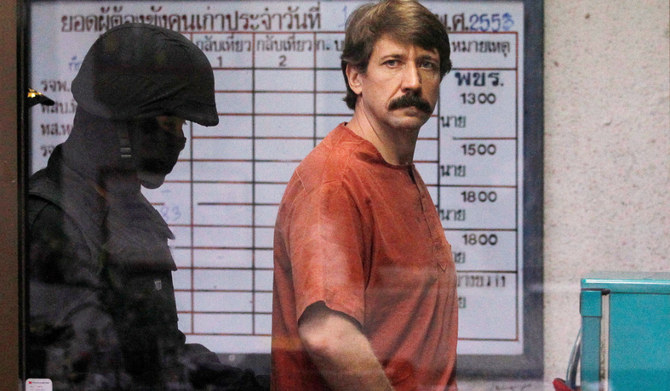
Alleged arms smuggler Viktor Bout from Russia is escorted by a member of the special police unit as he arrives at a criminal court in Bangkok October 4, 2010. (REUTERS)
Short Url
Updated 19 November 2022
Follow

Russia warms to US prisoner swap for weapons trader Bout

  • For the two former Cold War foes, now grappling with the gravest confrontation since the 1962 Cuban Missile Crisis, the exchange would mark one of the more extraordinary prisoner swaps in their history

LONDON: Russia said on Friday it hoped to clinch a prisoner swap with the United States to return convicted Russian weapons trafficker Viktor Bout, known as the “Merchant of Death,” in an exchange that would likely include US basketball star Brittney Griner.
Amid the deadliest war in Europe since World War Two, Russia and the United States are exploring a deal that could see imprisoned Americans including Griner return to the United States in exchange for Bout.
“I want to hope that the prospect not only remains but is being strengthened, and that the moment will come when we will get a concrete agreement,” Russian Deputy Foreign Minister Sergei Ryabkov was quoted as saying by Interfax.


WNBA star and two-time Olympic gold medalist Brittney Griner is escorted from a courtroom after a hearing in Khimki just outside Moscow, Russia, on Aug. 4, 2022. (AP)

“The Americans are showing some external activity, we are working professionally through a special channel designed for this,” Ryabkov said. “Viktor Bout is among those who are being discussed, and we certainly count on a positive result.”
For the two former Cold War foes, now grappling with the gravest confrontation since the 1962 Cuban Missile Crisis, the exchange would mark one of the more extraordinary prisoner swaps in their history.
The distinctly upbeat remarks from Ryabkov, the foreign ministry’s point man for the Americas and arms control, contrast with previous statements from Moscow which have cautioned Washington against trying to engage in megaphone diplomacy over the prisoner swap.
The possible swap includes Griner, facing nine years behind bars in Russia after being convicted on drug charges, and Paul Whelan who is serving a 16-year sentence in Russia after being convicted of espionage charges that he denies.
Russia and the United States have discussed swapping Griner and Whelan, a former US Marine, for Bout, but no deal has materialized amid heightened tensions over Russia’s invasion of Ukraine.
The US State Department on Friday said Washington has made a substantial offer that Moscow “has consistently failed to negotiate in good faith on.”
“The Russian government’s failure to seriously negotiate on these issues in the established channels, or any other channel for that matter, runs counter to its public statements. Ultimately, here, actions speak louder than words,” State Department deputy spokesperson Vedant Patel told reporters.
BOUT FOR GRINER
Variously dubbed “the merchant of death” and “the sanctions buster” for his ability to get around arms embargoes, Bout was one of the world’s most wanted men before his 2008 arrest on multiple charges related to arms trafficking.
For almost two decades, Bout was one of the world’s most notorious arms dealers, selling weaponry to rogue states, rebel groups and murderous warlords in Africa, Asia and South America.
But in 2008, Bout was snared in an elaborate US sting.
Bout was caught on camera agreeing to sell undercover US agents posing as representatives of Colombia’s leftist FARC guerrillas 100 surface-to-air missiles, which they would use to kill US troops. Shortly afterwards, he was arrested by Thai police.
Bout was tried on the charges related to FARC, which he denied, and in 2012 was convicted and sentenced by a US judge in New York to 25 years in prison, the minimum sentence possible.
Ever since, the Russian state has been keen to get him back.
Griner has been transferred to a penal colony in the Mordovia region, southeast of Moscow, her lawyers said on Thursday, confirming a Reuters report.
At her trial, Griner — who played basketball for a Russian team in the US off-season — said she had used cannabis for relief from sports injuries but had not meant to break the law. She told the court she made an honest mistake by packing the cartridges in her luggage.


India rolls out strictest anti-pollution curbs as toxic smog engulfs Delhi

Demonstrator wearing an oxygen mask and holding oxygen tanks takes part in protest.
Updated 14 December 2025
Follow

India rolls out strictest anti-pollution curbs as toxic smog engulfs Delhi

  • Private monitors in several parts of northern Delhi recorded AQI spikes between 550 and 700s
  • Authorities invoked stage four of the capital region’s emergency pollution-control framework

NEW DELHI: India’s capital choked under a thick blanket of smog on Sunday, with the government imposing anti-pollution curbs after monitoring stations in some areas recorded extremely hazardous air quality.

Home to 30 million people, Delhi has not recorded a single “clean air” day in 2025, with Air Quality Index readings hitting high above the 50 score throughout the year.

On the AQI scale from 0 to 500, good air quality is represented by levels below 50, while levels above 300 are dangerous.

Worsening since late October, official records over the weekend were in the severe to severe-plus range of 400–500, but as 24-hour averages, they did not capture the peaks. Private monitors in several parts of North and North West Delhi recorded AQI spikes above 550 and even into the 700s in real-time.

On Saturday evening, the Ministry of Environment’s Commission for Air Quality Management invoked stage four — the highest level — of the Graded Response Action Plan for Delhi and surrounding areas.

To “prevent further deterioration of air quality in the region,” the commission suspended all non-essential construction, shut stone crushers and mining operations, stopped entry of trucks into the capital region, and ordered schools to shift to hybrid classes or online, where possible.

While authorities blamed the pollution on “adverse meteorological conditions,” residents have been demanding more government action.

“The situation is so bad in Delhi that we don’t have any option but to force kids to do online classes. The government has failed us; it has not done anything to address the issue,” said Nabanita Nayak, who decided for her teenage children to attend school online only, despite concerns over their screen addiction.

“If the kids are too much in front of laptops, that’s also an issue. As a mother, I am worried.” 

Delhi’s pollution has been worsening since Diwali in late October, when the average AQI has been above 370, or “very poor.” Since mid-November, it has been over 400, which means “severe” air quality, with certain areas recording 500 and above, which is classified as a “hazardous” level.

“I don’t feel proud living in Delhi. It’s the capital city of the country … We talk about being a developed nation by 2047 — we have deadlines,” said Jagriti Arora, who is keeping her 7-year-old daughter at home to prevent allergy flare-ups caused by air pollution.

“The government has to do something … China had a big problem with pollution, but now they’ve managed to bring it down.”

Delhi’s air quality deteriorates in winter due to local emissions and seasonal weather conditions. Cold temperatures and low wind speeds result in a temperature inversion, which traps pollutants close to the ground instead of letting them disperse. This allows emissions from millions of vehicles, ongoing construction, and nearby industrial activity to accumulate in the air. Urban waste burning and dust from construction sites further add to it.

“This is not a new thing. This has been happening now for over 10 years,” Arora said. “You can see it. You don’t need to actually look at an AQI meter to see how bad the pollution is these days.”