

Pakistani minister insists on discussing ‘loss and damage’ at climate conference in Egypt

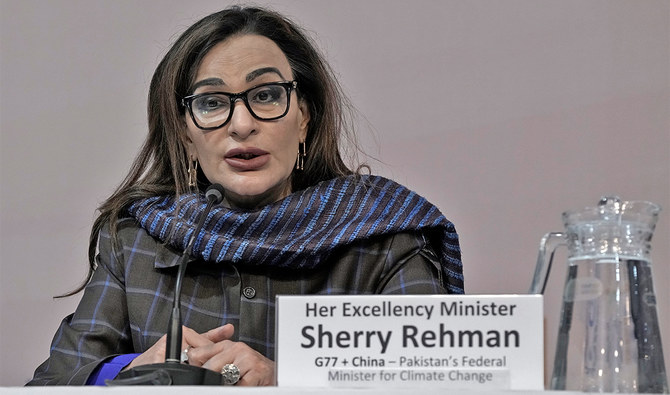
Sherry Rehman, minister of climate change for Pakistan, attends a news conference on loss and damage finance inaction at the COP27 U.N. Climate Summit, on November 17, 2022, in Sharm el-Sheikh, Egypt. (AP)
Short Url
Updated 17 November 2022
Follow

Pakistani minister insists on discussing ‘loss and damage’ at climate conference in Egypt

  • Sherry Rehman says recent floods in Pakistan show how people who have done little to cause climate change are being hit hard
  • The minister points out the world must learn to work together and bring some focus and real ambition for climate justice

SHARM EL-SHEIKH, Egypt: Pakistan’s climate minister Sherry Rehman said on Thursday developing countries would continue to press hard for a deal on the issue of ‘loss and damage’ at this year’s UN climate talks in Egypt.

Rehman told reporters that the group of countries she chairs, known as G77 and China, wants “at the very least a political announcement of intent” on rich polluters providing new financial aid to poor nations for the effects of global warming.

She made clear that she didn’t expect “a slew of finance” to result from the meeting in Sharm el-Sheikh but added that “if this continues to be kicked down the road we will see it as a climate justice denied.”

Rehman said she was aware that some countries “are anxious about liabilities and judicial proceedings.”

“I think we can work around all those anxieties,” she said. “The idea here is not to make any one country or group of countries uncomfortable or put them in an adversarial position.”

But she said the recent devastating floods in her own country, causing tens of billions of dollars in damage, showed how people who have done little to cause climate change are being hit hard.

“That dystopia that came to our doorstep will come to everyone’s,” she said. “So before it comes to that point, let’s learn to work together and bring some focus and real ambition for climate justice and delivery on joint goals.”


IMF hails Pakistan privatization drive, calls PIA sale a ‘milestone’

Updated 10 January 2026
Follow

IMF hails Pakistan privatization drive, calls PIA sale a ‘milestone’

  • Fund backs sale of national airline as key step in divesting loss-making state firms
  • IMF has long urged Islamabad to reduce fiscal burden posed by state-owned entities

KARACHI: The International Monetary Fund (IMF) on Saturday welcomed Pakistan’s privatization efforts, describing the sale of the country’s national airline to a private consortium last month as a milestone that could help advance the divestment of loss-making state-owned enterprises (SOEs).

The comments follow the government’s sale of a 75 percent stake in Pakistan International Airlines (PIA) to a consortium led by the Arif Habib Group for Rs 135 billion ($486 million) after several rounds of bidding in a competitive process, marking Islamabad’s second attempt to privatize the carrier after a failed effort a year earlier.

Between the two privatization attempts, PIA resumed flight operations to several international destinations after aviation authorities in the European Union and Britain lifted restrictions nearly five years after the airline was grounded following a deadly Airbus A320 crash in Karachi in 2020 that killed 97 people.

“We welcome the authorities’ privatization efforts and the completion of the PIA privatization process, which was a commitment under the EFF,” Mahir Binici, the IMF’s resident representative in Pakistan, said in response to an Arab News query, referring to the $7 billion Extended Fund Facility.

“This privatization represents a milestone within the authorities’ reform agenda, aimed at decreasing governmental involvement in commercial sectors and attracting investments to promote economic growth in Pakistan,” he added.

The IMF has long urged Islamabad to reduce the fiscal burden posed by loss-making state firms, which have weighed public finances for years and required repeated government bailouts. Beyond PIA, the government has signaled plans to restructure or sell stakes in additional SOEs as part of broader reforms under the IMF program.

Privatization also remains politically sensitive in Pakistan, with critics warning of job losses and concerns over national assets, while supporters argue private sector management could improve efficiency and service delivery in chronically underperforming entities.

Pakistan’s Cabinet Committee on State-Owned Enterprises said on Friday that SOEs recorded a net loss of Rs 122.9 billion ($442 million) in the 2024–25 fiscal year, compared with a net loss of Rs 30.6 billion ($110 million) in the previous year.