

Explainer: Who Pakistan picks as army chief matters far beyond its borders

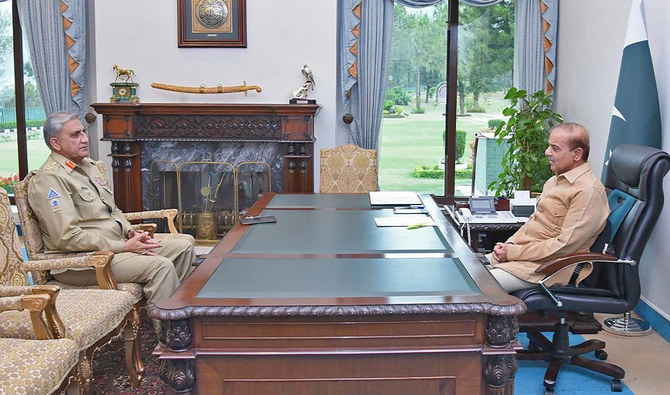
This handout photograph taken on April 19, 2022 and released by the Pakistan Prime Minister Office shows Pakistan's Prime Minister Shehbaz Sharif (R) speaks with Army Chief General Qamar Javed Bajwa at the Prime Minister House in Islamabad. (AFP/File)
Short Url
Updated 17 November 2022
Follow

Explainer: Who Pakistan picks as army chief matters far beyond its borders

  • Pakistan’s military set to get a new supremo later this month when Gen. Bajwa retires
  • New army chief could potentially play a key role in lowering high political temperatures

KARACHI: Pakistan’s nuclear armed military is set to get a new supremo later this month when General Qamar Javed Bajwa’s tenure as Chief of Army Staff comes to an end.

The military is the most powerful institution in a nation seldom far from its next crisis and the appointment could have a crucial bearing on the future of Pakistan’s fragile democracy, and whether relations with neighboring India are allowed to improve.

During the 75 years since independence and formation of Pakistan out of the Partition of India, the army has seized power three times and directly ruled the Islamic republic for more than three decades, fighting three wars with India along the way.

Even when a civilian government holds power, Pakistan’s generals retain a dominant influence over security matters and foreign affairs. And the new chief could set the tone for the conduct of relations with the Hindu nationalist government in India, the Taliban in Afghanistan, and determine whether Pakistan tilts more toward China or the United States.

BAJWA’S LEGACY

Appointed chief in 2016, Bajwa sought to balance ties with China and the United States. While Islamabad moved closer to Beijing, Bajwa also worked to thaw relations with Washington, with whom he worked closely during the evacuation of Kabul in 2021 when western forces pulled out of Afghanistan.

Bajwa also took an active interest in economic matters, as well he might given how much of the budget goes to the military.

He made highly-publicized visits to Beijing and the Middle East — helping to secure financial assistance for Pakistan. He also lobbied Washington to help strike a deal with the International Monetary Fund.

He even summoned Pakistan’s top industrialists to a meeting at army headquarters to encourage them to pay more tax.

During his tenure, India and Pakistan fought air skirmishes in 2019, but he was a public proponent of better ties and avoided escalation when tensions ran high, such as when an Indian missile accidentally crashed into Pakistan’s territory this year.

In early 2021, Bajwa sanctioned a restoration of a cease-fire agreement with Delhi in the disputed region of Kashmir.

Domestically, he was accused of political meddling, which the military denies. Politicians said he helped former cricketer Imran Khan become prime minister in 2018. In an about-turn earlier this year, Khan accused Bajwa of playing a part in his downfall. 

HOW IS A CHIEF APPOINTED?

The outgoing chief will give the prime minister a list of senior-most generals to choose from. Only on rare occasions has the baton been passed to someone outside the top four most senior officers in an army that, with just under a million personnel in 2019, was the sixth largest in the world.

An army chief’s tenure is for three years, but they often obtain extensions, as did Bajwa. Despite assurances by the military that Bajwa will retire this time, there has been speculation that he could be given another extension due to the latest political and economic ructions in Pakistan.

The generals regarded as front-runners to replace Bajwa are Lt. Generals Asim Munir, the army’s quartermaster general and a former spy chief, Sahir Shamshad, commander of the Rawalpindi Corps, Azhar Abbas, the army’s chief of general staff, and Nauman Mahmood, chief of the National Defense University.

WHY IT MATTERS GLOBALLY

Pakistan’s army chief will play a key role in managing risks of conflict with nuclear-armed rival India on its eastern border, while dealing with potential instability and friction with Afghanistan on its western frontier.

Many world capitals, including Washington and Beijing, have direct ties with Pakistan’s military, given the country’s strategic location in a volatile neighborhood, and a coastline close to major shipping lanes serving the oil-rich Gulf.

Foreign governments have periodically questioned the safety of a nuclear arsenal, that includes long-range missiles, in a country so frequently needing IMF bail outs and where anti-Western and anti-India militant groups have proliferated.

And internal security has been a near constant problem due to insurgencies in ethnic Pashtun and Baloch regions.

Despite all the risks, Pakistan and its military have dismissed foreigners’ concerns over the command and control, and security of its nuclear weapons.

WHY IS THIS APPOINTMENT IMPORTANT DOMESTICALLY?

The military has long been accused of manipulating the democratic process to maintain its dominance. Nineteen of Pakistan’s 30 prime ministers were elected, but not one of them completed their five year terms.

Having recently admitted to its past meddling in politics, the army has said it would no longer interfere. Whether the new chief stands by that commitment could be key to Pakistan’s democratic evolution.

Pakistan is in the midst of another bout of political uncertainty as Khan has led country-wide protests in an attempt to force Prime Minister Shehbaz Sharif into early elections.

The incoming army chief could potentially play a key role in lowering the political temperature as Pakistan attempts to survive an economic crisis and recover from historic floods.


‘Look ahead or look up?’: Pakistan’s police face new challenge as militants take to drone warfare

Updated 5 sec ago
Follow

‘Look ahead or look up?’: Pakistan’s police face new challenge as militants take to drone warfare

  • Officials say militants are using weapons and equipment left behind after allied forces withdrew from Afghanistan
  • Police in northwest Pakistan say electronic jammers have helped repel more than 300 drone attacks since mid-2025

BANNU, Pakistan: On a quiet morning last July, Constable Hazrat Ali had just finished his prayers at the Miryan police station in Pakistan’s volatile northwest when the shouting began.

His colleagues in Bannu district spotted a small speck in the sky. Before Ali could take cover, an explosion tore through the compound behind him. It was not a mortar or a suicide vest, but an improvised explosive dropped from a drone.

“Now should we look ahead or look up [to sky]?” said Ali, who was wounded again in a second drone strike during an operation against militants last month. He still carries shrapnel scars on his back, hand and foot, physical reminders of how the battlefield has shifted upward.

For police in the northwestern Khyber Pakhtunkhwa (KP) province, the fight against militancy has become a three-dimensional conflict. Pakistani officials say armed groups, including the Tehreek-e-Taliban Pakistan (TTP), are increasingly deploying commercial drones modified to drop explosives, alongside other weapons they say were acquired after the US military withdrawal from neighboring Afghanistan.

Security analysts say the trend mirrors a wider global pattern, where low-cost, commercially available drones are being repurposed by non-state actors from the Middle East to Eastern Europe, challenging traditional policing and counterinsurgency tactics.

The escalation comes as militant violence has surged across Pakistan. Islamabad-based Pakistan Institute for Conflict and Security Studies (PICSS) reported a 73 percent rise in combat-related deaths in 2025, with fatalities climbing to 3,387 from 1,950 a year earlier. Militants have increasingly shifted operations from northern tribal belts to southern KP districts such as Bannu, Lakki Marwat and Dera Ismail Khan.

“Bannu is an important town of southern KP, and we are feeling the heat,” said Sajjad Khan, the region’s police chief. “There has been an enormous increase in the number of incidents of terrorism… It is a mix of local militants and Afghan militants.”

In 2025 alone, Bannu police recorded 134 attacks on stations, checkpoints and personnel. At least 27 police officers were killed, while authorities say 53 militants died in the clashes. Many assaults involved coordinated, multi-pronged attacks using heavy weapons.

Drones have also added a new layer of danger. What began as reconnaissance tools have been weaponized with improvised devices that rely on gravity rather than guidance systems.

“Earlier, they used to drop [explosives] in bottles. After that, they started cutting pipes for this purpose,” said Jamshed Khan, head of the regional bomb disposal unit. “Now we have encountered a new type: a pistol hand grenade.”

When dropped from above, he explained, a metal pin ignites the charge on impact.

Deputy Superintendent of Police Raza Khan, who narrowly survived a drone strike during construction at a checkpoint, described devices packed with nails, bullets and metal fragments.

“They attach a shuttlecock-like piece on top. When they drop it from a height, its direction remains straight toward the ground,” he said.

TARGETING CIVILIANS

Officials say militants’ rapid adoption of drone technology has been fueled by access to equipment on informal markets, while police procurement remains slower.

“It is easy for militants to get such things,” Sajjad Khan said. “And for us, I mean, we have to go through certain process and procedures as per rules.”

That imbalance began to shift in mid-2025, when authorities deployed electronic anti-drone systems in the region. Before that, officers relied on snipers or improvised nets strung over police compounds.

“Initially, when we did not have that anti-drone system, their strikes were effective,” the police chief said, adding that more than 300 attempted drone attacks have since been repelled or electronically disrupted. “That was a decisive moment.”

Police say militants have also targeted civilians, killing nine people in drone attacks this year, often in communities accused of cooperating with authorities. Several police stations suffered structural damage.

Bannu’s location as a gateway between Pakistan and Afghanistan has made it a security flashpoint since colonial times. But officials say the aerial dimension of the conflict has placed unprecedented strain on local forces.

For constables like Hazrat Ali, new technology offers some protection, but resolve remains central.

“Nowadays, they have ammunition and all kinds of the most modern weapons. They also have large drones,” he said. “When we fight them, we fight with our courage and determination.”