US returns Pakistan artifacts trafficked by ex-Manhattan dealer

A guide poses while displaying original artefacts at Taxila in Punjab province on April 3, 2012. (AFP/File)
Short Url
Updated 11 November 2022
Follow

US returns Pakistan artifacts trafficked by ex-Manhattan dealer

  • Subhash Kapoor was convicted in India last week of stealing ancient religious idols, trafficking them to Manhattan
  • Wanted by US authorities, Kapoor was subject of major US federal investigation known as Operation Hidden Idol

NEW YORK: The United States has returned to Pakistan more than 100 antiquities recovered from Indian-American art smuggler Subhash Kapoor, New York prosecutors announced Thursday.

Kapoor was convicted in India last week of stealing ancient religious idols and trafficking them to his art gallery in Manhattan. He was sentenced to 13 years in prison.

Kapoor, also wanted by American authorities, was the subject of a massive US federal investigation known as Operation Hidden Idol.
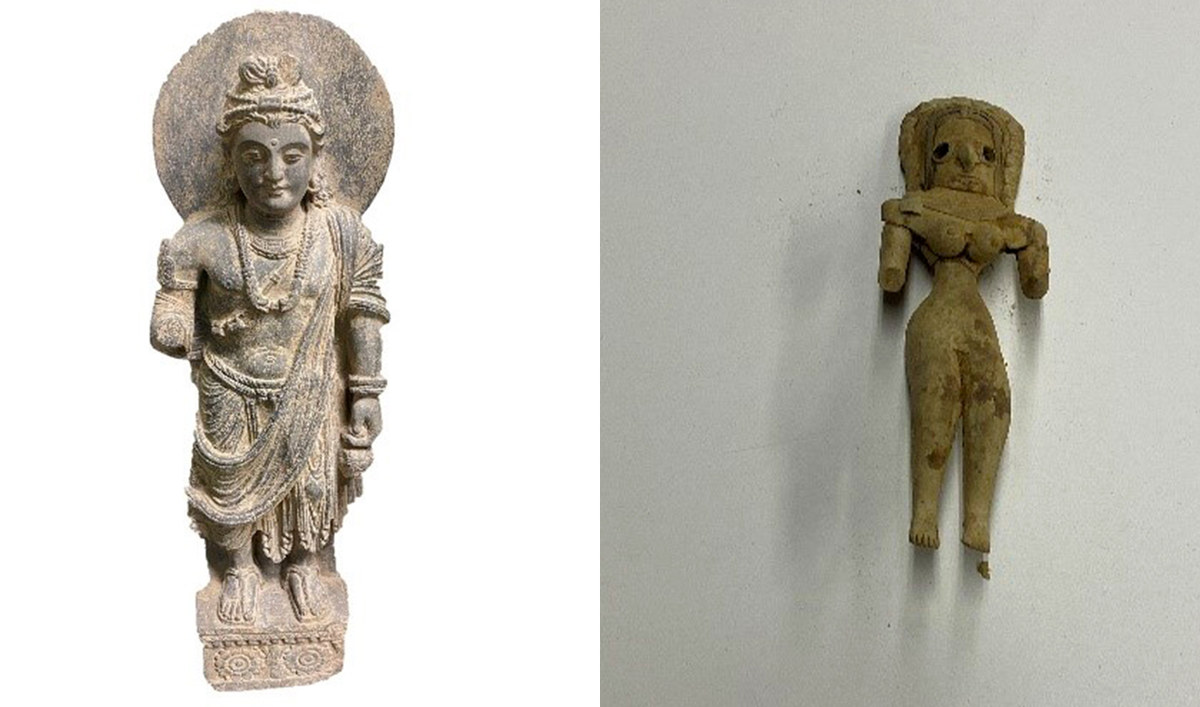


The collage shows "Maitreya" (left) and "Mehrgarh Dolls." (Photo courtesy: Manhattan District Attorney's Office)

The Manhattan District Attorney's office indicted him in 2020 and have requested his extradition from India.

New York returned 192 antiquities to Islamabad valued at almost $3.4 million, Manhattan DA Alvin Bragg said in a statement.

Some 187 of the artifacts were seized in relation to the investigation of Kapoor, Bragg added.

The returned items include a Gandhara statue depicting Maitreya, the enlightened Buddha, and Mehrgarh figures dating to around 3500-2600 BC that were looted from a Neolithic archaeological site in Pakistan.

Kapoor sold the smuggled items at his Madison Avenue-based gallery Art of the Past.

Bragg's office says that since 2011 it has recovered more than 2,500 artifacts worth at least $143 million that were trafficked by Kapoor and his associates.

In March, Australia returned to India 13 works connected with Kapoor.


Islamabad steps up vehicle checks to boost security as 166,000 cars get electronic tags

Updated 18 January 2026
Follow

Islamabad steps up vehicle checks to boost security as 166,000 cars get electronic tags

  • Authorities say over 3,000 vehicles registered in past 24 hours as enforcement intensifies
  • Extended service hours introduced to push full compliance with digital monitoring system

ISLAMABAD: Authorities in the Pakistani capital have intensified enforcement against vehicles without mandatory electronic tags with more than 166,000 cars now registered, according to data released on Sunday evening, as Islamabad moves to strengthen security and digital monitoring at key entry and exit points.

The Islamabad Capital Territory (ICT) administration introduced the electronic tagging system late last year as part of a broader effort to regulate traffic, improve record-keeping and enhance surveillance in a city that hosts the country’s main government institutions, foreign missions and diplomatic enclaves.

Under the system, vehicles are fitted with electronic tags that can be read automatically by scanners installed at checkpoints across the capital, allowing authorities to identify unregistered vehicles without manual inspections. Vehicles already equipped with a motorway tag, or m-tag, are exempt from the requirement.

“A total of 166,888 vehicles have successfully been issued M-Tags so far, including 3,130 vehicles in the last 24 hours,” the ICT administration said, according to the Excise Department.

Officials said readers installed at checkpoints across Islamabad are fully operational and are being used to stop vehicles still without tags, as enforcement teams carry out checks across the city.

To facilitate compliance, authorities have expanded installation facilities and extended operating hours. The Excise Department said m-tag installation is currently available at 17 booth locations, while select centers have begun operating beyond normal working hours.

According to Director General Excise Irfan Memon, m-tag centers at 26 Number Chungi and 18 Meel are providing services round the clock, while counters at Kachnar Park and F-9 Park remain open until midnight to accommodate motorists unable to visit during daytime hours.

Officials said the combination of enforcement and facilitation was aimed at achieving full compliance with minimal disruption, adding that operations would continue until all vehicles operating in the capital are brought into the system.

The enforcement drive builds on a wider push by the federal government to integrate traffic management, emergency response and security monitoring through technology-driven “safe city” initiatives. Last month, Interior Minister Mohsin Naqvi reviewed Islamabad’s surveillance infrastructure and said reforms in monitoring systems and the effective use of technology were the “need of the hour.”

Authorities have urged motorists to obtain electronic tags promptly to avoid delays and penalties at checkpoints as enforcement continues across the capital.