

US authorities return 104 artifacts to Pakistan valued at $3.3 million

Pakistani diplomats and US Homeland Security official pose for picture at handover ceremony of stolen Pakistani antiquities in New York, US, on August 24, 2021. (Photo courtesy: Pakistan Consulate General New York)
Short Url
Updated 31 August 2021
Follow

US authorities return 104 artifacts to Pakistan valued at $3.3 million

  • Subhash Kapoor was arrested in India in 2011 and accused of running antiquities looting enterprise worth over $100 million
  • Pakistan’s Consul General thanks Manhattan District Attorney’s Office, Department of Homeland Security for returned pieces

ISLAMABAD: The United States has returned 104 artifacts valued at $3.3 million to Pakistan that were among thousands of antiquities looted from Asian countries and seized from New York art dealer Subhash Kapoor, the Organized Crime and Corruption Reporting Project reported on Tuesday. 

Kapoor is awaiting trial in India and is accused of running an antiquities looting enterprise worth more than $100 million. Kapoor made headlines in the art world in 2011 when he was arrested by Interpol in Frankfurt, Germany for his involvement in the trafficking of objects, which stretched throughout Afghanistan, Cambodia, India, Indonesia, Myanmar, Nepal, Pakistan, Sri Lanka, and Thailand, among other states, and implicated the collecting practices of museums across the globe. 

The Manhattan District Attorney’s Office filed criminal charges against Kapoor and seven coconspirators in 2019, accusing them of operating a $145 million smuggling ring that dealt with thousands of looted antiquities over a period of 30 years. So far some 497 of as many as 2,500 artifacts in Kapoor’s collection have been repatriated to 11 countries.

“This magnificent collection of artifacts returned to the people of Pakistan today epitomizes that nation’s rich cultural heritage and humanity’s never-ending quest for enlightenment and peace,” Manhattan District Attorney Cy Vance, Jr. said in a statement last week. 

“It also evinces the importance of all collectors and gallery owners performing due diligence and ensuring all pieces they purchased were lawfully acquired. I want to thank my Office’s Antiquities Trafficking Unit and our partners at Homeland Security Investigations for their sterling efforts that have resulted in almost 500 treasures, including nearly 150 to Pakistan, being returned to 11 countries over the past year. I look forward to further repatriations in the near future.”
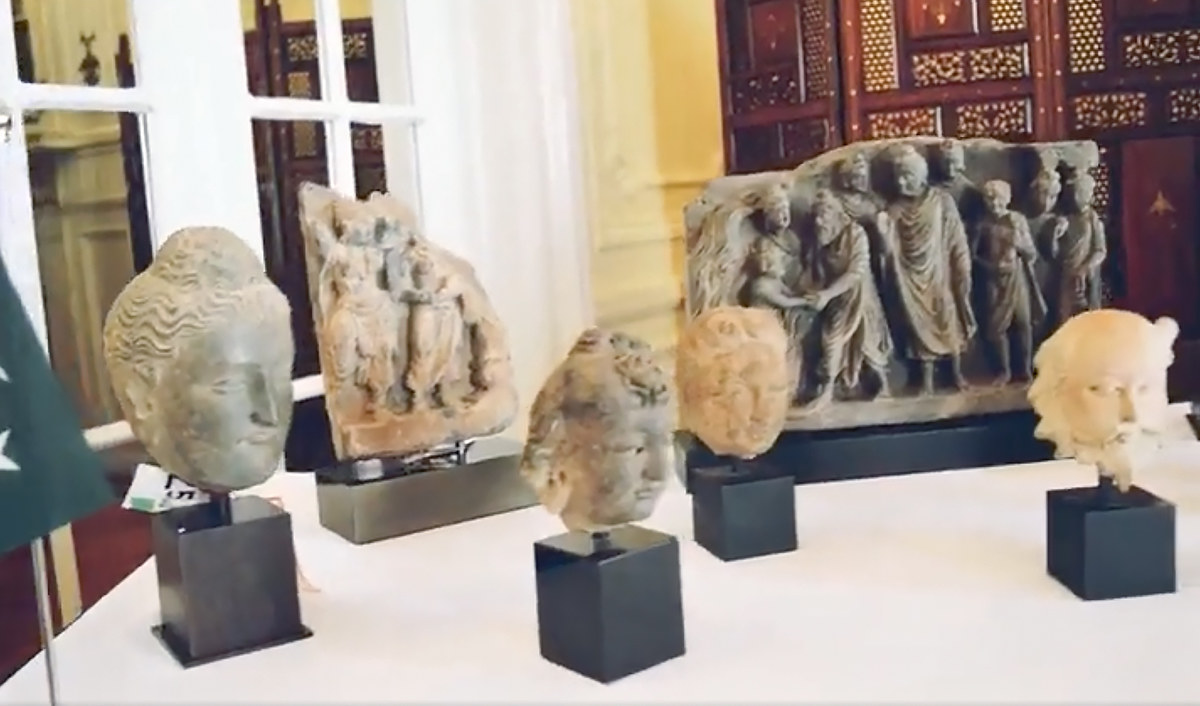


Stolen Pakistani antiquities are displayed in New York, US, on August 24, 2021. (Photo courtesy: Pakistan Consulate General New York)

“With every repatriation there is a new joy and satisfaction that goes with returning a piece of history to its home country,” said Peter C. Fitzhugh, Special Agent in Charge of HSI New York. “Each pilfered artefact tells its own story, as each line or scratch retells its journey and with this being the final chapter – going home. HSI New York’s Cultural Property, Arts and Antiquities group was able close the chapter on 104 pieces today, and with our partners at the Manhattan District Attorney’s Office, can provide some closure to the people of Pakistan.”

“I want to express my gratitude to the Manhattan District Attorney’s Office and the Department of Homeland Security for their efforts in retrieving these stolen cultural treasures of Pakistan,” Pakistan’s Consul General Ayesha Ali said. “Hopefully soon these artifacts will be displayed in Pakistani museums.”

The illegal antiquities trade is a multi-billion dollar global industry according to a 2018 report by Standard Charter Bank, and it’s beneficiaries are not just high society art aficionados like Kapoor and his Manhattan clients, but the trade is often a major funding source for criminal and militant groups on the supply side, OCCRP said.


Pakistan to maintain hard line on Afghanistan after strikes as Taliban vows military response

Updated 5 sec ago
Follow

Pakistan to maintain hard line on Afghanistan after strikes as Taliban vows military response

  • Islamabad blames Afghanistan’s ‘guerrilla mindset’ for escalating tensions between the two countries
  • Afghan Taliban spokesperson denies militant presence in his country, accuses Pakistan of hitting civilians

ISLAMABAD: Pakistan vowed on Wednesday to continue its current policy toward Afghanistan unless the Taliban leadership abandons its “guerrilla mindset,” days after Islamabad carried out airstrikes inside Afghan territory, sharply escalating tensions between the two neighbors once again.

Pakistan conducted intelligence-based strikes overnight into Sunday in Afghanistan’s eastern Nangarhar and southeastern Paktika provinces, saying it had targeted camps of the banned Tehreek-e-Taliban Pakistan (TTP), its affiliates and Daesh-linked fighters.

Islamabad has long accused Kabul of allowing militant groups to use Afghan soil to launch attacks on Pakistani civilians and security forces, a charge the Taliban deny. The two sides also clashed in October last year, leading Pakistan to close key border crossings for bilateral and transit trade.

State Minister for Interior Talal Chaudhry told Geo News that Pakistan had attempted dialogue but would now persist with practical measures if the Taliban failed to change course.

“They call themselves a state, but they have not yet emerged from their guerrilla mindset,” he said.

“Now, with the practical steps we are taking, we want to change their behavior and see them in the form of a state,” he added.

Pakistan blamed a string of recent suicide bombings in Islamabad, Bajaur and Bannu on militants operating from Afghan territory before launching the latest strikes.

Chaudhry said Afghanistan had been acting like “an irresponsible neighbor,” warning that his country’s current approach would continue if attacks inside Pakistan persisted.

“This war will be won, and all this will end,” he said. “If it is not resolved the straight way, then it will be completely ended by a hard-line approach.”

Meanwhile, Kabul has condemned the airstrikes as violations of its sovereignty and said civilians were killed.

In an interview with Al Arabiya, Taliban government spokesman Zabihullah Mujahid also pledged to respond militarily.

“It would be a military response, but its details are confidential and I cannot explain further,” he said.

Mujahid rejected Pakistan’s allegations that TTP or Daesh militants operate from Afghan soil, saying security problems inside Pakistan were domestic in nature.

“Afghan soil is not allowed to be used against anyone,” he said, adding that Kabul had carried out extensive operations against Daesh and eliminated its presence in Afghanistan.

The 2,600-kilometer border between the two countries remains a vital trade and transit route, but crossings have faced repeated closures amid rising tensions, disrupting commerce and humanitarian movement.

Several regional countries, including Saudi Arabia, Türkiye and Qatar, have sought to mediate between the two countries, though their military exchanges risk further destabilizing their ties.