

Turkish bus refuses to stop for prayer, igniting fresh secularism debate

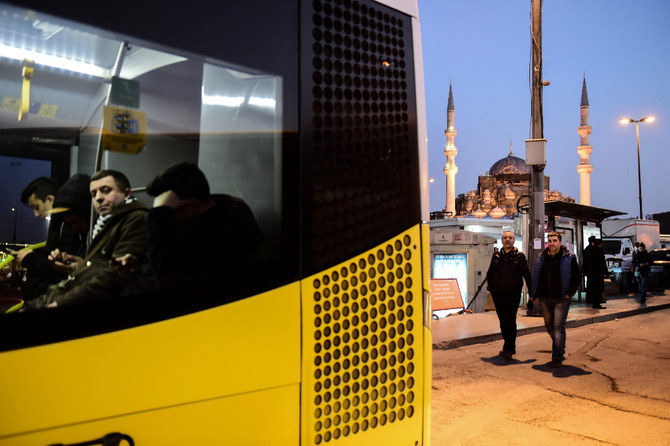
People walk by a bus stop station near the New mosque in the Eminonu district of Istanbul. (AFP file photo)
Short Url
Updated 09 November 2022
Follow

Turkish bus refuses to stop for prayer, igniting fresh secularism debate

ANKARA: A long-distance bus driver’s unwillingness to stop so that a passenger could pray in Turkey has helped ignite a fresh debate over secularism in the predominantly Muslim country.
Following the driver’s refusal at the weekend, the passenger complained on Twitter, drawing a controversial response from the travel company.
“None of the rights defined by (Turkey’s) constitution can be used to violate the democratic and secular conception” of the republic, the firm Oz Ercis said in a statement, which went viral.
The controversy is the latest example of a long-standing debate in a country with a Muslim majority but a secular tradition, despite the erosion of this principle under President Recep Tayyip Erdogan.
The bus was making one of the longest journeys through Turkey — connecting the Van region near the Iranian border in the east to Izmir on the Aegean coast in western Turkey — the travel firm’s lawyer said on Tuesday.
The journey takes more than 24 hours.
“The company finds itself at the center of a controversy on secularism. We are being singled out as a target. But we are respectful of all beliefs,” said the lawyer, Tuncay Keserci.
“It is not possible... to ignore the rights of other passengers who do not pray and who want to arrive at their destination in time, for a passenger to pray,” the firm’s statement added.
The response drew both praise and criticism, with supporters commending Oz Ercis for their “courage” in defending secularism, while detractors said they would not travel with the company again.
The Islamic faith provides that travelers can adapt prayer times and length when traveling.
“We are victims of a lynching campaign, as if we were preventing people from praying,” said Keserci, adding that the passenger in question was able to pray later when the bus stopped at a rest area.
Keserci said secularism “does not mean that we are not religious. Secularism also protects Muslims.”


Istanbul gaining fast on Heathrow as Europe’s busiest airport

Updated 4 sec ago
Follow

Istanbul gaining fast on Heathrow as Europe’s busiest airport

  • Istanbul Airport, where traffic has surged since its inauguration in 2018, saw passenger growth of 5.5 percent to 84.44 million
  • Turkiye has benefitted as a gateway between Europe and Asian destinations as well as being a hub for flights between Russia and the rest of the world
PARIS: London Heathrow remained the busiest aviation hub in Europe last year but Istanbul Airport was nearly neck-and-neck and is likely to overtake it soon, an industry group said Thursday.
With 84.48 million passengers, Heathrow had a 0.7 percent increase in traffic last year, ACI Europe reported, citing the use of larger planes by airlines at “the capacity-constrained British hub.”
British authorities say a third runway will be added at Heathrow but it is not expected to be ready before 2035.
Istanbul Airport, where traffic has surged since its inauguration in 2018, saw passenger growth of 5.5 percent to 84.44 million — just 40,000 behind Heathrow.
Turkiye has benefitted as a gateway between Europe and Asian destinations as well as being a hub for flights between Russia, subject to Western sanctions over its war in Ukraine, and the rest of the world.
Rounding out the top five European airports were Paris-Charles de Gaulle (72 million), Amsterdam-Schiphol (68.8 million) and Madrid (68.1 million).
Overall, passenger traffic across Europe climbed 4.4 percent last year to 2.6 billion people, “entirely driven by international traffic,” ACI Europe said.
“Travel remains among consumers’ top discretionary spending priorities — even as geopolitics and geoeconomics are likely to further test the sector’s resilience,” ACI Europe’s director general Olivier Jankovec said in a statement.
The sector continues to benefit as well from the post-COVID-19 pandemic travel restrictions, and traffic growth is expected to “normalize” at around 3.3 percent this year, Jankovec said.