



RIYADH: According to the UN, net-zero emissions can be achieved by balancing carbon dioxide emissions with removal or by eliminating emissions.
Net-zero emissions are also referred to as carbon neutrality or becoming climate neutral. This specific climate goal is key to reducing global warming under the 2015 Paris Agreement. The agreement calls for countries to achieve net-zero emissions by 2050.
For the oil and gas dominated Gulf Cooperation Council countries, this means translating net-zero emissions ambitions into tangible action.
Saudi Arabia
Saudi Arabia pledged to achieve net-zero emissions by 2060. The country has undertaken $1 billion in climate change initiatives as part of the Saudi Green Initiative program, which seeks to establish a regional carbon capture and storage center, an early storm warning center and cloud seeding programs as part of its efforts to create a greener future.

Saudi Arabia has committed to plant 450 million trees and rehabilitate 8 million hectares of degraded lands by 2030. (Supplied)
The Kingdom will also join the Global Methane Pledge to cut global methane emissions by 30 percent by 2030 to deliver a cleaner, greener future.
Crown Prince Mohammed bin Salman said that the Kingdom will plant 450 million trees and rehabilitate 8 million hectares of degraded lands by 2030, reducing 200 million tons of carbon emissions with additional initiatives to be announced in the years to come.
According to the King Abdullah Petroleum Studies and Research Center, the Kingdom will achieve this ambition through numerous programs and initiatives, which include energy efficiency, renewable energy, hydrogen and carbon capture, utilization and storage.

Caption
Saudi Arabia established the Saudi Energy Efficiency Center in 2010 and launched the Saudi Energy Efficiency Program in 2012.
“Since then, the program has led to many actions to improve energy efficiency. For example, insulation standards for buildings were introduced, the minimum energy efficiency levels for appliances like air conditioners were increased, fuel economy standards for cars were launched and various awareness campaigns were implemented,” Anwar Gasim, a researcher at KAPSARC, told Arab News.
Saudi Arabia launched and built several major renewable energy projects, taking advantage of its natural potential in solar and wind. For example, there is the Sakaka solar power plant, the first “utility-scale” solar power project in Saudi Arabia, with 1.2 million solar panels arranged in an area of over 6 sq. km. and a capacity of 300 MW.
“This project, which is fully operational, has set a new world record for the lowest solar power generation cost,” Gasim said.
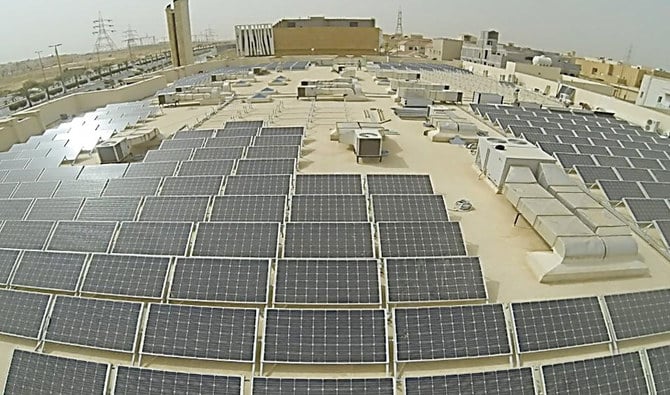
Power efficiency is one of the central themes of Saudi Vision 2030. (SPA)
Another example is Dumat Al Jandal, Saudi Arabia’s first utility-scale wind project. “With a capacity of 400 MW, Dumat Al Jandal is the largest wind farm in the Middle East,” he added.“Furthermore, Saudi Arabia very recently announced five new renewable energy projects, with a combined capacity of 3,300MW,” he said.
Moreover, Saudi Arabian Oil Co. has been pioneering the capture and storage of carbon dioxide to enhance oil recovery from its fields. At its plant in Hawiyah, Saudi Aramco can capture 45 million standard cubic feet of the gas, which they pump and store in an oil reservoir, leading to increased oil production.
Saudi Basic Industries Corp. has built one of the largest CCUS plants, which uses the captured gas to produce liquified carbon dioxide that can be used in the food and drink industry. It also uses the captured gas to produce valuable chemicals like urea and methanol.
The Kingdom aims to become the world’s leading hydrogen producer and exporter in hydrogen production and has already taken the first step globally. Saudi Aramco and SABIC, in partnership with the Institute of Energy Economics, Japan, announced in 2020 the world’s first blue ammonia shipment from the Kingdom to Japan.
“Ammonia, a form that makes transporting hydrogen easier, is obtained by combining hydrogen with nitrogen,” Gasim said.
“The blue ammonia was shipped to Japan to be used in zero-carbon power generation,” he added.
Furthermore, NEOM announced its plans to build one of the world’s largest green hydrogen plants.
Saudi Arabia also announced its ambition to generate 50 percent of its electricity from renewables by 2030, with the remaining 50 percent coming from natural gas.
The UAE
According to the state’s government portal, the UAE was the first country in the Middle East to establish the Net-Zero by 2050 strategy, pledging to cut carbon emissions by 23.5 percent, equal to 70 million tons by 2030.
The Abu Dhabi Department of Energy announced new clean energy generation projects focusing on solar and nuclear sources to help meet these goals. In addition, the Dubai Future Council of Energy released a detailed path to establishing a carbon-free economy.
The Abu Dhabi Fund for Development has also pledged $400 million to a new energy transition program to finance renewable energy projects in developing countries that would otherwise be unable to raise funds.
The deployment and use of clean energy solutions are one of the main pillars of the UAE’s model of addressing the challenge of climate change and reducing carbon dioxide emissions.

EGA’s CelestiAL aluminum is made using electricity generated at the Mohammed Bin Rashid Al-Maktoum Solar Park, located in the desert outside Dubai. (Supplied)
The UAE government portal reported that the country began financing clean energy projects more than 15 years ago and has invested over $40 billion in the sector to date.
Current trends predict the production capacity of clean energy, including solar and nuclear, to reach 14 GW by 2030, up from about 100 MW in 2015 and 2.4 GW in 2020.
The country has also invested in renewable energy ventures worth around $16.8 billion in 70 countries, focusing on developing nations.
It has also provided more than $400 million in aid and soft loans for clean energy projects.
Qatar
Qatar, which has the highest carbon intensity per capita in the world, reaching 34.3 tons of carbon dioxide per capita in 2021, has created a national climate change action plan to lower greenhouse gas emissions by 25 percent by 2030 and liquefied natural gas facility carbon intensity by 25 percent by the same year.
Qatar is the world’s largest producer of liquefied natural gas and aims to expand its production to 127 million tons annually by 2027.
It says its gas production helps combat climate change globally because it can help the world shift from high-polluting fuels like oil and coal to renewable energies.
The plan pledged to intensify efforts at carbon capture and storage at its gas production facilities, Reuters reported.
Kuwait
Kuwait has pledged to reduce greenhouse gas emissions by 7.4 percent by 2035.
The country estimates greenhouse gas emissions at around 142 tons of carbon by 2035, 65 percent more than in 2016. The 7.4 percent cut would limit GHG emissions by nearly 11 tons to 132 tons.

Most of the reduction in GHG emissions would come from an oil-to-gas substitution in energy production, according to Enerdata intelligence and consultant.
In 2016, fuel combustion activities accounted for 95 percent of the country’s total GHG emissions, amounting to 86 tons, followed by industrial processes and product use 2 percent and waste 2 percent.
In 2018, Kuwait implied a commitment following the Paris Agreement to transitioning to a low-carbon economy without a quantitative target, Enerdata reported.
Bahrain
Bahrain committed to net-zero emissions by 2060 and pledged a 30 percent reduction by 2035, including investments in renewable energy, carbon removal solutions and afforestation.
The state’s action plan includes an integrated strategic plan for afforestation, aesthetic landscaping and green patches in all parts of the country.
More than 120 public parks and gardens have already been constructed all over the governorates in addition to a series of construction projects underway in which it has been observed that they should satisfy the housing, urbanization needs in each region, according to the UK-based Climate Action platform.
Oman
Oman is the latest country to commit to achieving net-zero emissions by 2050, announcing its plan recently. The target involves reaching zero routine flaring by 2030 and a 7 percent reduction in emissions by that year.
According to media reports, renewable energy and energy efficiency efforts are among the country’s interim goals, aiming to generate 20 percent of its electricity from renewable sources by 2027.
In October, Oman also established the state’s Sustainability Center to supervise and follow up on zero-carbon emission plans and programs.
The 2021 UN Climate Change Conference in Paris agreement, signed by 192 countries, including Oman, requires states to balance anthropogenic emissions by sources and removals by sinks of greenhouse gases in the second half of this century, The National reported.


