Egypt–Saudi power link set to boost regional energy integration, minister says 

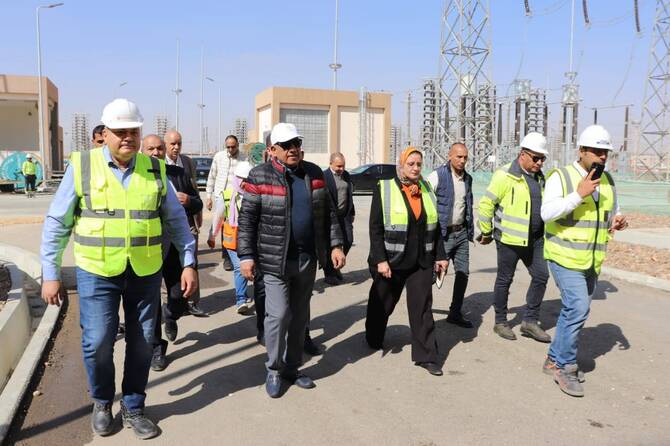
The project is described as the first of its kind in the Middle East in terms of scale, manufacturing technology, operation, and application in grid interconnection lines. Supplied
Short Url
Updated 22 February 2026
Follow

Egypt–Saudi power link set to boost regional energy integration, minister says 

RIYADH: Electricity interconnection projects between Egypt and Saudi Arabia will strengthen regional energy cooperation and economic integration, Egypt’s minister of electricity and renewable energy said during a visit to a key cross-border power facility. 

Mahmoud Esmat made the remarks while inspecting the Egypt–Saudi electricity interconnection station linking the two countries’ power grids, where he reviewed construction progress and equipment testing ahead of trial operations expected in the coming weeks, according to a statement from the Egyptian State Information Service. 

The project is described as the first of its kind in the Middle East in terms of scale, manufacturing technology, operation, and application in grid interconnection lines. 

The initiative supports the state’s broader vision to implement sustainable solutions aimed at ensuring the stability of the national unified grid and enhancing the reliability and quality of electricity supply. 

It also aligns with Egypt’s allocation of 136.3 billion Egyptian pounds ($2.8 billion) to the electricity and renewable energy sector in its 2025–26 development plan, nearly double the 72.6 billion pounds set aside the previous year. 

The plan focuses on diversifying energy sources, expanding renewable capacity, and strengthening the national grid to meet rising demand. 

The statement said: “The minister toured the station’s departments and control and operation center, following up on the completion of testing for all equipment and components in preparation for launching operations and synchronizing the project with the unified power grids of Egypt and Saudi Arabia in the coming weeks.” 

It added: “Esmat reviewed the implementation rate of the project and testing works, as well as the project’s timeline. He highlighted finalization of operational tests at the Badr transformer station and the Sakakin Taba 2 station, as well as the 500 kilovolts overhead transmission line extending approximately 320 km.”  

The minister said the project forms part of broader efforts to build an integrated power network connecting the two countries, facilitating efficient and flexible electricity exchange and laying the groundwork for a unified Arab electricity market. 

He added that the initiative reflects a clear vision and comprehensive strategy to strengthen the efficiency of the energy system while delivering both immediate and long-term solutions to safeguard grid stability and enhance service quality. 


Gold, silver, aluminum and coal gain as Middle East tensions stir supply concerns 

Updated 13 sec ago
Follow

Gold, silver, aluminum and coal gain as Middle East tensions stir supply concerns 

RIYADH: Commodities such as aluminum, gold, coal, and silver have seen prices rise after US-Israeli strikes on Iran triggered supply chain concerns and prompted countries to consider shifting away from oil and gas. 

Gold and silver rose on March 10, supported by a weaker US dollar and easing energy costs after US President Donald Trump suggested that the war in the Middle East could end soon, Reuters reported. 

The increases have not been as dramatic as those seen on the oil markets, which saw the cost of barrel of Brent surpass $119 on March 9, before falling back below the $100 threshold the next day.

Abdulrahman Al-Sudairy, CEO of Vault Saudi, told Arab News: “Beyond oil and gas, gold is seeing the clearest safe-haven demand as Iran tensions escalate, with prices rising on investor rotation into traditional hedges.” 

He added that the Strait of Hormuz is the critical chokepoint to watch, as any disruption threatens not just oil flows, but Qatari liquified natural gas exports and the ammonia and urea derivatives that feed global fertilizer markets.

“Shipping rates and insurance premiums in the tanker and LNG carrier segments are already reacting, serving as a real-time gauge of how seriously markets are pricing the risk of escalation,” Al-Sudairy said.

Vijay Valecha, chief investment officer at Century Financial, said that as of March 10, gold climbed 0.76 percent to $5,177, while silver surged 2.27 percent to $89. 

“Signs that the US–Iran standoff may be moving toward a resolution sent oil sharply lower and softened the dollar, aiding the yellow metal after weeks of volatile, liquidity‐driven selling,” Valecha said. 

He added that, impacted by geopolitical risk, higher oil prices and sticky inflation, gold prices have suffered from dwindling expectations for aggressive rate cuts, leading to exchange-traded fund outflows and investors selling gold to cover other positions in the equity market.

“The multi-year buying streak by central banks, led by China, has continued to underpin prices structurally as it remains firm in its role as an alternative to the dollar-based system,” Valecha said. 

Similarly, aluminum prices surged to their highest level in nearly four years before erasing gains, as escalating conflict in the Middle East worsened supply prospects from the region, according to Al-Eqtisadiah. 

The metal rose as much as 2.8 percent to $3,544 a tonne in London, its highest level since March 2022, before retreating to trade about $100 lower.

The spread between spot and three-month aluminum contracts closed at $47.40 a ton on March 6, also the widest level since 2022, indicating tight immediate supplies. 

Aluminum had already jumped nearly 10 percent in the week ending March 6 after the conflict disrupted shipments from the Arabian Gulf, which accounts for about 9 percent of global supply. 

Buyers in the US rushed to secure alternative shipments from Asia after at least two major smelters in the Middle East — one in Qatar and the other in Bahrain — were forced to suspend deliveries. 

Copper and other industrial metals also declined due to reduced risk appetite. 

Coal prices jumped to their highest level since November 2024 as military strikes continued in the Middle East, prompting countries around the world to consider shifting away from oil and gas tied to the region. 

Newcastle coal futures, the Asian benchmark, climbed 9.3 percent to $150 a tonne on March 9, according to Al-Eqtisadiah. 

This coincided with a surge in crude oil prices, which approached $120 a barrel after producers in the Arabian Gulf cut output. 

An Iranian drone attack last week forced Qatar to shut down the world’s largest LNG export facility, which accounts for about 20 percent of global supply. 

This prompted buyers to seek alternatives, with some importers, such as Taiwan, considering increasing reliance on coal-fired facilities if gas supply disruptions persist. 

Gas prices have also risen, with natural gas prices in Europe jumping as much as 30 percent on March 9, while spot prices in Asia have doubled over the past week and remain elevated.