ISLAMABAD: Pakistan is hopeful to exit the grey list of Financial Action Task Force (FATF) this Friday after the upcoming plenary of the global dirty money watchdog in Paris since the country has successfully implemented 34 action points to counter money laundering and terrorism financing, said officials on Wednesday.
The FATF downgraded Pakistan to its “increased monitoring list” – commonly known as the grey list – in June 2018.
The list includes countries with weak financial systems which can be exploited by criminal elements for money laundering and terrorism financing. These countries formally pledge to work with the task force to strengthen their financial systems by making necessary amendments to them.
Pakistan also agreed to address the deficiencies in its legal, financial and regulatory systems to curb money-laundering and terrorism financing. The country was initially handed over a 27-point action plan, though it was later enhanced to 34 to address all the deficiencies.
“We are hopeful to exit the grey list as we have met all the requirements,” a top Federal Board of Revenue (FBR) official, who was involved in implementing the watchdog’s concerns regarding designated non-financial businesses and professions, told Arab News on condition of anonymity.
He informed that his FBR unit had ensured that the ill-gotten criminal proceeds could not be stashed in real estate, gold or other precious metals and stones.
“We have completed all the action plans and the FATF has also recognized it,” he continued. “Now it is entirely up to them as to what they decide in the meeting.”
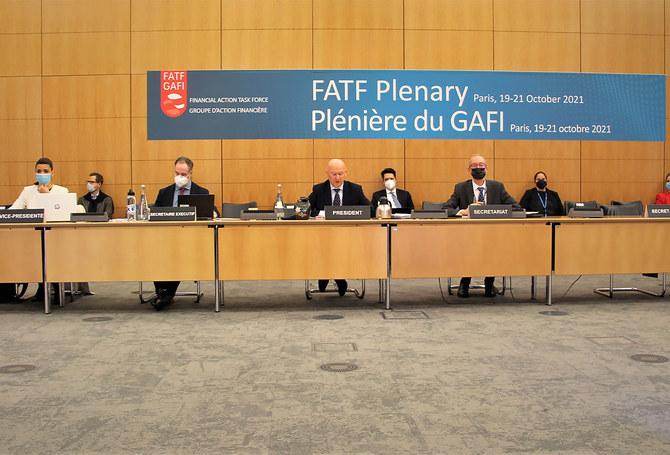
The FATF plenary will be held on October 20-21. It will be attended by the delegates representing 206 members of the Global Network and observer organizations, including the International Monetary Fund, United Nations, World Bank, Interpol and Egmont Group of Financial Intelligence Units.
In June this year, the global watchdog recognized Pakistan’s progress on implementing the 34-point action plan, though it continued to keep the country on the grey list while mentioning an onsite inspection to verify the country’s progress.
A 15-member joint delegation of the FATF and its Sydney-based regional affiliate — Asia Pacific Group — paid the visit to Pakistan between August 29 and September 2 to verify its compliance with the action plan.
“From our perspective, the onsite visit was successful,” the FBR official said.
The Pakistan foreign office spokesperson, Asim Iftikhar, did not respond to a telephone call and text message by the time the story was filed.
Another official of the Financial Monitoring Unit (FMU), who supervised the implementation of the 34-point action plan, cautiously told Arab News the plenary would make the final decision on the issue by Friday.
“Things are in process at the moment,” Samina Chagani, deputy-director at the FMU, said. “We have done our job and things will now be discussed at the plenary.”
She also advised to wait “until the final announcement by the FATF” on Friday.
In June, Pakistan said it was “one step away” from exiting the grey list after the successful completion of the action plans.
“The successful completion of the action plans and its formal endorsement by FATF means that Pakistan has come to one step away from exiting from the grey list,” state minister for foreign affairs Hina Rabbani Khar, who is also the chair of Pakistan’s National FATF Coordination Committee, said at a media briefing.
Economists and experts said that Pakistan’s removal from the FATF watchlist could help the country attract foreign investment in different sectors if a proper strategy was adopted.
“This will be positive news for the investors,” Dr. Salman Shah, a senior economist and former adviser to the government, told Arab News. “But this is unlikely to have any immediate, short-term impact on our economy because some other irritants like political instability still exist to put the investors off.”
He said that a “negative irritant” would be abolished with the removal of the country from the FATF’s grey list and “this will help bring foreign inflows in the long-term.”


![]()

Pakistan hopeful to exit global dirty money watchdog’s grey list on Friday – officials
Short Url
https://arab.news/pnmw2
Pakistan hopeful to exit global dirty money watchdog’s grey list on Friday – officials
- The Financial Action Task Force will announce its decision after discussing Pakistan’s implementation of 34-point action plan
- Experts say they don’t see immediate positive impact on the country’s economy, though exiting the list may boost foreign inflows
Latest updates


© 2026 SAUDI RESEARCH & PUBLISHING COMPANY, All Rights Reserved And subject to Terms of Use Agreement.