

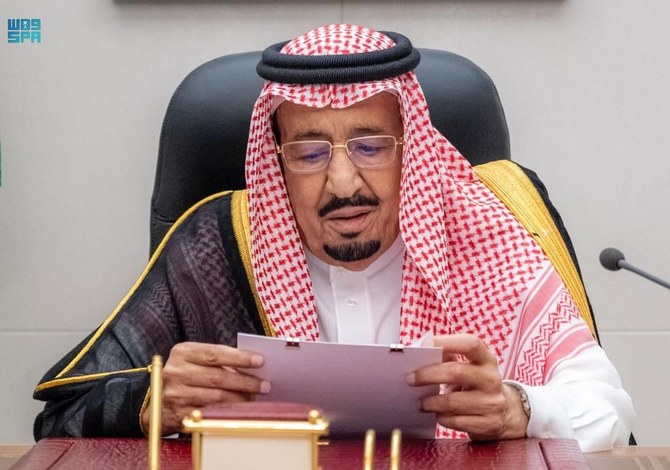

RIYADH: Saudi Arabia’s King Salman has outlined plans to invest trillions of dollars to spur the domestic economy, and also reiterated that the Kingdom remains committed to help boost global growth through stable energy markets as part of the OPEC+ agreements.
In a wide-ranging address to the Shoura Council on Sunday, at the start of the body’s eighth session of its current three-year cycle, King Salman lauded the progress achieved by the Kingdom over the past few years despite the dampening effects of the COVID-19 pandemic.
Crown Prince Mohammed bin Salman attended the session virtually.

“The Kingdom, since its unification, has laid the foundations of peace, stability and the achievement of justice,” the king said.
He said God has honored the Kingdom with serving the two holy mosques, and that Saudi Arabia remains committed to serving Islam and Muslims.
“Our country is witnessing a comprehensive and sustainable development movement and is now in the second phase of Vision 2030,” King Salman said.
The king said Saudi Arabia would continue to seek a peaceful solution to the Russia-Ukraine crisis, and that the Kingdom was working hard to stabilize global oil markets by maintaining the agreement of the OPEC+ alliance.
He further urged Iran to fulfill its nuclear commitments and cooperate fully with the International Atomic Energy Agency.
Providing further details of the domestic economic agenda, the king said the National Investment Strategy launched by Crown Prince Mohammed bin Salman was one of the most important pillars of Saudi Vision 2030.
He said the Kingdom will invest more than SR12 trillion ($3.2 trillion) by 2030 to spur local economic growth, while the economy will receive SR10 trillion ($2.7 trillion) through government spending over the next 10 years, and a further SR5 trillion ($1.3 trillion) from private consumption spending in the same period.
The Public Investment Fund, the king added, would invest SR3 trillion ($798 billion) in the local economy by 2030.
“These are important investments to achieve the targeted returns from the fund, which will result in supporting the economy, creating opportunities for small and large private sector enterprises, and creating more jobs for both male and female citizens, bringing the total expenditure close to SR27 trillion ($7 trillion) by 2030.”
The king said the Saudi economy has shown remarkable resilience despite the COVID-19 pandemic, as confirmed by the International Monetary Fund.
“This success reflects the key role of the economic and structural reforms implemented within the framework of the Saudi Vision 2030,” he said.
King Salman added that the country’s education system remains robust because of the government’s investment in the sector, and had been given further impetus at the G20 during the Kingdom’s presidency of the grouping in 2020.
“We have also succeeded in overcoming the obstacles resulting from the spread of COVID-19, as both distance and in-person learning were put in practice to ensure the continuity of the education process,” he said.
The king added that this would not have been possible without God’s help, and that the investments in the country’s advanced digital infrastructure had paid off.
He said work would continue to develop higher education institutions. “A number of our universities have won advanced positions on the global indicators.”
He added that the recently announced Prince Mohammed bin Salman Nonprofit City will be the world’s first such enterprise.
“The city will be an incubator for academies, colleges, museums and conference centers in addition to creativity centers and Misk schools,” he said.
On the country’s mega- and giga-projects, the king said NEOM, The Line and Amaala affirmed the nation’s vision for a prosperous future through innovation and entrepreneurship.
“The new concept of urban development in The Line, which is part of NEOM, emphasizes the creative side and hard work in this exceptional city, which will be a competitive environment, providing 380,000 job opportunities and adding SR180 billion ($47.9 billion) to the GDP by 2030,” he said.


