

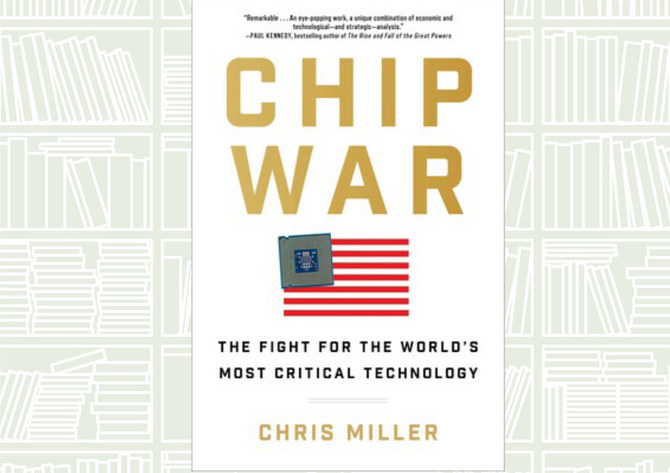
What We Are Reading Today: Chip War by Chris Miller

Short Url
Updated 15 October 2022
Follow

What We Are Reading Today: Chip War by Chris Miller

  • Economic historian Chris Miller explains how the semiconductor came to play a critical role in modern life

This is a fantastic book presenting the complicated and challenging development of the semiconductor industry, and its relations and impact on consumer electronics and national defense.

Economic historian Chris Miller explains how the semiconductor came to play a critical role in modern life and how the US became dominant in chip design and manufacturing and applied this technology to military systems.

America’s victory in the Cold War and its global military dominance stems from its ability to harness computing power more effectively than any other power. 

“Illuminating, timely, and fascinating, Chip War shows that, to make sense of the current state of politics, economics, and technology, we must first understand the vital role played by chips,” said a review on Goodreads.com.

The book explains the state-of-art of chip fabrication and where China, the US and Taiwan are today. Also, what this can potentially mean for the competition between the US and China.

The author is clear in drawing his lessons from a chronological set of main events and personalities that built the industry in the west.


What We Are Reading Today: The Political Economy of Security by Stephen G. Brooks

Updated 04 March 2026
Follow

What We Are Reading Today: The Political Economy of Security by Stephen G. Brooks

In this book, Stephen Brooks provides a systematic empirical and theoretical examination of how economic factors influence security affairs. Empirically, he analyzes how economic variables of all kinds affect interstate war, terrorism, and civil war; in total, 16 pathways are examined.

Brooks shows that the relationship between economic factors and conflict is complex and multifaceted; discrete economic factors—such as international trade, economic development, and globalized manufacturing, to name a few—are sometimes helpful for promoting peace and stability, but at other times are detrimental.

Brooks also develops a stronger theoretical foundation for guiding future research on the economics-security interaction. 

Drawing on Adam Smith, he provides a more complete range of answers to the three key conceptual questions analysts must consider: how economic goals relate to security goals; what economic factors to focus on; and how economic actors influence security policies.

Combining an innovative theoretical understanding with empirical rigor, Brooks’s account will reshape our understanding of the political economy of security.