Iran ex-president’s daughter held, charged amid protests

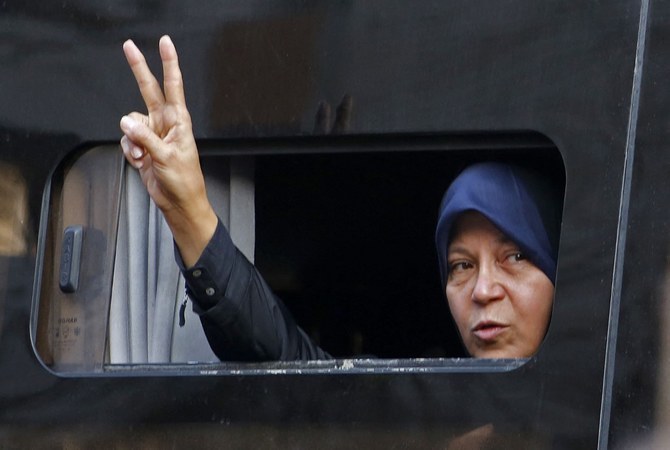
Faezeh Hashemi, the daughter of former President Akbar Hashemi Rafsanjani, has been arrested for ‘inciting riots’. (AFP file photo)
Short Url
Updated 11 October 2022
Follow

Iran ex-president’s daughter held, charged amid protests

  • Faezeh Hashemi, a former lawmaker and a women's rights activist, was arrested on September 27 in Tehran
  • “Ms. Hashemi has been accused of collusion, disruption of public order and propaganda against the Islamic republic”

TEHRAN: The daughter of Iran’s former president Akbar Hashemi Rafsanjani, arrested last month amid protests following the death of Mahsa Amini, has been charged with “propaganda” activity, the judiciary said Tuesday.
Faezeh Hashemi, 59, a former lawmaker and a women’s rights activist, was arrested on September 27 in the capital Tehran for reportedly inciting residents to take part in demonstrations.
Her arrest came amid a continuing wave of unrest that has rocked Iran since 22-year-old Amini, a Kurdish Iranian woman, died on September 16 after her arrest by the morality police in Tehran for allegedly violating the Islamic republic’s strict dress code for women.
“Ms. Hashemi has been accused of collusion, disruption of public order and propaganda against the Islamic republic,” judiciary spokesman Massoud Setayeshi told reporters.
In July, she had previously faced separate charges of carrying out propaganda activity against the country and blasphemy in social media comments.
In March, she was “sentenced to 15 months in prison and two years of additional punishment such as a ban on Internet activities,” said Setayeshi, without elaborating.
In 2012, she was sentenced to six months in jail on charges of “propaganda against the Islamic republic.”
Hashemi’s late father, president between 1989 and 1997, who died in 2017, was considered a moderate who advocated improved ties with the West and the United States.
Iran says dozens of people have been killed in the protests triggered by Amini’s death, including 18 security personnel, and hundreds have been arrested at what it calls “riots.”


Sudanese nomads trapped as war fuels banditry and ethnic splits

Updated 4 sec ago
Follow

Sudanese nomads trapped as war fuels banditry and ethnic splits

  • War disrupts nomads’ traditional routes and livelihoods
  • Nomads face threats from bandits as well as ethnic tensions
NEAR AL-OBEID: Gubara Al-Basheer and his family used ​to traverse Sudan’s desert with their camels and livestock, moving freely between markets, water sources, and green pastures. But since war erupted in 2023, he and other Arab nomads have been stuck in the desert outside the central Sudanese city of Al-Obeid, threatened by marauding bandits and ethnic tensions. The war between the Sudanese army and the paramilitary Rapid Support Forces (RSF) has left nearly 14 million people displaced, triggered rounds of ethnic bloodshed, and spread famine ‌and disease. It ‌has also upset the delicate balance of ‌land ⁠ownership ​and livestock routes ‌that had maintained the nomads’ livelihoods and wider relations in the area, local researcher Ibrahim Jumaa said. Al-Obeid is one of Sudan’s largest cities and capital of North Kordofan state, which has seen the war’s heaviest fighting in recent months. Those who spoke to Reuters from North Kordofan said they found themselves trapped as ethnic hatred, linked to the war and fueled largely online, spreads.
“We used to be ⁠able to move as we wanted. Now there is no choice and no side accepts you,” ‌al-Basheer said. “In the past there were a ‍lot of markets where we ‍could buy and sell. No one hated anyone or rejected anyone. Now ‍it’s dangerous,” he said.
RISK OF ROBBERY
As well as the encroaching war, the nomads — who Jumaa said number in the millions across Sudan — face a threat from bandits who steal livestock.
“There are so many problems now. We can’t go anywhere and if we ​try we get robbed,” said Hamid Mohamed, another shepherd confined to the outskirts of Al-Obeid. The RSF emerged from Arab militias known ⁠as the Janjaweed, which were accused of genocide in Darfur in the early 2000s. The US and rights groups have accused the RSF of committing genocide against non-Arabs in West Darfur during the current conflict, in an extension of long-running violence stemming from disputes over land. The RSF has denied responsibility for ethnically charged killings and has said those responsible for abuses will be held to account. Throughout the war the force has formed linkages with other Arab tribes, at times giving them free rein to loot and kidnap.
But some Arab tribes, and many tribesmen, have not joined the fight.
“We require a national program to counter ‌hate speech, to impose the rule of law, and to promote social reconciliation, as the war has torn the social fabric,” said Jumaa.