

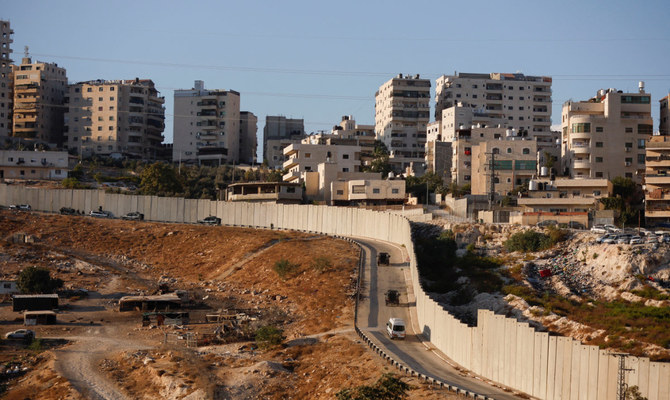

RAMALLAH: Palestinian residents of the Shuafat refugee camp and the nearby town of Anata on the outskirts of Jerusalem are facing growing hardship after Israeli military authorities imposed a blockade on the area.
The crackdown followed a shooting incident at an Israeli army checkpoint on Saturday in which a soldier was killed and two other Israeli security guards were wounded.
At dawn on Sunday, Israeli security forces closed all the entrances to the refugee camp, the town of Anata, and the suburb of Al-Salam, northeast of Jerusalem.
Troops carried out house-to-house searches and arrested relatives of the suspect who allegedly led the attack.
East Jerusalem schools also closed because of the Israeli troop deployment after a night of clashes in the Shuafat camp and nearby town.
The Palestinian Red Crescent Society said that Israeli forces prevented ambulance crews from entering the Shuafat camp and Anata.
In a press statement, the society said that troops had blocked access to emergency services and stopped “medical staff from performing their humanitarian duty.”
Ibrahim Mohammed, 53, a resident of Shuafat camp, described the humanitarian situation as “dire and tragic” less than 24 hours after troops blocked access to the site.
He described the blockade by Israeli military authorities as “collective punishment” for the 150,000 residents of the camp and the neighboring town.
“This is unacceptable collective punishment, and Israel is punishing innocent residents who have nothing to do with what happened,” Mohammed told Arab News.
The closure prevented doctors, students, teachers, merchants and cleaning workers from entering or leaving the area, and also halted the supply of essential goods.
Israeli armed forces used surveillance drones as part of constant search operations.
With the Israeli parliamentary elections scheduled for Nov. 1, political and security officials view Palestinian militant attacks in Jerusalem as more dangerous than those in the West Bank.
Palestinians said that the Israeli army’s use of armed drones in the West Bank constituted a new development in its deadly onslaught against activists, as happened several times in the Gaza Strip.
On Oct. 6, an Israeli television channel revealed how armed drones helped and guided ground forces in targeting Palestinian militants.
However, Palestinians fear their use in overcrowded residential areas, such as Jenin camp and the old city of Nablus, might increase civilian casualties.
Jenin Gov. Akram Rajoub on Sunday described the use of drones as “a dangerous escalation aimed at harming Palestinians.”
Palestinians and human rights groups say that settlers’ attacks against them have intensified in the past two weeks.
On Oct. 7, extremist settlers destroyed crops in Bardala village in the northern Jordan Valley, while other areas have witnessed frequent attacks by settlers at night.
Munir Kadous, a field researcher at Israeli human rights organization Yesh Din, told Arab News that recent settler attacks on Palestinians were backed by the army, border guards and the Israeli police.
Settlers previously carried out their attacks on their own, he said.
Groups of settler youths, protected by Israeli troops, blocked main streets in the West Bank to prevent Palestinian vehicles passing.
“Instead of expelling the settlers, the Israeli army is forcing Palestinian motorists to search for alternative roads, while allowing settlers to keep the roads used by Palestinians closed for long periods,” Kadous told Arab News.
Palestinian vehicles were also being attacked and damaged by settlers, he said.
Young settlers film their attacks on the Palestinians and broadcast them on social media to gain admiration or encourage further attacks, the researcher said.
Three weeks before the Israeli elections, observers believe that firm measures against the settlers are unlikely.
Palestinians say that settler attacks are now the greatest threat to lives and property, and are more dangerous than Israeli army actions.
Settlers’ targeting of Palestinians during the olive harvest season increases the threat to their lives, they added.


