

UN revises up humanitarian aid appeal for Pakistan five-fold to $816 million

Director General World Health Organization, Tedros Adhanom Ghebreyesus (2nd from L) and Pakistan's Climate Change Miniter Sherry Rehman (C) attend a meeting hosted the United Nations on October 4, 2022. (Twitter/@DrTedros)
Short Url
Updated 04 October 2022
Follow

UN revises up humanitarian aid appeal for Pakistan five-fold to $816 million

  • Surge of water-borne diseases, fear of growing hunger pose new dangers after weeks of unprecedented flooding 
  • Climate minister urges developed world to accelerate funding for disaster she says has no parallel in known history

ISLAMABAD: Pakistan and the United Nations on Tuesday jointly launched a humanitarian appeal of $816 million, revising it up five-fold from $160 million, as a surge of water-borne diseases and fear of growing hunger pose new dangers after weeks of unprecedented flooding in the South Asian nation that has left 33 million people struggling to survive. 

The torrential rains and floods have so far killed over 1,700 people while many districts in the southern Sindh and southwestern Balochistan provinces still remain inundated. A preliminary assessment by the UN has found that some 8.62 million people in 28 assessed districts are estimated to be in crisis.
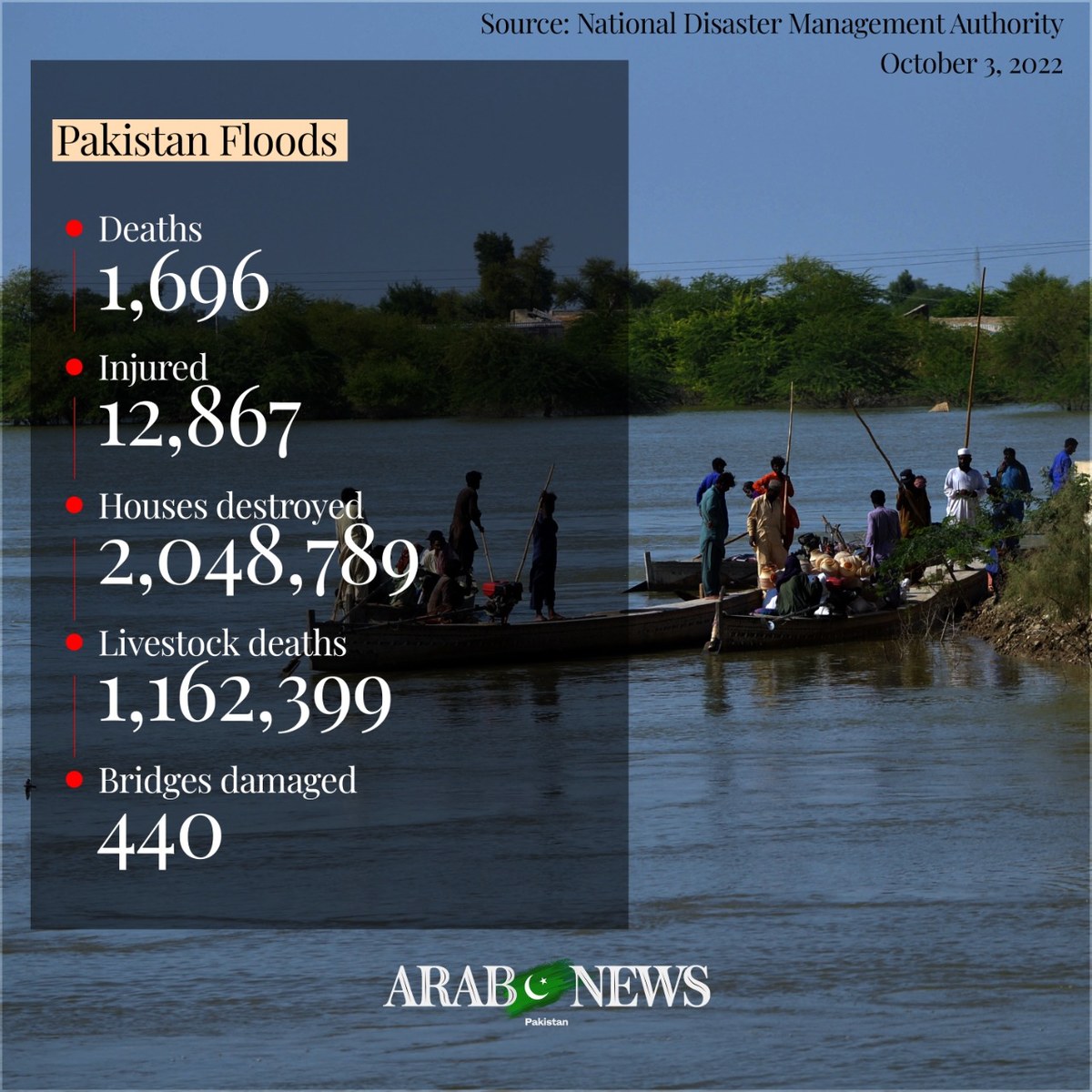
The government estimates damages caused by the floods, that have swept away homes, roads, bridges and livestock, are at least $30 billion. 

Hundreds of thousands of displaced people who are living in the open are being exposed to diseases like malaria, diarrhea, dengue fever, severe skin and eyes infections, all of which are fast spreading amid stagnant floodwaters that officials say could take up to six months to recede.

Both the UN and Pakistan have blamed the floods on climate change as Islamabad is among the top ten countries hit by global warming.

“Pakistan is on the verge of a public health disaster,” Tedros Adhanom Ghebreyesus, director-general of the World Health Organization, said while speaking on the occasion of the UN appeal. “The floods have damaged approximately ten percent of the country’s health facilities.”

Stocks of medicines and medical supplies had also been washed away in floods. “We must move together to support Pakistan,” he said.

Pakistan’s minister for climate change, Sherry Rehman, highlighted the need for urgent medical supplies to protect against fast-spearding water-borne diseases, urging the developed world to accelerate funding for the ongoing climate-linked disaster, which she said had no parallel in known history.

Over seven million people had been displaced from their homes, she added.

“The flood affectees and Pakistan are facing the real race against time as winter is coming,” Rehman said, addressing the flash appeal ceremony in Geneva, saying millions of people were living under the open sky, with up to 7.9 million people “still scrambling for dry land.”

“We are still in the longest rescue and life-saving phase crossing 16 nightmarish weeks,” she said, adding that one-third of all reported deaths and injuries were children.

“Meeting the needs on the ground, even for the relief phase, is beyond the overstretched capacities of any one country, especially the one that is already paying for climate losses at about 9.1 percent of GDP,” Rehman said.

The climate minister said Pakistan’s export crops had also been largely destroyed: “We will even need to now import a huge quantum of food to feed our population.” 

Director-General of the Provincial Disaster Management Authority in Sindh, Salman Shah, said the relief phase in the province was near completion as the flood water had started receding in some parts while efforts were underway to prepare the land for the cultivation of wheat and other crops in the next two months.

“We will be utilising international aid for provision of free seed and fertilizer to our farmers,” he said, “to restore their livelihoods and ensure the country’s food security.” 


Nine killed, one child injured as avalanche hits house in northwest Pakistan

Updated 23 January 2026
Follow

Nine killed, one child injured as avalanche hits house in northwest Pakistan

  • Avalanche strikes family home in Arandu area of Lower Chitral district
  • Heavy snowfall cuts off towns and villages across northern Pakistan

PESHAWAR/QUETTA: At least nine people were killed while an injured child was rescued alive when an avalanche struck a house in a mountainous district of northwestern Khyber Pakhtunkhwa province, officials said on Friday, as the Pakistan Meteorological Department (PMD) warned of more rain and snowfall in the area along with southwestern Pakistan.

The incident occurred in the Arandu region of Lower Chitral district, affecting members of the same family, as the PMD urged tourists to avoid unnecessary travel while authorities worked to prevent weather-related emergencies.

Rescuers evacuated dozens of residents and tourists as heavy snow blocked roads in Khyber, South Waziristan and Swat districts, where authorities cleared routes and provided food, clothing and bedding, the Rescue 1122 service said.

“An avalanche fell in Sarigal village of Arandu, a far-flung area in subdivision Drosh,” Deputy Commissioner of Lower Chitral Rao Hashim Azeem told Arab News over the phone.

“Ten people from the same family came under the avalanche in which nine were found dead and one child was rescued alive,” he added. “Police, Chitral scouts, rescue and local administration took part in the operation.”

Azeem said the rescue efforts were hampered by heavy snowfall and the area’s remote location, adding that the bodies were taken to Drosh for burial.

Heavy snow hit Azad Kashmir, Gilgit-Baltistan, Murree, and Galiyat, stranding vehicles and causing power outages, local media reported.

“The system causing rain/snowfall is active over northern parts of the country,” the PMD said in its advisory on Friday at noon, predicting more showers and snow in the next few hours.

“Tourists [are] advised to stay vigilant and avoid unnecessary travel during rain and snowfall,” it added.

TEMPERATURE DROP IN BALOCHISTAN

The PMD said temperatures in several in districts southwestern Balochistan province dropped to –9°C as a snowstorm with strong winds hit Quetta, Kalat, Chaman, Killa Saifullah, Nushki and Loralai, disrupting daily life.

“Dozens of vehicles including passenger buses have been stranded at N-50 highway near Muslim Bagh due to heavy snowfall since Thursday night,” Assistant Commissioner Muslim Bagh Dheeraj Kalra told Arab News.

“District administration accompanied by PDMA [Provincial Disaster Management Authority] Balochistan removed the snow from the N-50 highway and opened the roads for traffic on Friday morning.”

Meanwhile, PMD Balochistan Deputy Director Muhammad Afzal said the next spell of snowfall and rain would hit the southwestern parts of the country from Jan. 25 to 27 but will not be as harsh as the first one.

“The recent system of snowstorm entered Balochistan through the Iran-Afghan border which dropped the mercury to –9°C and this freezing temperature will continue till tomorrow evening,” he said.

Weather authorities this week forecast intermittent rains and snowfall in northern regions of the country between Jan. 21 and Jan. 24, with heavy snowfall likely in upper and hilly areas of the province.

Tens of thousands of tourists flock to Pakistan’s scenic north every winter to witness snowfall, often neglecting warnings from disaster management authorities.

In Jan. 2022, at least 21 people, including children, died after they were stuck in freezing temperatures during a snowstorm in the Pakistani hill station of Murree.

In view of the situation, Federal Minister Abdul Aleem Khan on Friday directed the National Highway Authority (NHA) to ensure that all highways remain open and fully operational under all circumstances.

“The minister has instructed NHA field staff to remain on high alert and to maintain 24/7 monitoring of weather conditions on highways in snowfall-affected areas,” the Pakistani information ministry said.

“He emphasized that ensuring uninterrupted traffic flow on national highways, particularly in upper regions, is a top priority.”