

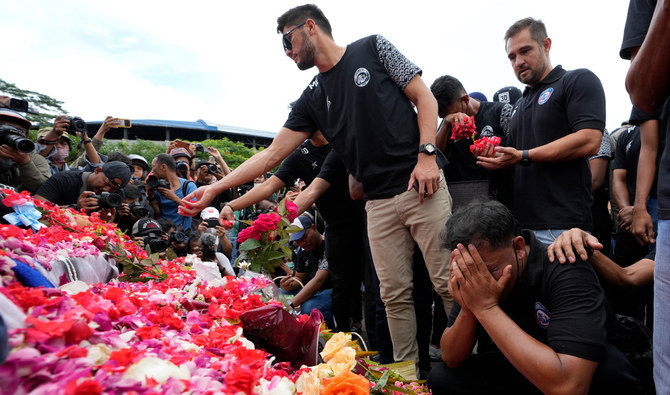
Relatives mourn those crushed at Indonesia soccer match

Players and officials of the soccer club Arema FC pray outside Kanjuruhan Stadium where riots broke out on Saturday night, in Malang, Indonesia, October 3, 2022. (AP)
Short Url
Updated 03 October 2022
Follow

Relatives mourn those crushed at Indonesia soccer match

  • The crush in East Java’s Malang city is among world’s deadliest disasters ever at a sporting event
  • President Joko Widodo orders probe, while FIFA chief calls it ‘a dark day for all involved in football’

JEMBER: Families and friends of some of the 125 people who died in a deadly crush after an Indonesia soccer match wailed in grief as the bodies of the victims were returned home Monday. Seventeen children were among the dead.

The distraught family members were struggling to comprehend the sudden loss of loved ones at a soccer match in East Java’s Malang city that was watched only by hometown Arema FC fans because the organizer had banned visiting Persebaya Surabaya’s supporters due to Indonesia’s history of violent soccer rivalries.

The crush was among the world’s deadliest disasters ever at a sporting event. President Joko Widodo ordered an investigation of security procedures, and the president of FIFA called the deaths “a dark day for all involved in football and a tragedy beyond comprehension.”

Faiqotul Hikmah, 22, was an Aremania — the moniker for Arema fans — who died while fleeing to exit 12 at Kanjuruhan Stadium.

A dozen friends traveled to see the match but Hikmah was one of only four who entered the stadium because tickets were sold out, her friend, Abdul Mukid, said Monday in an Associated Press interview. He later bought a ticket separately from a broker then learned of the chaos that had erupted inside the stadium.

“I have to find her, save her... that’s kept me from thinking anything else,” Mukid recalled, “The situation is really... really terrible!”

Two of his friends died and two were injured. Mukid found Hikmah’s body laid at a building in the stadium compound, her face full of bluish bruises and broken ribs.

At Hikmah’s parents’ home in Jember, East Java province, relatives wailed when an ambulance arrived with her body wrapped in white cloth and a black blanket.

“I can’t put into words how much my sorrow is to lose my sister,” said Nur Laila, Hikmah’s older sister. “She was just a big Arema fan who wanted to watch her favorite team play. She shouldn’t die just for that,” she said, wiping tears.

Mukid learned a second friend had died from friends who called him while he was on the ambulance carrying Hikmah’s body to a hospital. Noval Putra Aulia, 19, was an orphan who had been cared for by his brother since their parents died five years ago, Mukid said.

At least 17 children were among the dead and seven children were injured and treated hospitals, the Ministry of Women’s Empowerment and Child Protection said. Police say 323 people overall were injured in the crush, some of them still in critical condition.

Witnesses said fans flooded the pitch and demanded that Arema management explain why, after 23 years of undefeated home matches against Persebaya, Saturday night’s ended in a 3-2 defeat. Some of the 42,000 Arema fans threw bottles and other objects at players and soccer officials. At least five police vehicles were toppled and set ablaze outside the stadium.

Riot police trying to stop the violence fired tear gas, including toward the spectator stands, and triggered the disastrous crush of fans making a panicked, chaotic run for the exits. Most of the 125 people who died were trampled upon or suffocated. Children were reported to be among the casualties, and two others were said to be police officers.

“I ensure that investigation on this case will be conducted thoroughly and seriously,” National Police chief Listyo Sigit Prabowo said in a news conference late Sunday.

Widodo ordered the premier soccer league suspended until safety is reevaluated and security is tightened. Indonesia’s soccer association has also banned Arema from hosting soccer matches for the rest of the season.

Rights group Amnesty International urged Indonesia to investigate the use of tear gas at the stadium and ensure that those found in violations are tried in open court. While FIFA has no control over domestic games, it has advised against the use of tear gas at soccer stadiums.

Despite Indonesia’s lack of international accolades in the sport, hooliganism is rife in the soccer-obsessed country where fanaticism often ends in violence. Data from Indonesia’s soccer watchdog, Save Our Soccer, showed 78 people have died in game-related incidents over the past 28 years.

Saturday’s game was among the world’s worst crowd disasters in sports, including the 1996 World Cup qualifier between Guatemala and Costa Rica in Guatemala City where over 80 died and over 100 more were injured. In April 2001, more than 40 people are crushed to death during a soccer match at Ellis Park in Johannesburg, South Africa.



Kyiv mayor calls for temporary evacuation over heating outages

Updated 4 sec ago
Follow

Kyiv mayor calls for temporary evacuation over heating outages

  • “Moscow is trying to use cold weather as a tool of terror,” Zelensky said
  • He said 20 residential buildings in Kyiv had been damaged, including the Qatari embassy

KYIV: Mass heating outages caused by Russian strikes on Kyiv are set to last into the weekend, as the capital’s mayor called on residents to temporarily leave the city with sub-zero temperatures expected to fall even lower.
A massive missile and drone attack on Kyiv killed four and ripped open apartment blocks. Moscow also fired its feared Oreshnik ballistic missile at western Ukraine, drawing condemnation from Europe.
The barrage came hours after Moscow rejected a plan by Kyiv and its Western allies to deploy peacekeeping forces to Ukraine should a ceasefire be reached.
AFP journalists in Kyiv saw residents running for shelter late Thursday night as the air raid siren echoed, and heard Russian drones exploding into residential buildings and missiles whistling over the capital.
“Moscow is trying to use cold weather as a tool of terror,” Ukrainian President Volodymyr Zelensky said at a meeting in Kyiv with British Defense Secretary John Healy.
He said 20 residential buildings in Kyiv had been damaged, including the Qatari embassy, in one of the largest attacks on the capital for months.
Qatar expressed “deep regret” over the embassy hit and said that none of its staff there had been harmed.

- ‘Very difficult’ situation -

The Russian barrage left around half of all apartment blocks in the capital, some 6,000 buildings, without heating, Mayor Vitaliy Klitschko said.
Temperatures are set to fall to -15C on Saturday.
Officials said they were hopeful some heating could be restored on Friday night.
“In some areas where the damage is more complex, additional time is needed,” Ukraine’s Restoration Minister Oleksiy Kuleba said.
Klitschko said the situation was “very difficult” and called on “residents of the capital who have the opportunity to temporarily leave the city for places with alternative sources of power and heat to do so.”
City authorities said they had set up 1,200 warming centers.

- Russia fires rarely-used missile -

A medic who died at a building that was struck in a repeat attack was among the four killed, officials said. Another 26 were wounded.
Nina, 70, who lives in one of the buildings hit, told AFP she was angry that the world was talking about a possible deal to end the conflict at a time when Russia was launching such deadly barrages.
“Where is Europe, where is America? It doesn’t hurt them the same way,” she said.
Her neighbor, 58-year-old Kostiantyn Kondratchenko fought the second-floor blaze from a drone hit with a hose used to water flowers, he told AFP.
The barrage is just the latest to batter Ukraine as diplomats wrangle for a breakthrough in what has been Europe’s deadliest conflict since World War II.
Russia has shown no sign of slowing down its ground offensive or aerial bombardments.
Moscow’s defense ministry said it had fired the Oreshnik ballistic missile on “strategic targets” — only the second time the new weapon, which the Kremlin says is impossible to stop, is known to have been used.

- ‘Escalatory and unacceptable’ -

Ukrainian authorities said a ballistic missile traveling “at about 13,000 kilometers (8,000 miles) per hour” had struck an “infrastructure facility” near the western city of Lviv.
It said Russia had attacked “civilian infrastructure,” without specifying the target or extent of any damage.
The Oreshnik is an intermediate-range ballistic missile that can be equipped with both nuclear and conventional warheads.
Lviv region officials said that radiation levels were within normal range after the attack.
France, Germany and Britain condemned Moscow’s “escalatory and unacceptable” use of Oreshnik, a UK government spokeswoman said after a call between leaders of the three countries.
Across the border in Russia’s Belgorod, the governor said more than half a million people were without power or heating after a Ukrainian attack targeted the region’s utilities.
Despite intense diplomatic efforts led by US President Donald Trump, a deal to end the fighting remains elusive.
Moscow baulked this week after European leaders and US envoys announced post-war guarantees for Ukraine would include a US-led monitoring mechanism and a multinational force.
Russia called the plan “dangerous” and “destructive.”
Key territorial issues are also unresolved as Russia insists on getting full control of Ukraine’s Donbas region, part of which is still controlled by Kyiv.
Russia occupies around 20 percent of Ukraine.
Tens of thousands have been killed since it invaded in February 2022, millions forced to flee their homes and much of eastern and southern Ukraine decimated.