

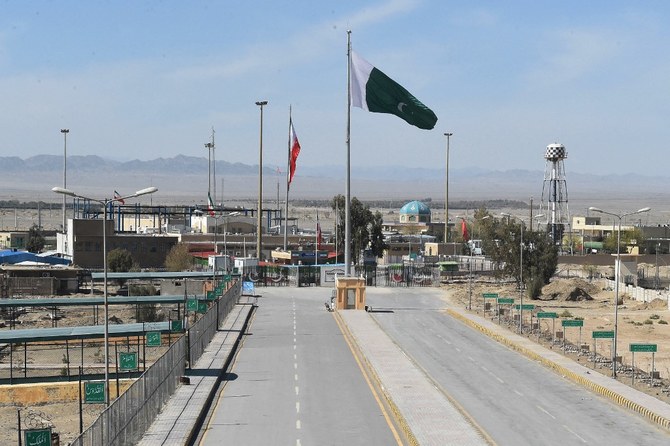

QUETTA: Iran sealed a main crossing point with Pakistan on Sunday amid deadly unrest and a crackdown on protesters in Zahedan, a southeastern Iranian city near the border.
Violence broke out in the capital of the Iranian Sistan and Balochistan province during Friday prayers, after worshipers in the city’s Makki Mosque called for a protest over the rape of a 15-year-old girl, allegedly by a local military commander.
Islamic Revolutionary Guard Corps provincial intelligence chief Ali Mousavi was shot during the clashes on Friday and pronounced dead at a hospital.
The killing was claimed by the Jaish Al-Adl militant group, which says it is fighting for the independence of Sistan and Balochistan, and greater rights for Baloch people, who are the main ethnic group in the province.
A Pakistani Federal Investigation Agency official told Arab News the border crossing in Taftan, about 90 km from Zahedan, was sealed off by Iranian authorities.
“They are not allowing departure movement from Pakistan into Iran,” he said on condition of anonymity.
“On Saturday, they allowed 780 people, including foreigners who wanted to cross into Pakistan, but on Sunday they completely halted all kinds of trade and pedestrian movement.”
Sardarzada Umair Muhammad Hassani, former adviser to the chief minister of Pakistan’s Balochistan province, said the border closure would affect Iran itself, as food supplies to Iran pass through Pakistan.
“The border closure decision by Iranian forces wasn’t fair in the better interest of Iran,” he told Arab News, adding that he had backtracked on his earlier opinion that Pakistani-Iranian ties should be enhanced, as the killings in Zahedan have affected the Baloch community on the Pakistani side.
“Baloch tribes have been living on both sides of the border,” Hassani said. “The recent brutality toward the people of Zahedan by the Iranian forces has hurt the sentiments and emotions of the Baloch.”
Footage emerging from the city showed people carrying dead and wounded protesters amid heavy gunfire. The administration of Sistan and Balochistan said 19 people have been killed in the clashes, but journalists in the province and activists estimate the number of deaths to be at least 50, as clashes continue.
“According to local media in Zahedan, the death toll has risen to 50, because the majority of the injured who were shot by Iranian forces were being treated in their homes instead of hospitals due to fear of arrest by the Iranian forces,” Asif Burhanzai, a journalist in Taftan, told Arab News.
The Baloch Activists Campaign said at least 58 people have died and 270 have been wounded.
Communication services were down in Zahedan and surrounding areas over the weekend. On Sunday, mobile networks were partially restored, but access to the internet remained blocked.
Iran’s Mehr News Agency reported on Sunday that the number of personnel from the IRGC and its volunteer Basiji force killed in Zahedan had risen to five.
Their deaths, and that of the provincial IRGC intelligence chief, represent a major escalation in the antigovernment demonstrations that began in mid-September, triggered by the death of a 22-year-old woman, Mahsa Amini, in the custody of the Iranian morality police.
The IRGC’s chief, Gen. Hossein Salami, pledged revenge for the killing of its forces.
“We consider revenge for the blood of the IRGC and Basiji martyrs and the people who were victims of the Black Friday crime in Zahedan to be on our agenda,” he said, as quoted by Iran’s official news agency IRNA.
Ongoing countrywide demonstrations have been the largest manifestation of dissent against the Iranian government in over a decade.
Rallies have spread to all of Iran’s 31 provinces, with ethnic and religious minorities joining in, despite a violent response from authorities.
With the deaths in Sistan and Balochistan, the number of those killed in the protests is likely to have crossed 100.
On Friday, the Norway-based Iran Human Rights organization estimated the number of dead to be at least 83. Many more have been wounded and thousands arrested.

keywords


