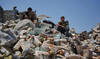
Iraqis gather in Baghdad to mark anniversary of 2019 anti-government protest

Demonstrators face off with security forces during protests in Tahrir Square as anti-government protesters try to enter the Green Zone of Baghdad, Iraq, 28 September 2022. (EPA)
Short Url
Updated 01 October 2022
Follow

Iraqis gather in Baghdad to mark anniversary of 2019 anti-government protest

  • In 2019, protests erupted against then prime minister Adel Abdul Mahdi’s government with demonstrators demanding an overhaul of political system

BAGHDAD: Hundreds of Iraqis gathered in Baghdad’s central Tahrir square on Saturday to mark the anniversary of anti-government unrest that erupted in 2019, amid tight security and prolonged political deadlock in the country.
With concerns about the risk of street violence, security personnel deployed checkpoints across the city, closed off bridges and squares and erected walls across some of the bridges leading to the fortified Green Zone that houses government headquarters and foreign embassies. Protesters waved the Iraqi flag and chanted “we want to overthrow the regime.”
“We took part in today’s peaceful protests because we want our demands to be met... we want security, jobs and our simple rights ... we are not here to fight or shed blood,” said Laith, a young protester from Baghdad.
A few meters from the square, security forces fired teargas to disperse stone-throwing protesters who had tried to tear down a wall blocking the Republic Bridge leading across the Tigris to the Green Zone, according to a Reuters reporter who witnessed the incident.
A military statement said some “infiltrated elements” were assaulting security forces using Molotov cocktails and hunting rifles.
In 2019, protests erupted against then prime minister Adel Abdul Mahdi’s government with demonstrators demanding an overhaul of a political system they see as profoundly corrupt and keeping most Iraqis in poverty.
More than 560 people, mostly unarmed demonstrators but also members of the security forces, were killed in the spate of popular unrest as Iraqi security forces and unidentified gunmen cracked down.
Mahdi quit under pressure from the protests with powerful Shiite Muslim cleric Moqtada Al-Sadr the biggest winner in an election last October.
Sadr in June withdrew all his lawmakers, nearly a quarter of parliament, and resorted to whipping up street protests after his movement failed to form a government, leading to some of the worst clashes the country has seen in years.
Saturday’s gathering raised fears of more unrest and tension among power-hungry politicians that could further delay the formation of a government after Sadr quit politics at the end of August.
Four rockets landed in the Green Zone on Wednesday during a partial lockdown as parliament was convening, wounding seven security personnel, and another four rockets fired from eastern Baghdad landed around the zone on Thursday.


Israeli tank fires near Lebanese army and UNIFIL patrol amid escalating tensions

On Friday, President Joseph Aoun met with Parliament Speaker Nabih Berri to address the Israeli escalation. (Supplied)
Updated 6 sec ago
Follow

Israeli tank fires near Lebanese army and UNIFIL patrol amid escalating tensions

  • On Friday, President Joseph Aoun met with Parliament Speaker Nabih Berri to address the Israeli escalation
  • Aoun has faced mounting criticism from Hezbollah-aligned activists for his repeated insistence on the state’s exclusive authority over arms

BEIRUT: An Israeli tank opened fire near a joint Lebanese army and UNIFIL patrol on Friday afternoon, in the latest incident to heighten tensions along the Blue Line.

The tank shell reportedly landed near Wadi Al-Asafir, south of the town of Khiam, where the Lebanese army and UNIFIL were conducting a field operation. The fire was said to have come from a newly established Israeli position in the Hamams area, according to eyewitnesses.

A Lebanese military source told Arab News: “This is not the first time Israeli forces have targeted Lebanese army and UNIFIL units. Similar incidents have occurred during operations south of the Litani River, and UNIFIL has previously issued statements condemning such actions.”

Earlier on Friday, an Israeli drone fired three missiles at a vehicle in Baalbek, eastern Lebanon, in a failed assassination attempt. Witnesses said the first strike hit a car traveling on the Majdaloun-Baalbek road. The driver, believed to be Palestinian, managed to escape, tossing his phone out before parking near Dar Al-Amal Hospital.

The drone fired a second missile that missed, resulting in material damage only. A third strike followed, but the target was not injured.

The attacks come amid renewed Israeli skepticism over Lebanon’s efforts to confiscate weapons south of the Litani River. Israeli officials dismissed Beirut’s recent announcement of completing the first phase of the disarmament plan as a “media stunt to buy time.” Lebanese officials insisted that progress was being made under a phased national strategy backed by international partners.

On Friday, President Joseph Aoun met with Parliament Speaker Nabih Berri to address the Israeli escalation, which this week included the bombing of residential areas north of the Litani River, displacing dozens of families.

Aoun has faced mounting criticism from Hezbollah-aligned activists for his repeated insistence on the state’s exclusive authority over arms. A social media campaign launched Thursday accused the president of betraying the resistance, using defamatory language in videos widely circulated online.

Despite the backlash, Berri is said to be supportive of Aoun’s position. A Lebanese official told Arab News, “Berri continues to play a mediating role and agrees that the real problem lies in the lack of international pressure on Israel to respect the ceasefire and end its violations.”

Aoun told a visiting delegation from the Southern Border Towns Association on Friday that Lebanon’s stability is impossible without security in the south. “We are coordinating with the army to reinforce their presence in the border villages,” he said. “Our primary demand in the mechanism meetings remains the safe return of displaced residents and the release of prisoners.”

Meanwhile, the Public Prosecutor’s Office has begun summoning individuals accused of insulting Aoun online, including journalist Hassan Alik, who failed to appear on Friday.

The Presidential Palace told Arab News that the president had not filed a complaint and that the judiciary acted independently in accordance with Lebanese law, which criminalizes insults against the head of state.

Alik’s lawyer, Alia Moallem, filed a legal memorandum arguing that the summons violated the constitution and press laws, stating the remarks fall within the scope of journalistic work and freedom of expression.

In a statement, the Lebanese Press Editors Syndicate urged journalists to uphold responsible discourse during this sensitive time, while reaffirming the importance of safeguarding freedom of speech under Lebanese law.