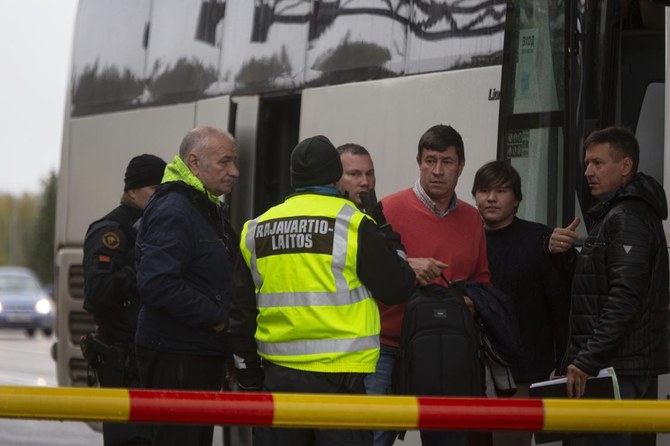
COPENHAGEN: Finland’s border with Russia was closed to Russians with tourist visas Friday, curtailing one of the last easily accessible routes to Europe for Russians trying to flee a military mobilization aimed at bolstering the Kremlin’s war in Ukraine.
Long queues were reported until midnight at the border crossings. Among the last to enter Finland were two cyclists who arrived a little before 11 p.m., Finnish broadcaster YLE reported from Vaalimaa, one of the main border crossings between the Nordic country and Russia. Finland has the longest border with Russia of all European Union member countries.
With the exception of the one border crossing between Russia and Norway, Finland had provided the last easily accessible land route to Europe for Russian holders of European Schengen-zone visas.
The government justified its decision by saying that continued arrivals of Russian tourists in Finland is endangering the country’s international relations, and cited security concerns related to Russia’s war in Ukraine, the “illegal” referendums arranged by Russia in parts of Ukraine and recent sabotage of the Nord Stream gas pipelines from Russia under the Baltic Sea.
Russian citizens can still enter Finland for family reasons, study or work. Also, Russian political dissidents may seek to enter for humanitarian purposes.
As of Sept. 1, Finland slashed the number of visas — including for tourism purposes — issued to Russian citizens to one-tenth of the typical number, in a show of solidarity with Ukraine.
Earlier this week, Finnish border guards said they want a fence along the border with Russia, deeming it “necessary due to the changing security environment” in the Nordic country. Such a fence requires the approval of the Finnish Parliament.
The fence would not run the entire 1,340-kilometer (830-mile) length of the border, but shoudl be in “riskier areas, such as border crossings and their nearby areas,” the border guards said.
Norway said Friday it was considering imposing an entry ban for Russians with Schengen visas. The Scandinavian country has a border in the Arctic with Russia which is 198 kilometers (123 miles) long. The sole crossing point is at Storskog.
“We will close the border quickly if necessary, and changes can come at short notice,” Justice Minister Emilie Enger Mehl said.


Finnish border closed to Russians with tourist visas
https://arab.news/jwrdx
Finnish border closed to Russians with tourist visas

- Russians have been trying to flee a military mobilization aimed at bolstering the Kremlin’s war in Ukraine

Winter storm packing snow and strong winds to descend on Great Lakes, Northeast
- The fierce winds on Lake Erie sent water surging toward the basin’s eastern end near Buffalo, New York, while lowering water on the western side in Michigan to expose normally submerged lakebed — even the wreck of a car and a snowmobile
NEW YORK: A wild winter storm was expected to bring strong winds, heavy snow and frigid temperatures to the Great Lakes and Northeast on Tuesday, a day after a bomb cyclone barreled across the northern US and left tens of thousands of customers without power.
The storm that hit parts of the Plains and Great Lakes on Monday brought sharply colder air, strong winds and a mix of snow, ice and rain, leading to treacherous travel. Forecasters said it intensified quickly enough to meet the criteria of a bomb cyclone, a system that strengthens rapidly as pressure drops.
Nationwide, more than 127,000 customers were without power Tuesday morning, more than a third of them in Michigan, according to Poweroutage.us.
BACKGROUND
The storm that hit parts of the Plains and Great Lakes on Monday brought sharply colder air, strong winds and a mix of snow, ice and rain, leading to treacherous travel.
As the storm moved into Canada, the National Weather Service predicted more inclement weather conditions for the Eastern US, including quick bursts of heavy snow and gusty winds known as snow squalls. Blustery winds were expected to add to the arctic chill, with low temperatures dipping below freezing as far south as the Florida panhandle, the agency said.
New York Gov. Kathy Hochul warned that whiteout conditions were expected Tuesday in parts of the state, including the Syracuse metro area.
“If you’re in an impacted area, please avoid all unnecessary travel,” she said in a post on the social platform X.
Snow piled up quickly in Michigan’s Upper Peninsula on Monday, where as much as 2 feet (60 centimeters) fell in some areas, according to the National Weather Service. Meteorologist Ryan Metzger said additional snow was expected in the coming days, although totals would be far lighter.
Waves on Lake Superior that were expected to reach 20 feet (6 meters) on Monday sent all but one cargo ship into harbors for shelter, according to MarineTraffic.com.
The fierce winds on Lake Erie sent water surging toward the basin’s eastern end near Buffalo, New York, while lowering water on the western side in Michigan to expose normally submerged lakebed — even the wreck of a car and a snowmobile.
Kevin Aldrich, 33, a maintenance worker from Monroe, Michigan, said he has never seen the lake recede so much and was surprised on Monday to spot remnants of piers dating back to the 1830s. He posted photos on social media of wooden pilings sticking up several feet from the muck.
“Where those are at would typically be probably 12 feet deep,” he said. “We can usually drive our boat over them.”
Dangerous wind chills plunged as low as minus 30 F (minus 34 C) across parts of North Dakota and Minnesota on Monday. And in northeast West Virginia, rare, nearly hurricane-force winds were recorded on a mountain near Dolly Sods, according to the National Weather Service.
In Iowa, after blizzard conditions eased by Monday morning, high winds continued blowing snow across roadways, keeping more than 200 miles (320 kilometers) of Interstate 35 closed. State troopers reported dozens of crashes during the storm, including one that killed a person.
On the West Coast, the National Weather Service warned that moderate to strong Santa Ana winds were expected in parts of Southern California through Tuesday, raising concerns about downed trees in areas where recent storms had saturated the soil. Two more storms were forecast later this week, with rain on New Year’s Day potentially soaking the Rose Parade in Pasadena for the first time in about two decades.


