

Iran curbs Internet access as protests claim 11 lives

1 / 4
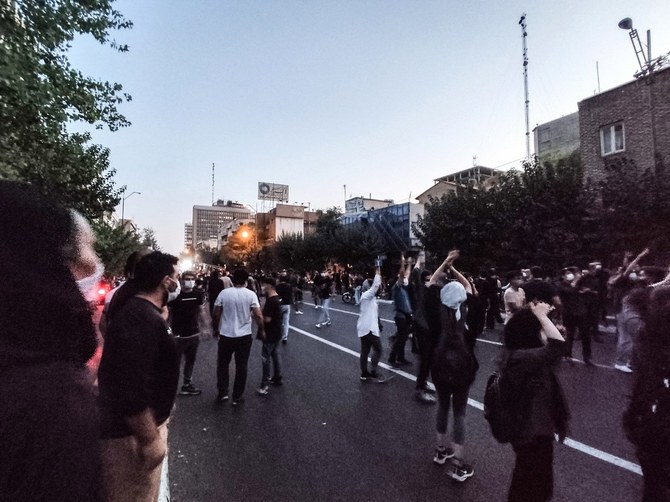
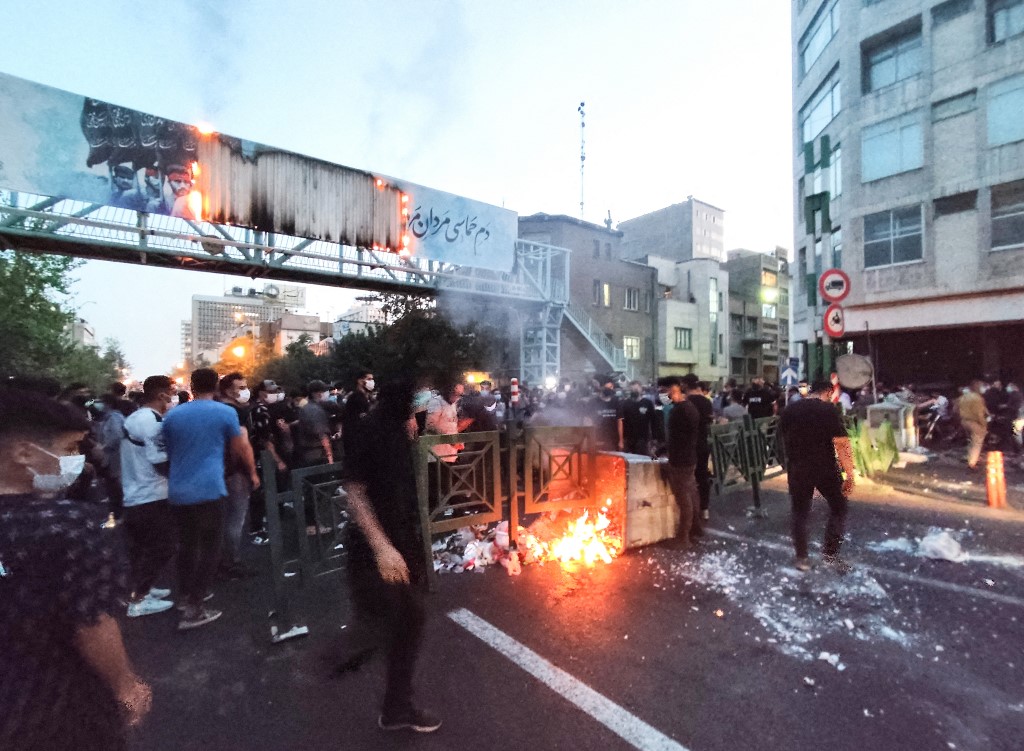
Iranian demonstrators taking to the streets of the capital Tehran during a protest for Mahsa Amini, days after she died in police custody. (AFP)
2 / 4
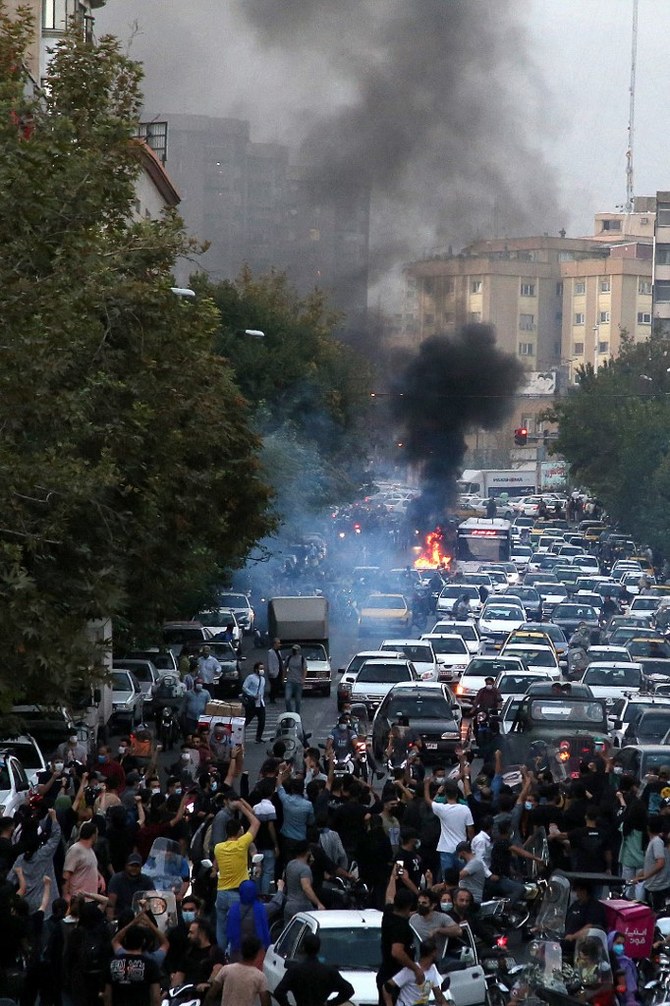
Iranian demonstrators taking to the streets of the capital Tehran during a protest for Mahsa Amini, days after she died in police custody. (AFP)
3 / 4
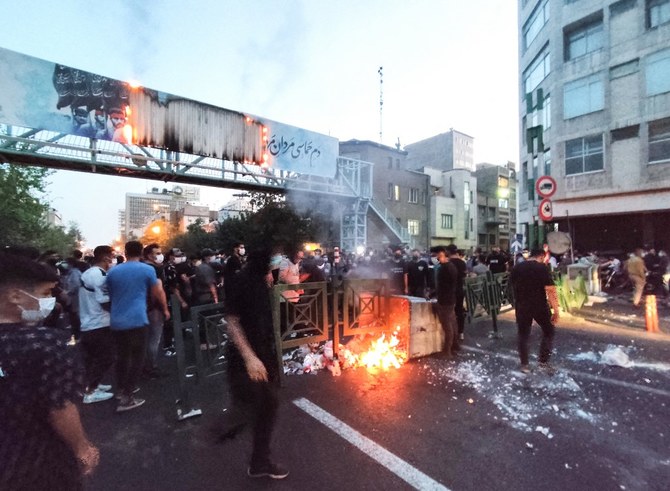
Iranian demonstrators taking to the streets of the capital Tehran during a protest for Mahsa Amini, days after she died in police custody. (AFP)
4 / 4
Iranian demonstrators taking to the streets of the capital Tehran during a protest for Mahsa Amini, days after she died in police custody. (AFP)
Short Url
Updated 22 September 2022
Follow

Iran curbs Internet access as protests claim 11 lives

  • Public anger has flared since Iranian authorities on Friday announced the death of Mahsa Amini
  • Women demonstrators take off their hijabs and burn them or symbolically cut their hair

PARIS: Iran restricted Internet access Thursday after days of protests and unrest that have claimed at least 11 lives, following the death of a young woman in the custody of the morality police.

Public anger has flared in the Islamic republic over the death last week of 22-year-old Mahsa Amini, who had been detained for allegedly wearing a hijab headscarf in an “improper” way.

Activists said the woman, whose Kurdish first name is Jhina, had suffered a fatal blow to the head, a claim denied by officials, who have announced an investigation.

During six straight nights of protests, women demonstrators have defiantly taken off their headscarves and burned them in bonfires or symbolically cut their hair before cheering crowds, video footage spread on social media has shown.

Protesters in Tehran and several other Iranian cities torched police stations and vehicles as unrest triggered by the death of a woman detained by the Islamic Republic’s morality police intensified for a sixth day.

Another police station was set ablaze in the capital Tehran as the unrest spread from Kurdistan, the home province of Amini, according to a Reuters report.

“No to the headscarf ... yes to freedom and equality!” protesters in Tehran were heard chanting in a rally that has been echoed by solidarity protests abroad.

Iranian women interviewed by AFP on the streets of Tehran said they were now more careful about their dress to avoid run-ins with the morality police.

“I’m frightened,” said Nazanin, a 23-year-old nurse, who asked to be identified by her first name only for safety reasons. “They shouldn’t confront people at all” or interfere with how women dress, she added.

There has been growing international alarm at the Iranian crackdown on the protests, including from US President Joe Biden in an address to the United Nations.

“Today we stand with the brave citizens and the brave women of Iran who right now are demonstrating to secure their basic rights,” Biden told the General Assembly on Wednesday.

Iranian state media reported that by Wednesday street rallies had spread to 15 cities, with police using tear gas and making arrests to disperse crowds of up to 1,000 people.

In southern Iran, video footage purportedly from Wednesday showed demonstrators setting fire to a gigantic picture on the side of a building of general Qassem Soleimani, the revered Revolutionary Guards commander killed in a 2020 US drone strike in Iraq.

Demonstrators hurled stones at security forces, set fire to police vehicles and garbage bins, and chanted anti-government slogans, the official IRNA news agency said.
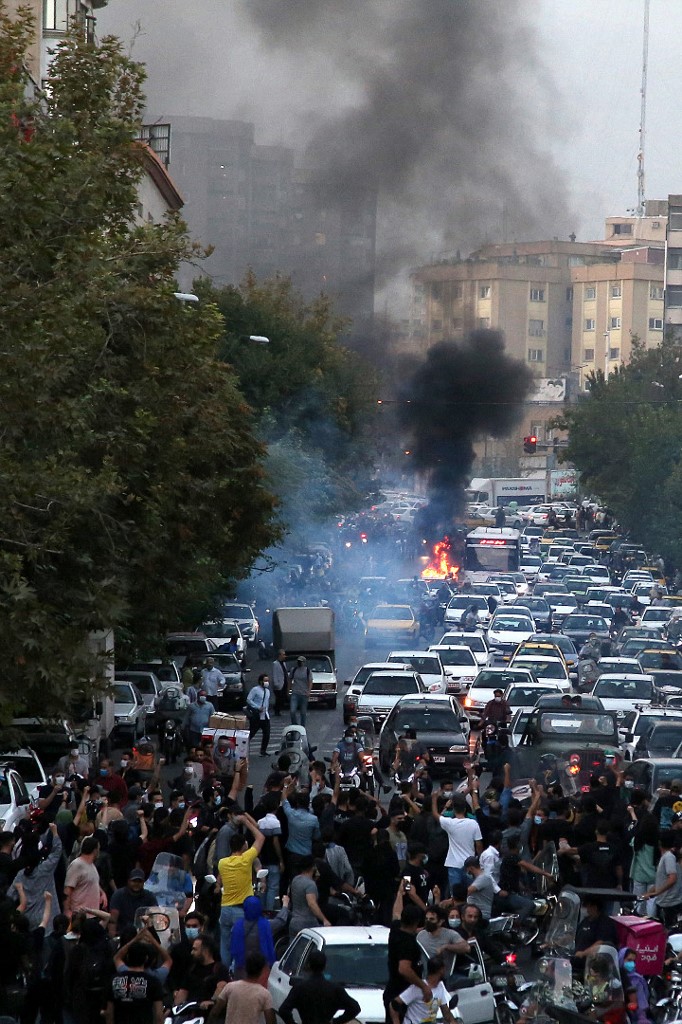
“Death to the dictator” and “Woman, life, freedom,” protesters could be heard shouting in video footage that spread beyond Iran, despite online restrictions first reported by Internet access monitor Netblocks.

Iran moved to further block access to Instagram and WhatsApp on Thursday.

“In accordance with a decision by officials, it has no longer been possible to access Instagram in Iran since yesterday (Wednesday) evening and access to WhatsApp is also disrupted,” the semi-official Fars news agency reported.

The two apps were the most widely used in Iran after the blocking of other platforms in recent years, including Facebook, Twitter, Telegram, YouTube and Tiktok.

UN human rights experts condemned both the “use of physical violence against women” and the “state-mandated Internet disruptions.”

“Disruptions to the Internet are usually part of a larger effort to stifle... free expression... and to curtail ongoing protests,” they said in a statement.

On Thursday, Iranian media said three militiamen “mobilized to deal with rioters” were stabbed or shot dead in northwestern Tabriz, central Qazvin and northeastern Mashhad.

A fourth member of the security forces died in the southern city of Shiraz, the reports said, adding that a protester was stabbed to death in Qazvin, adding to six protester deaths already announced by officials.
But there were fears the death toll could rise, as Norway-based Kurdish rights group Hengaw on Wednesday also reported the deaths of two protesters, aged 16 and 23, in West Azerbaijan province.

The Iranian authorities have denied any involvement in the deaths of protesters.

Amnesty International said it has recorded the deaths of eight people — six men, one woman and a child — with four of them shot by security forces at close range with metal pellets.

The protests are among the most serious in Iran since November 2019 unrest over fuel price rises.

The wave of unrest over Amini’s death “is a very significant shock, it is a societal crisis,” said Iran expert David Rigoulet-Roze of the French Institute for International and Strategic Affairs.


US military transfers first 150 Daesh detainees from Syria to Iraq

Updated 3 sec ago
Follow

US military transfers first 150 Daesh detainees from Syria to Iraq

  • Transfer follows Syrian government forces taking control of Al-Hol camp from SDF
  • US Central Command says up to 7,000 detainees could be transferred to Iraqi-controlled facilities
AL-HOL, Syria: The US military said Wednesday it has started transferring detainees from the Daesh group being held in northeastern Syria to secure facilities in Iraq.
The move came after Syrian government forces took control of a sprawling camp, housing thousands of mostly women and children, from the US-backed Syrian Democratic Forces, or SDF, which withdrew as part of a ceasefire. Troops on Monday seized a prison in the northeastern town of Shaddadeh, where some Daesh detainees escaped and many were recaptured, state media reported.
The Kurdish-led SDF still controls more than a dozen detention facilities holding around 9,000 Daesh members.
US Central Command said the first transfer involved 150 Daesh members, who were taken from Syria’s northeastern province of Hassakah to “secure locations” in Iraq. The statement said that up to 7,000 detainees could be transferred to Iraqi-controlled facilities.
“Facilitating the orderly and secure transfer of Daesh detainees is critical to preventing a breakout that would pose a direct threat to the United States and regional security,” said Adm. Brad Cooper, CENTCOM commander. He said the transfer was in coordination with regional partners, including Iraq.
US troops and their partner forces detained more than 300 Daesh operatives in Syria and killed over 20 last year, the US military said. An ambush last month by Daesh militants killed two US soldiers and one American civilian interpreter in Syria.
An Iraqi intelligence general told The Associated Press that an agreement was reached with the US to transfer 7,000 detainees from Syria to Iraq. He said that Iraqi authorities received the first batch of 144 detainees Wednesday night, after which they will be transferred in stages by aircraft to Iraqi prisons.
The general, who spoke on condition of anonymity because he was not authorized to speak to the media, said the Daesh members who will be transferred to Iraq are of different nationalities. He said they include around 240 Tunisians, in addition to others from countries including Tajikistan and Kazakhstan and some Syrians.
“They will be interrogated and then put on trial. All of them are commanders in Daesh and are considered highly dangerous,” the general said. He added that in previous years, 3,194 Iraqi detainees and 47 French citizens have been transferred to Iraq.

Regional threat despite battle setbacks

The Daesh group was defeated in Iraq in 2017, and in Syria two years later, but the group’s sleeper cells still carry out deadly attacks in both countries. The SDF played a major role in defeating Daesh.
Tom Barrack, the US envoy to Syria, said in a statement on Tuesday that the SDF’s role as the primary anti-Daesh force “has largely expired, as Damascus is now both willing and positioned to take over security responsibilities.”
He added that the “recent developments show the US actively facilitating this transition, rather than prolonging a separate SDF role.”
Syria’s Foreign Ministry welcomed the transfer of detainees, calling it “an important step to strengthen security and stability.”
Earlier on Wednesday, a convoy of armored vehicles with government forces moved into the Al-Hol camp following two weeks of clashes with the SDF, which appeared closer to merging into the Syrian military, in accordance with government demands.
At its peak in 2019, some 73,000 people were living at Al-Hol. Their number has since declined with some countries repatriating their citizens.
The camp is still home to some 24,000, most of them women and children. They include about 14,500 Syrians and nearly 3,000 Iraqis. Some 6,500 others, many of them loyal Daesh supporters who came from around the world to join the extremist group, are separately held in a highly secured section of the camp.
The Syrian government and the SDF announced a new four-day truce on late Tuesday after a previous ceasefire broke down.