

Japan restarts world’s biggest nuclear plant

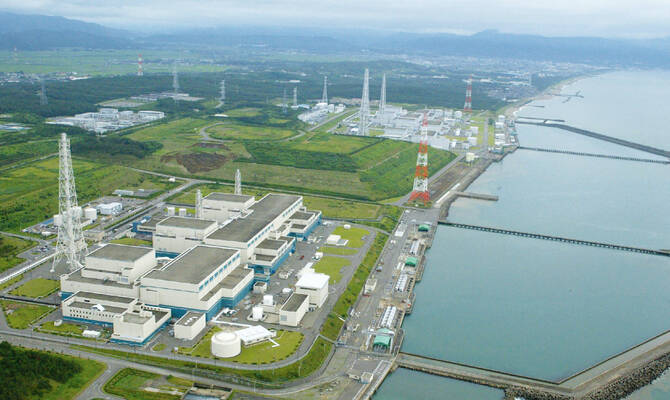
This photo taken on July 16, 2007 shows an aerial view of Tokyo Electric Power Company Kashiwazaki-Kariwa Nuclear Power Plant in Kashiwazaki City, Niigata Prefecture that restarted on Wednesday. (AFP)
Short Url
Updated 22 January 2026
Follow

Japan restarts world’s biggest nuclear plant

  • Japan wants to revive atomic energy to reduce its reliance on fossil fuels

KARIWA: The world’s biggest nuclear power plant was restarted Wednesday for the first time since the 2011 Fukushima disaster, its Japanese operator said, despite persistent safety concerns among residents.

The plant was “started at 19:02” (1002 GMT), Tokyo Electric Power Company spokesman Tatsuya Matoba said of the Kashiwazaki-Kariwa plant in Niigata prefecture.

The regional governor approved the resumption last month, although public opinion remains sharply divided.

On Tuesday, a few dozen protesters — mostly elderly — braved freezing temperatures to demonstrate in the snow near the plant’s entrance, whose buildings line the Sea of Japan coast.

“It’s Tokyo’s electricity that is produced in Kashiwazaki, so why should the people here be put at risk? That makes no sense,” Yumiko Abe, a 73-year-old resident, told AFP.

Around 60 percent of residents oppose the restart, while 37 percent support it, according to a survey conducted in September.

TEPCO said Wednesday it would “proceed with careful verification of each plant facility’s integrity” and address any issues appropriately and transparently.

Kashiwazaki-Kariwa is the world’s biggest nuclear power plant by potential capacity, although just one reactor of seven was restarted.

The facility was taken offline when Japan pulled the plug on nuclear power after a colossal earthquake and tsunami sent three reactors at the Fukushima atomic plant into meltdown in 2011.

However, resource-poor Japan now wants to revive atomic energy to reduce its reliance on fossil fuels, achieve carbon neutrality by 2050 and meet growing energy needs from artificial intelligence.

Prime Minister Sanae Takaichi has voiced support for the energy source.

Fourteen reactors, mostly in western and southern Japan, have resumed operation since the post-Fukushima shutdown under strict safety rules, with 13 running as of mid-January. The vast Kashiwazaki-Kariwa complex has been fitted with a 15-meter-high (50-foot) tsunami wall, elevated emergency power systems and other safety upgrades.

However, residents raised concerns about the risk of a serious accident, citing frequent cover-up scandals, minor accidents and evacuation plans they say are inadequate.


Hundreds of thousands without power after storm lashes France

Updated 6 sec ago
Follow

Hundreds of thousands without power after storm lashes France

  • Around 450,000 households in southern France were without power on Friday, operator Enedis said, a day after a storm tore through the region, ripping up trees and flooding roads
PARIS: Around 450,000 households in southern France were without power on Friday, operator Enedis said, a day after a storm tore through the region, ripping up trees and flooding roads.
High winds and hard rain brought chaos across southern France, northern Spain and parts of Portugal on Thursday, forcing cancelations of flights, trains and ferries and disruption on roads.
French officials said a truck driver was killed when a tree smashed through his windscreen, while dozens were injured in weather-related incidents in Spain and a viaduct in Portugal partially collapsed because of flooding.
French forecasters said the storm, named Nils, was “unusually strong” and France’s electricity distributor said it had mobilized around 3,000 as it battled to reconnect households to the grid.
“Enedis has restored service to 50 percent of the 900,000 customers who were without electricity,” it wrote around 6:00 am (0500 GMT).
“Flooding complicates repairs because the fields are waterlogged and some roads are blocked,” Enedis crisis director Herve Champenois said during a press briefing on Thursday.
Residents across the south of France were shocked at the storm’s ferocity.
“I’ve never seen anything like it,” Ingrid, a florist in the city of Perpignan, told AFP. “A tree almost fell on my car — two seconds more and it would have.”
“During the night, you could hear tiles lifting, rubbish bins rolling down the street — it was crazy,” said Eugenie Ferrier, 32, from the village of Roaillan near Bordeaux in the southwest.
Forecasters said the storm had moved eastwards away from French territory during Thursday, though some areas were still on alert for flooding.