

Iranian activist gets 3-year sentence in prison for sharing video without hijab

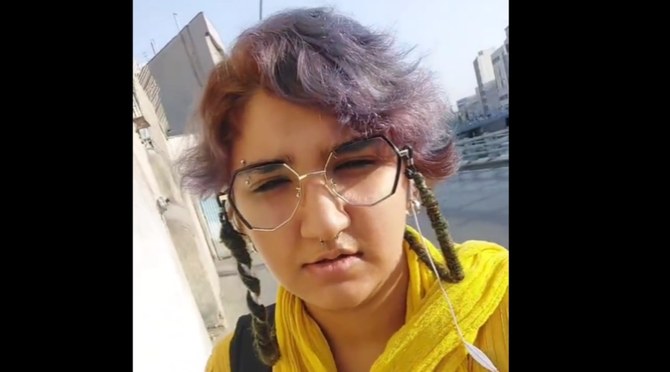
Iranian rights activist Melika Qaragozlu posted a video of herself on social media without the mandatory head covering. (Social media)
Short Url
Updated 21 September 2022
Follow

Iranian activist gets 3-year sentence in prison for sharing video without hijab

DUBAI: An Iranian rights activist has been sentenced to three years and eight months in prison for protesting the country’s mandatory hijab rules, her lawyer said.

Activist Melika Qaragozlu was arrested for appearing on a social media video without wearing the mandatory Islamic headscarf, according to Radio Farda.

Qaragozlu’s sentence was handed down as Iran was hit by widespread protests after the death of a 22-year-old woman while in police custody for breaking hijab rules.

Her lawyer, Mohammad Kamfiruzi, wrote on Twitter that the Islamic Revolutionary Court of Tehran recently handed down the sentence to his client “for publishing a few seconds of video herself without a headscarf on social media.”

In the video, Qaragozlu protested the compulsory Islamic headscarf in Iran as part of a nationwide anti-hijab campaign, where she was a participant, that started in July.

The hijab – the head covering worn by Muslim women – became compulsory in public for Iranian women and girls over the age of nine after the 1979 Islamic Revolution.

Iranian President Ebrahim Raisi ordered authorities to enforce the hijab law more strictly in July. This reportedly resulted in a new list of restrictions on how women shall be dressed in public.

Radio Farda reported that following the presidential order, “women judged not to be in compliance have been barred from government offices, banks and public transportation.”

Several activists have launched a social media campaign under the hashtag #no2hijab, calling on people to boycott companies enforcing tougher restrictions on women outfits.

On July 12, women’s rights activists posted videos of themselves publicly removing their veils to coincide with the government’s National Day of Hijab and Chastity.


Baghdad traders protest new customs tariffs

Iraqi traders protest against the imposition of customs duties on imported goods in Baghdad, Iraq, Sunday, Feb. 8, 2026. (AP)
Updated 57 min 51 sec ago
Follow

Baghdad traders protest new customs tariffs

  • The demonstrators gathered outside the General Customs Directorate on Sunday, chanting slogans against corruption and rejecting the new fees

BAGHDAD: Hundreds of traders and owners of customs clearance companies protested in central Baghdad on Sunday, demanding that Iraq’s government reverse recently imposed customs tariffs they say have sharply increased their costs and disrupted trade.
The new tariffs that took effect on Jan. 1 were imposed to reduce the country’s debt and reliance on oil revenues, as oil prices have fallen.
Iraq faces a debt of more than 90 trillion Iraqi dinars ($69 billion) — and a state budget that remains reliant on oil for about 90 percent of revenues, despite attempts to diversify.

We used to pay about 3 million dinars per container, but now in some cases they ask for up to 14 million.

Haider Al-Safi, Company owne

But traders say the new tariffs — in some cases as high as 30 percent — have placed an unfair burden on them. Opponents have filed a lawsuit aiming to reduce the decision, which Iraq’s Federal Supreme Court is set to rule on Wednesday.
The demonstrators gathered outside the General Customs Directorate on Sunday, chanting slogans against corruption and rejecting the new fees.
“We used to pay about 3 million dinars per container, but now in some cases they ask for up to 14 million,” said Haider Al-Safi, a transport and customs clearance company owner. 
“Even infant milk fees rose from about 495,000 dinars to nearly 3 million.”
He said that the new tariffs have caused a backlog of goods at the Umm Qasr port in southern Iraq and added that electric vehicles, previously exempt from customs duties, are now subject to a 15 percent fee.
“The main victim is the citizen with limited income, and government employee whose salary barely covers his daily living, those who have to pay rent, and have children with school expenses — they all will be affected by the market,” said Mohammed Samir, a wholesale trader from Baghdad.
Protesters also accused influential groups of facilitating the release of goods in exchange for lower unofficial payments, calling it widespread corruption. 
Many traders, they said, are now considering routing their imports through the Kurdistan region, where fees are lower.
The protests coincided with a nationwide strike by shop owners, who closed markets and stores in several parts of Baghdad to oppose the tariff increase. 
In major commercial districts, shops remained shut and hung up banners reading “Customs fees are killing citizens.”