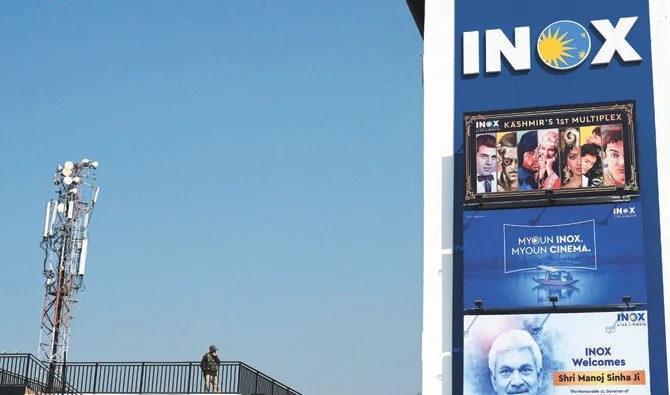

NEW DELHI: Movies are set to return to the big screens in Kashmir Valley after more than two decades, as a top Indian government inaugurated on Tuesday a multi-screen cinema hall in Srinagar, which he said represented a “new dawn” for the volatile region.
Srinagar, the largest city in the disputed Muslim-majority region, had over a dozen theaters before an armed anti-India rebellion broke out in 1989 and gripped the valley, forcing its last cinema hall to close in 1999.
Indian multiplex chain Inox will be the city’s first multi-screen cinema hall since then, with screenings scheduled to start from the end of September. Over the weekend, Administrator of Jammu and Kashmir Manoj Sinha inaugurated two theaters in Shopian and Pulwama, two militancy-scarred districts of the region.
“It is a reflection of a new dawn of hope, dreams, confidence and aspirations of people,” Sinha said at the inauguration on Tuesday.
“The government in Delhi is very clear…that it does not believe in buying peace but establishing peace, and for that we are making efforts,” he added.
For Vijay Dhar, a Srinagar-based entrepreneur who took the initiative to open theaters in Kashmir and has been working with Inox to make that happen, it was a dream come true.
“We were running theater halls when they were closed down in the 1990s. It was already in my DNA to have an entertainment center,” Dhar told Arab News.
Though he is aware there is a security risk in the valley, Dhar said his decision to open the theater in the valley was sincere.
“My idea is that if a movie is released in Mumbai, it should be released in Kashmir,” he said. “This is from our heart, our contribution to Kashmir and to the people. The question of security does not arise.”
Kashmir is claimed in full but ruled in part by nuclear-arch rivals India and Pakistan, who have fought two wars for control of the territory.
The region of Jammu and Kashmir, which is controlled by India, has been witnessing a wave of deadly attacks since August 2019, when the government abrogated the Muslim-majority region’s limited constitutional autonomy to bring it under the direct rule of New Delhi.
As the cinemas’ return makes headlines across India, residents of the valley are questioning the initiative.
Prof. Siddiq Wahid, a Srinagar-based political analyst, called it a “non-event.”
“If the intent is a projection of some sort of victory over extremism, then it is a cheap attempt at politicization. If it is crony capitalism at work, then it is a corruption story. My suspicion is that it is a combination of both, so in real terms: a non-event,” Wahid told Arab News.
Srinagar resident Sandeep Kaul said he will “think many times” before going to the cinema.
“I feel the government should have first created a conducive atmosphere for security before promoting entertainment in the valley,” Kaul told Arab News. “For me, it would be taking a grave risk considering the prevailing security situation in the valley.”
Deeba Ashraf, a lawyer based in the city, told Arab News that Kashmir residents “don’t need theaters.”
“We need better transport facilities, better educational system, better jobs, better healthcare facilities,” Ashraf said.
The opening of the theaters in Kashmir is part of the government’s attempt “to portray normalcy,” Aijaz Ahmad, a businessman based in Srinagar, told Arab News.
“But we all know how the situation is in the region,” Ahmad said.