

China doubles down on coal as energy crunch bites

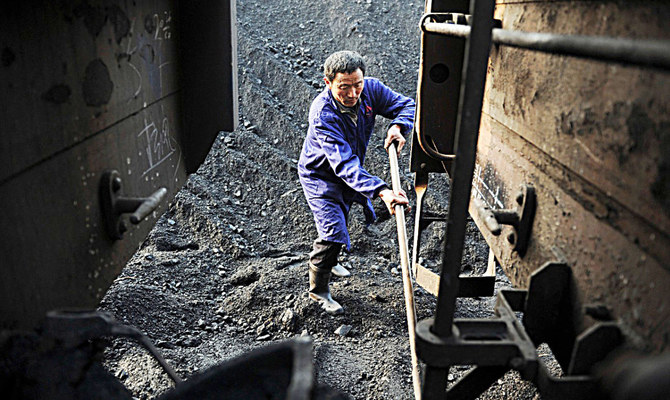
China has stepped up spending on coal in the face of extreme weather and rising global fuel prices. (Reuters/File)
Short Url
Updated 18 September 2022
Follow

China doubles down on coal as energy crunch bites

BEIJING: China has stepped up spending on coal in the face of extreme weather, a domestic energy crunch and rising global fuel prices — raising concerns Beijing’s policies may hinder the fight against climate change.

The country is the world’s biggest emitter of the greenhouse gases driving global warming, and President Xi Jinping has vowed to reduce coal use from 2026 as part of a broad set of climate promises.

Beijing has committed to peaking its carbon emissions by 2030 and achieving carbon neutrality by 2060.

Overall carbon emissions in China have fallen for four consecutive quarters on the back of an economic slowdown, research reported by climate monitor Carbon Brief showed in early September.

But at the same time, slowing growth has led authorities to rely on smokestack industries in an effort to boost the economy.

The push to shore up coal power — which still makes up most of China’s energy supply — has alarmed analysts who warn that it will make an eventual transition to a renewables-dominated energy mix more difficult.

Spooked by an energy shortage last autumn, Chinese authorities in spring ordered coal producers to add 300 million tons of mining capacity this year — the equivalent of an extra month of coal production for the country.

In just the first quarter of 2022, regulators endorsed the equivalent of half the entire coal-fired power plant capacity approved in 2021, according to Greenpeace.

Authorities have also burned and mined more coal in recent weeks in order to meet increased air conditioning demand and make up for shrunken hydropower dams during China’s hottest-ever summer. Premier Li Keqiang in June called for “releasing advanced coal capacity, as much as possible, and implementing long-term coal supply.”

The independent Climate Action Tracker warns that even the “most binding” climate targets laid out by Beijing would be in line with global warming of between 3-4 degrees Celsius before the end of the century — well above the Paris Agreement’s goal to limit global warming to 1.5 C.

To meet that goal, it said, China would “need to reduce emissions as early as possible and well before 2030” — as well as “decrease coal and other fossil fuel consumption at a much faster rate than currently planned.”

China has made real progress in building up renewable energy capacity.

The current operating solar capacity in the country accounts for nearly half the global total, according to San Francisco-based nongovernmental organization Global Energy Monitor.

But unlike wind or sunlight, stockpiles of coal and gas can be held for long periods of time and deployed as needed, giving local authorities a sense of security.


Lebanese social entrepreneur Omar Itani recognized by Schwab Foundation

Updated 23 January 2026
Follow

Lebanese social entrepreneur Omar Itani recognized by Schwab Foundation

  • FabricAID co-founder among 21 global recipients recognized for social innovation

DAVOS: Lebanon’s Omar Itani is one of 21 recipients of the Social Entrepreneurs and Innovators of the Year Award by the Schwab Foundation for Social Entrepreneurship.

Itani is the co-founder of social enterprise FabricAID, which aims to “eradicate symptoms of poverty” by collecting and sanitizing secondhand clothing before placing items in stores in “extremely marginalized areas,” he told Arab News on the sidelines of the World Economic Forum in Davos, Switzerland.

With prices ranging from $0.25 to $4, the goal is for people to have a “dignified shopping experience” at affordable prices, he added.

FabricAID operates a network of clothing collection bins across key locations in Lebanon and Jordan, allowing people to donate pre-loved items. The garments are cleaned and sorted before being sold through the organization’s stores, while items that cannot be resold due to damage or heavy wear are repurposed for other uses, including corporate merchandise.

Since its launch, FabricAID has sold more than 1 million items, reached 200,000 beneficiaries and is preparing to expand into the Egyptian market.

Amid uncertainty in the Middle East, Itani advised young entrepreneurs to reframe challenges as opportunities.

“In Lebanon and the Arab world, we complain a lot,” he said. Understandably so, as “there are a lot of issues” in the region, resulting in people feeling frustrated and wanting to move away. But, he added, “a good portion of the challenges” facing the Middle East are “great economic and commercial opportunities.”

Over the past year, social innovators raised a combined $970 million in funding and secured a further $89 million in non-cash contributions, according to the Schwab Foundation’s recent report, “Built to Last: Social Innovation in Transition.”

This is particularly significant in an environment of geopolitical uncertainty and at a time when 82 percent report being affected by shrinking resources, triggering delays in program rollout (70 percent) and disruptions to scaling plans (72 percent).

Francois Bonnici, director of the Schwab Foundation for Social Entrepreneurship and a member of the World Economic Forum’s Executive Committee, said: “The next decade must move the models of social innovation decisively from the margins to the mainstream, transforming not only markets but mindsets.”

Award recipients take part in a structured three-year engagement with the Schwab Foundation, after which they join its global network as lifelong members. The program connects social entrepreneurs with international peers, collaborative initiatives, and capacity-building support aimed at strengthening and scaling their work.