SAMARKAND, Uzbekistan: Russian President Vladimir Putin vowed Friday to press his attack on Ukraine despite Kyiv’s latest counteroffensive and warned that Moscow could ramp up its strikes on the country’s vital infrastructure if Ukrainian forces target facilities in Russia.
Speaking to reporters Friday after attending a summit of the Shanghai Cooperation Organization in Uzbekistan, Putin said the “liberation” of Ukraine’s entire eastern Donbas region remained Russia’s main military goal and that he sees no need to revise it.
“We aren’t in a rush,” the Russian leader said, adding that Moscow has only deployed volunteer soldiers to fight in Ukraine. Some hard-line politicians and military bloggers have urged the Kremlin to follow Ukraine’s example and order a broad mobilization to beef up the ranks, lamenting Russia’s manpower shortage.
Russia was forced to pull back its forces from large swaths of northeastern Ukraine last week after a swift Ukrainian counteroffensive. Ukraine’s move to reclaim control of several Russian-occupied cities and villages marked the largest military setback for Moscow since its forces had to retreat from areas near the capital early in the war.
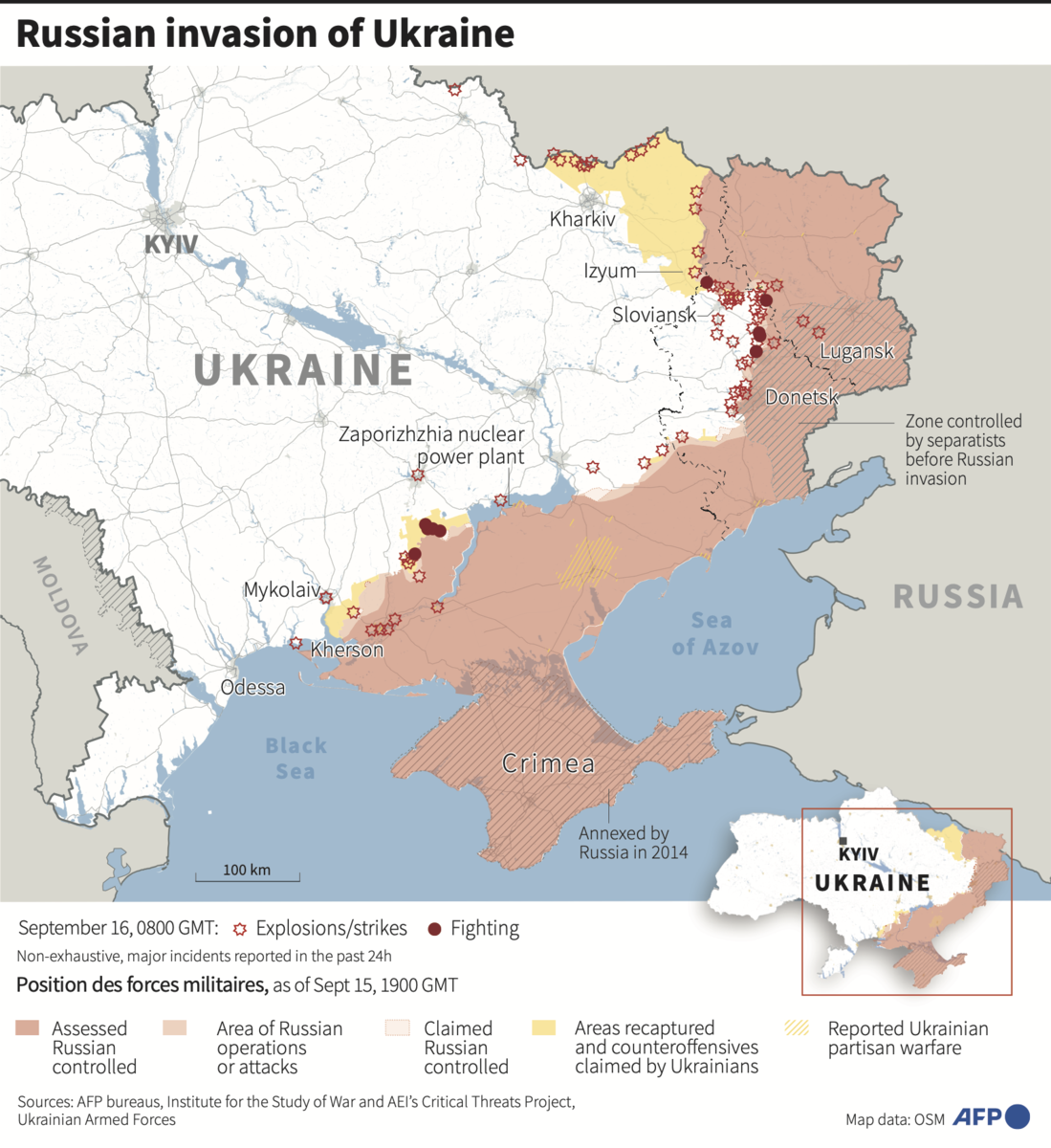
In his first comment on the Ukrainian counteroffensive, Putin said: “Let’s see how it develops and how it ends.”
He noted that Ukraine has tried to strike civilian infrastructure in Russia and “we so far have responded with restraint, but just yet.”
“If the situation develops this way, our response will be more serious,” Putin said.
“Just recently, the Russian armed forces have delivered a couple of impactful strikes,” he said in an apparent reference to Russian attacks earlier this week on power plants in northern Ukraine and a dam in the south. ”Let’s consider those as warning strikes.”
He alleged, without offering specifics, that Ukraine has attempted to launch attacks “near our nuclear facilities, nuclear power plants,” adding that “we will retaliate if they fail to understand that such methods are unacceptable.”
Russia has reported numerous explosions and fires at civilian infrastructure in areas near Ukraine, as well munitions depots and other facilities. Ukraine has claimed responsibility for some of the attacks and refrained from commenting on others.
Putin also sought Friday to assuage India’s concern about the conflict in Ukraine, telling Indian Prime Minister Narendra Modi that Moscow wants to see a quick end to the fighting and alleging that Ukrainian officials won’t negotiate.
“I know your stand on the conflict in Ukraine and the concerns that you have repeatedly voiced,” the Russian leader told Modi. “We will do all we can to end that as quickly as possible. Regrettably, the other side, the leadership of Ukraine, has rejected the negotiations process and stated that it wants to achieve its goals by military means, on the battlefield.”
Ukrainian President Volodymyr Zelensky says it’s Russia that allegedly doesn’t want to negotiate in earnest. He also has insisted on the withdrawal of Russian troops from occupied areas of Ukraine as a precondition for talks.
Putin’s remarks during the talks with Modi echoed comments the Russian leader made during Thursday’s meeting with Chinese President Xi Jinping when Putin thanked him for his government’s “balanced position” on the Ukraine war, while adding that he was ready to discuss China’s unspecified “concerns” about Ukraine.
Speaking to reporters Friday, Putin said he and Xi “discussed what we should do in the current conditions to efficiently counter unlawful restrictions” imposed by the West. The European Union, the United States and other Western nations have put sanctions on Russian energy due to the war in Ukraine.
Xi, in a statement released by his government, expressed support for Russia’s “core interests” but also interest in working together to “inject stability” into world affairs. China’s relations with Washington, Europe, Japan and India have been strained by disputes about technology, security, human rights and territory.
Zhang Lihua, an international relations expert at Tsinghua University, said the reference to stability “is mainly related to China-US relations,” adding that “the United States has been using all means to suppress China, which forced China to seek cooperation with Russia.”
China and India have refused to join Western sanctions against Russia over its war in Ukraine while increasing their purchases of Russian oil and gas, helping Moscow offset the financial restrictions imposed by the US and its allies.
Putin also met Friday with Turkish President Recep Tayyip Erdogan to discuss bolstering economic cooperation and regional issues, including a July deal brokered by Turkey and the United Nations that allowed Ukrainian grain exports to resume from the country’s Black Sea ports.
Speaking at the Uzbekistan summit on Friday, Xi warned his Central Asian neighbors not to allow outsiders to destabilize them. The warning reflects Beijing’s anxiety that Western support for democracy and human rights activists is a plot to undermine Xi’s ruling Communist Party and other authoritarian governments.
“We should prevent external forces from instigating a color revolution,” Xi said in a speech to the leaders of Shanghai Cooperation Organization member nations, referring to protests that toppled unpopular regimes in the former Soviet Union and the Middle East.
Xi offered to train 2,000 police officers, to set up a regional counterterrorism training center and to “strengthen law enforcement capacity building.” He did not elaborate.
His comments echoed longtime Russian grievances about the color-coded democratic uprisings in several ex-Soviet nations that the Kremlin viewed as instigated by the US and its allies.
Xi is promoting a “Global Security Initiative” announced in April following the formation of the Quad by the US, Japan, Australia and India in response to Beijing’s more assertive foreign policy. US officials complain it echoes Russian arguments in support of Moscow’s actions in Ukraine.
Central Asia is part of China’s multibillion-dollar Belt and Road Initiative to expand trade by building ports, railways and other infrastructure across an arc of dozens of countries from the South Pacific through Asia to the Middle East, Europe and Africa.
The Shanghai Cooperation Organization was formed by Russia and China as a counterweight to US influence. The group also includes India, Pakistan and the four ex-Soviet Central Asian nations of Kazakhstan, Kyrgyzstan, Tajikistan and Uzbekistan. Iran is on track to receive full membership.