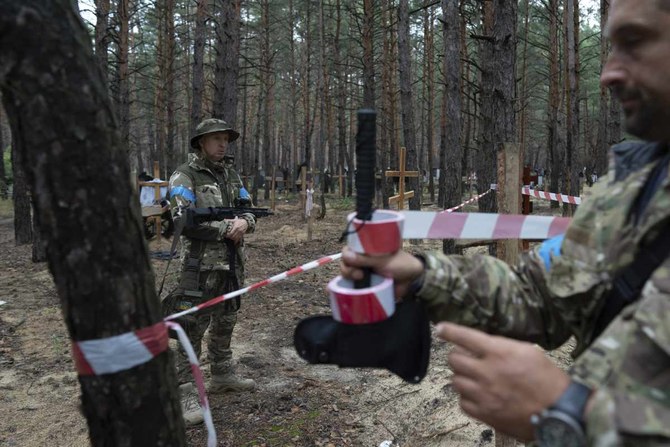
Ukraine says mass grave found in Izium where Russians were ousted days ago

Oleg Kotenko, Ukrainian commissioner for Issues of Missing Persons under Special Circumstances (left) inspect a mass grave in Izium that was recently retaken from Russian forces. (AP)
Short Url
Updated 16 September 2022
Follow

Ukraine says mass grave found in Izium where Russians were ousted days ago

  • More than 440 bodies in grave in northeastern town: police
  • Zelensky blames Russia and says it must be held responsible

KYIV: Ukrainian authorities found a mass grave of more than 440 bodies in the northeastern town of Izium that was recaptured from Russian forces days ago, a regional police official said, adding some of the people had been killed by shelling and air strikes.
Thousands of Russian troops fled Izium last weekend after occupying the city and using it as a logistics hub in the Kharkiv region. They left behind large amounts of ammunition and equipment.
“I can say it is one of the largest burial sites in a big town in liberated (areas)... 440 bodies were buried in one place,” Serhiy Bolvinov, the chief police investigator for Kharkiv region, told Sky News. “Some died because of artillery fire ... some died because of air strikes.”
Reuters could not immediately verify the Ukrainian claim and there was no immediate public comment from Russia on the allegation.
President Volodymyr Zelensky, who had paid a surprise visit to Izium on Wednesday to greet Ukrainian troops, put the blame on Russia and likened the discovery to what happened in Bucha, on the outskirts of the capital Kyiv in the early stages of the late February invasion by Russian forces.
Ukraine and its Western allies have accused Russian forces of perpetrating war crimes there. Tens of thousands of civilians were likely killed in a separate Russian assault on the southern port of Mariupol, Ukrainian officials said in April.
“Russia is leaving death behind it everywhere and must be held responsible,” Zelensky said in a video address late on Thursday.
Russia has denied targeting civilians or committing war crimes.

Fortifying
After a week of rapid Ukrainian gains in the northeast, Ukrainian officials said Russian forces were fortifying defenses and it would be hard to maintain the pace of the advance.
Russian President Vladimir Putin has yet to comment publicly on the setback suffered by his forces this month. Ukrainian officials say 9,000 sq km (3,400 sq miles) has been retaken, territory about the size of the island of Cyprus.
Footage shot by Reuters on Thursday in the eastern town of Kupiansk, which Ukrainian forces recaptured last week, showed many buildings had been damaged or burned out.
“No electricity, no communications ... if there were communications we could least talk to family. If only there hadn’t been all this bombing with everyone in their basements,” said one man.
The speed of the advance has lifted hopes of further gains before the winter sets in.
But Serhiy Gaidai, governor of Ukraine’s eastern Luhansk region, said it would still be a tough fight to wrest control of his region back from Russia, which recognizes it as an independent state controlled by separatists.
There was no let-up either in Russia’s daily missile strikes on Thursday, a day after it fired cruise missiles at a reservoir dam near Kryvyi Rih, Zelensky’s hometown in central Ukraine.
Authorities in Kryvyi Rih are working to repair the damage and as a result water levels are receding, said Kyrylo Tymoshenko, deputy head of the presidential administration.
Ukrainian forces repelled three Russian attacks north of the city of Donetsk, the armed forces’ general staff said in a Facebook post.
Russian forces had launched attacks on several settlements on the Kharkiv frontline in the past 24 hours, the General Staff of Ukraine’s Armed Forces said.
Reuters was not able to verify battlefield reports.

China's concern about Ukraine
Russia’s Putin said on Thursday he understood China’s leader Xi Jinping had concerns about the crisis in Ukraine, a surprise acknowledgement of friction with Beijing over the war.
Since Russia invaded Ukraine, China has trod a careful line, criticizing Western sanctions against Moscow but stopping short of endorsing or assisting in the military campaign.
“We highly value the balanced position of our Chinese friends when it comes to the Ukraine crisis,” Putin told Xi in Uzbekistan at their first meeting since the war began.
“We understand your questions and concern about this. During today’s meeting, we will of course explain our position.”
Xi did not mention Ukraine in his public remarks, nor was it mentioned in a Chinese account of the meeting.
Russian Foreign Minister Sergei Lavrov later told reporters the talks with China had been excellent.
The last time Putin and Xi met they signed a “no limits” friendship agreement between their countries. Three weeks later, Russia invaded Ukraine in what it called a “special military operation” to “disarm” its smaller neighbor.

Ukraine and the West accuse Russia of an unprovoked war of aggression. Pope Francis said it was morally legitimate for nations to supply weapons to Ukraine to help the country defend itself from Russian aggression.
“This is a political decision which it can be moral, morally acceptable, if it is done under conditions of morality,” Francis said in an airborne news conference while traveling from a trip to Kazakhstan.
Francis also urged the Kyiv government to be open to eventual dialogue, even though it may “smell” because it would be difficult for the Ukrainian side.
In Washington, US officials said the United States will soon announce a new $600 million weapons package for Ukraine’s military.


Court ruling jeopardizes freedom for pro-Palestinian activist Mahmoud Khalil

Updated 15 January 2026
Follow

Court ruling jeopardizes freedom for pro-Palestinian activist Mahmoud Khalil

  • The panel ruled a federal judge in New Jersey didn’t have jurisdiction to decide the matter at this time
  • The law bars Khalil “from attacking his detention and removal in a habeas petition,” the panel added

WASHINGTON: A federal appeals panel on Thursday reversed a lower court decision that released former Columbia University graduate student Mahmoud Khalil from an immigration jail, bringing the government one step closer to detaining and ultimately deporting the Palestinian activist.
The three-judge panel of the 3rd US Circuit Court of Appeals didn’t decide the key issue in Khalil’s case: whether the Trump administration’s effort to throw Khalil out of the US over his campus activism and criticism of Israel is unconstitutional.
But in its 2-1 decision, the panel ruled a federal judge in New Jersey didn’t have jurisdiction to decide the matter at this time. Federal law requires the case to fully move through the immigration courts first, before Khalil can challenge the decision, they wrote.
“That scheme ensures that petitioners get just one bite at the apple — not zero or two,” the panel wrote. “But it also means that some petitioners, like Khalil, will have to wait to seek relief for allegedly unlawful government conduct.”
The law bars Khalil “from attacking his detention and removal in a habeas petition,” the panel added.
Ruling won’t result in immediate detention
It was not clear whether the government would seek to detain Khalil, a legal permanent resident, again while his legal challenges continue.
Thursday’s decision marked a major win for the Trump administration’s sweeping campaign to detain and deport noncitizens who joined protests against Israel.
In a statement distributed by the American Civil Liberties Union, Khalil said the appeals ruling was “deeply disappointing, but it does not break our resolve.”
He added: “The door may have been opened for potential re-detainment down the line, but it has not closed our commitment to Palestine and to justice and accountability. I will continue to fight, through every legal avenue and with every ounce of determination, until my rights, and the rights of others like me, are fully protected.”
Baher Azmy, one of Khalil’s lawyers, said the ruling was “contrary to rulings of other federal courts.” He noted the panel’s finding concerned a “hypertechnical jurisdictional matter,” rather than the legality of the Trump administration’s policy.
“Our legal options are by no means concluded, and we will fight with every available avenue,” he added, saying Khalil would remain free pending the full resolution of all appeals, which could take months or longer.
The ACLU said the Trump administration cannot lawfully re-detain Khalil until the order takes formal effect, which won’t happen while he can still immediately appeal.
Khalil has multiple options to appeal
Khalil’s lawyers can request the active judges on the 3rd Circuit hear an appeal, or they can go to the US Supreme Court.
An outspoken leader of the pro-Palestinian movement at Columbia, Khalil was arrested on March 8, 2025. He then spent three months detained in a Louisiana immigration jail, missing the birth of his firstborn.
Federal officials have accused Khalil of leading activities “aligned to Hamas,” though they have not presented evidence to support the claim and have not accused him of criminal conduct. They have also accused Khalil, 30, of failing to disclose information on his green card application.
The government has justified the arrest under a seldom-used statute that allows for the expulsion of noncitizens whose beliefs are deemed to pose a threat to US foreign policy interests.
In June, a federal judge in New Jersey ruled that justification would likely be declared unconstitutional and ordered Khalil released.
President Donald Trump’s administration appealed that ruling, arguing the deportation decision should fall to an immigration judge, rather than a federal court.
Khalil has dismissed the allegations as “baseless and ridiculous,” framing his arrest and detention as a “direct consequence of exercising my right to free speech as I advocated for a free Palestine and an end to the genocide in Gaza.”
Dissenting judge says Khalil has right to fight detention

Judge Arianna Freeman dissented Thursday, writing that her colleagues were holding Khalil to the wrong legal standard. Khalil, she wrote, is raising “now-or-never claims” that can be handled at the district court level. He does not have a final order of removal, which would permit a challenge in an appellate court, she wrote.
Both judges who ruled against Khalil, Thomas Hardiman and Stephanos Bibas, were Republican appointees. President George W. Bush appointed Hardiman to the 3rd Circuit, while Trump appointed Bibas. President Joe Biden, a Democrat, appointed Freeman.
The majority opinion noted Freeman worried the ruling would leave Khalil with no remedy for unconstitutional immigration detention, even if he later can appeal.
“But our legal system routinely forces petitioners — even those with meritorious claims — to wait to raise their arguments, the judges wrote. “To be sure, the immigration judge’s order of removal is not yet final; the Board has not affirmed her ruling and has held the parties’ briefing deadlines in abeyance pending this opinion. But if the Board ultimately affirms, Khalil can get meaningful review.”
The decision comes as an appeals board in the immigration court system weighs a previous order that found Khalil could be deported. His attorneys have argued that the federal order should take precedence.
That judge has suggested Khalil could be deported to Algeria, where he maintains citizenship through a distant relative, or Syria, where he was born in a refugee camp to a Palestinian family.
His attorneys have said he faces mortal danger if forced to return to either country.