

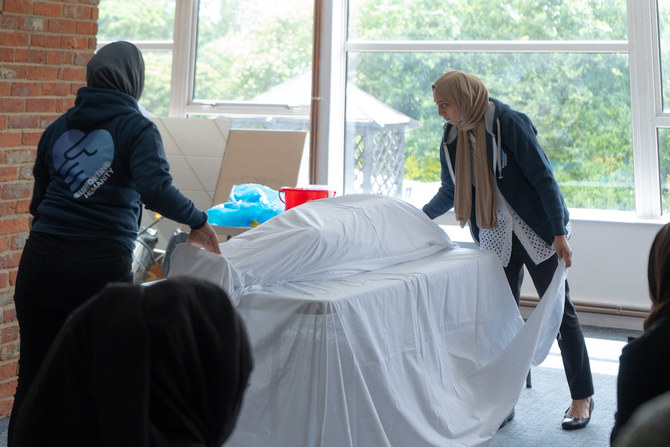
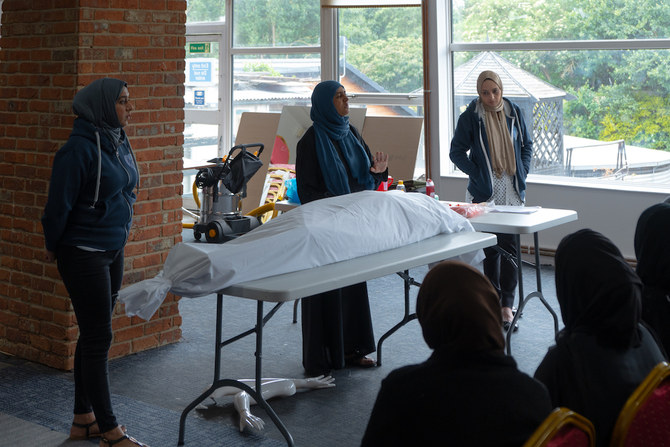

LONDON: A British bereavement charity is set to resume a series of workshops next month to teach young people the Islamic practice of washing and shrouding a dead body, following an increase in demand after the COVID-19 pandemic.
Supporting Humanity, which is based in London and also provides mental health support for minority communities, launched the ghusl workshops in February. In the last few months it has seen an interest from Muslim communities and universities across Britain.
“Supporting Humanity has been running some ghusl workshops for the past few months. They basically are washing and shrouding of the body in an Islamic manner, and we have been teaching females from across the area, and more broader across London, about how to do this procedure for family and friends and become volunteers themselves around it,” Sumaiya Khoda, trustee at Supporting Humanity, told Arab News.
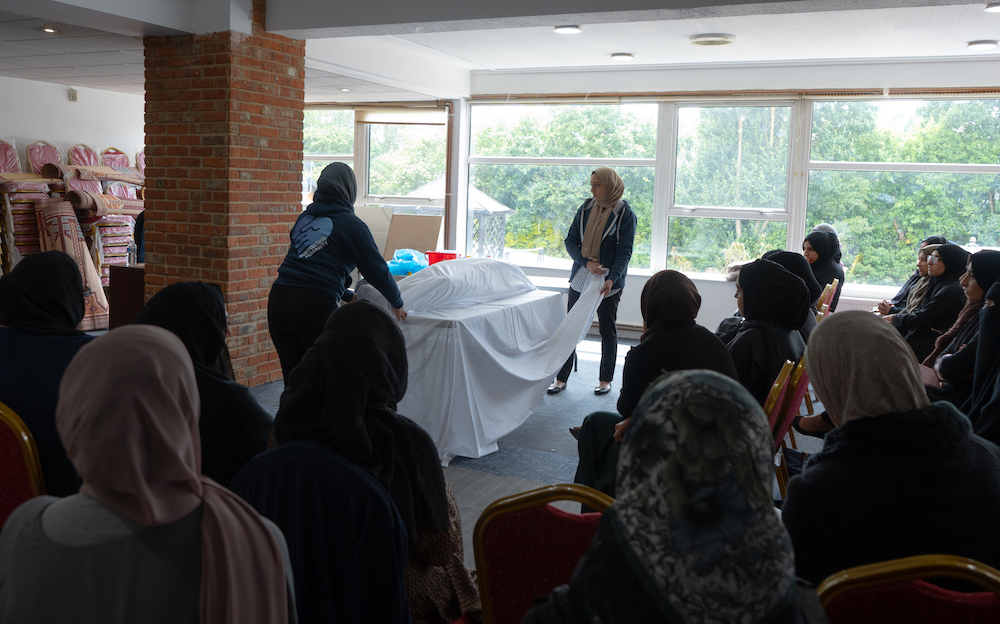
In Islam, the preparation for the burial should take place as soon as possible after death. (AN Photo/Sarah Glubb)
In Islam, the preparation for the burial should take place as soon as possible after death. The body is washed and then wrapped in a clean and perfumed white shroud, while the hair is combed and, if female, braided. Usually, the relatives of the deceased are involved in the procedure along with an expert guide.
“Although we initially anticipated only doing three, because it’s such a popular demand we’re actually going to continue with running these and looking to offer them more nationally, because we’re getting reach out for people to teach the practice across England,” Khoda added.
She said the charity was looking to broaden the initiative to young males as well.
“Surprisingly, it’s become increasingly popular. So most of the people coming to them is coming through word of mouth, because people are going away feeling quite enlightened with the knowledge and understanding, (and) breaking myths that they thought were around it,” Khoda said.

Supporting Humanity, which is based in London and also provides mental health support for minority communities, launched the ghusl workshops in February. (AN Photo/Sarah Glubb)
“We do support anybody from any community that wants support with the burial process, and we do have engagement with the coroners … but in terms of the burial itself, we are adhering to Islamic principles for burial,” Khoda said.
She added that when it comes to the burial procedure, there are limited distinctions made between the different casts of Sunni and Shiite, but the workshops were following the Sunni method of burial.
Previously, the elderly women in the Muslim community used to take on this responsibility. However during the pandemic people over 60, those with chronic conditions, or those considered high risk had to protect themselves, and they struggled to find younger females who were able to take on the task, said Tahreem Noor, head of operations and communications at Supporting Humanity.
“We need to teach people how to do it, especially the youth, we need to show them that it’s an important part of our culture, our religion, and we need to promote it as something that is rewarding, elevating. It liberates you as a Muslim who goes into a wash and shroud room to wash a body, because you have just prepared that body to meet Allah and that is the most precious part of that person’s journey,” she said.
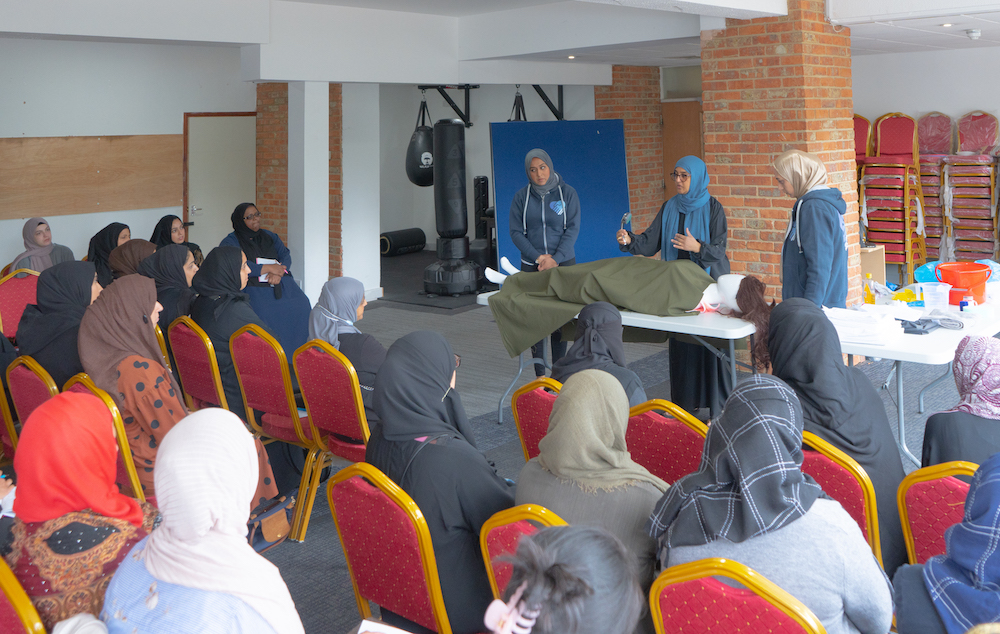
The charity is looking to broaden the initiative to young males as well, and are in talks to hold the workshops in universities. (AN Photo/Sarah Glubb)
“We think helping them throughout their life would be, whereas it’s not, it’s actually the end of their life, where you’ve really treated them with utmost respect, you’ve treated that female body with dignity, you’ve given them the modesty that they’ve always preserved throughout their life, and you follow the Sunnah (way of the Prophet Muhammad),” Noor added.
She said the purpose of the workshops was also to destigmatize the myths that come with washing and shrouding, and raise awareness on a more nationwide scale, adding that the next set of workshops, which are held on a monthly basis, will recommence on Sept. 25.
Salma Patel, lead facilitator at the ghusl workshop, said she was approached during the pandemic to help wash and shroud and in the last three years has done thousands of ghusls and gained vast experience.
She instructed the attendees on personal protective equipment, how they should be dressed, have their hair covered, and to have performed ablution before beginning the process.
“We are not to see any part of their body apart from their face, hands and feet, and the way that we’ve got to wash them, just like we normally would wash ourselves, washing all the private parts is very, very important. So we make sure all that is clean, and then how we’ve got to dry them,” Patel said.
She also dealt with some myths regarding the process of embalming the body if it is to be transported to another country. It is forbidden in Islam to have the body meant for transport to be drained of blood and then filled with an alcohol-based substance.
She answered questions on whether hair, eye and nail extensions should be removed, or any artificial materials attached to the body. This should be dealt with carefully as the deceased person feels pain “70 or 100 times more.” She also tackled a myth on whether females can perform the process while on their menstrual cycle.
“I have most of them coming up to me saying it is brilliant, because there’s a lot of things that they didn’t know, there was a lot of myths. Basically I’ve cleared the myths especially, so I think everybody has been really happy,” Patel added.


