

Sick dolphin calf improves with tube-fed milk, helping hands

1 / 2
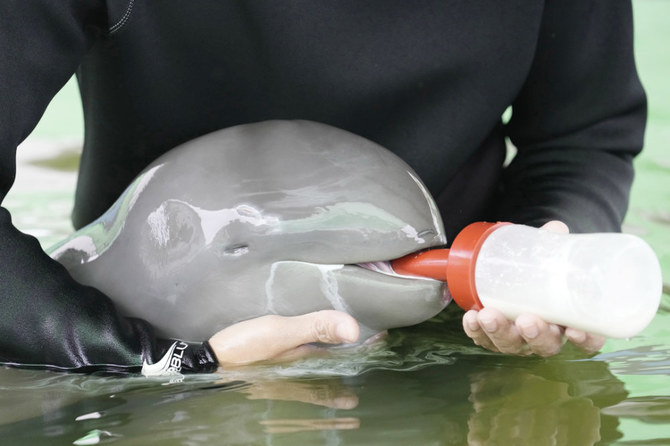
Volunteer Tosapol Prayoonsuk feeds a baby dolphin nicknamed Paradon with milk at the Marine and Coastal Resources Research and Development Center in Rayong province in eastern Thailand, Friday, Aug. 26, 2022. (AP)
2 / 2
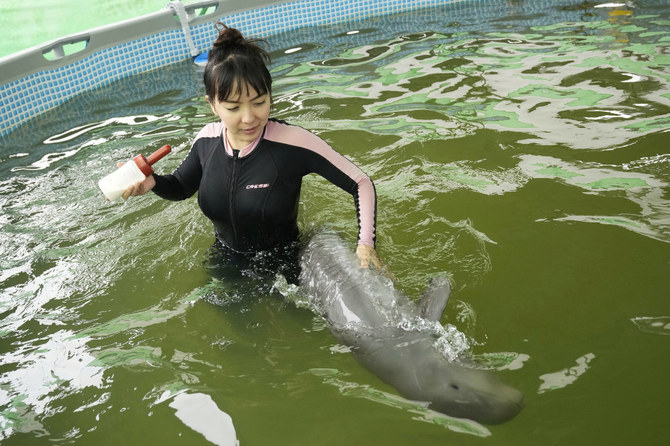
Volunteer Thippunyar Thipjuntar takes care of a baby dolphin nicknamed Paradon at the Marine and Coastal Resources Research and Development Center in Rayong province in eastern Thailand, Friday, Aug. 26, 2022. (AP)
Short Url
Updated 28 August 2022
Follow

Sick dolphin calf improves with tube-fed milk, helping hands

  • Irrawaddy dolphins, considered a vulnerable species by International Union for Conservation of Nature, are found in the shallow coastal waters of South and Southeast Asia and in three rivers in Myanmar, Cambodia and Indonesia

RAYONG, Thailand: The Irrawaddy dolphin calf — sick and too weak to swim — was drowning in a tidal pool on Thailand’s shore when fishermen found him.
The fishermen quickly alerted marine conservationists, who advised them how to provide emergency care until a rescue team could transport the baby to Thailand’s Marine and Coastal Resources Research and Development Center for veterinary attention.
The baby was nicknamed Paradon, roughly translated as “brotherly burden,” because those involved knew from day one that saving his life would be no easy task.
Irrawaddy dolphins, considered a vulnerable species by International Union for Conservation of Nature, are found in the shallow coastal waters of South and Southeast Asia and in three rivers in Myanmar, Cambodia and Indonesia. Their survival is threatened by habitat loss, pollution and illegal fishing.
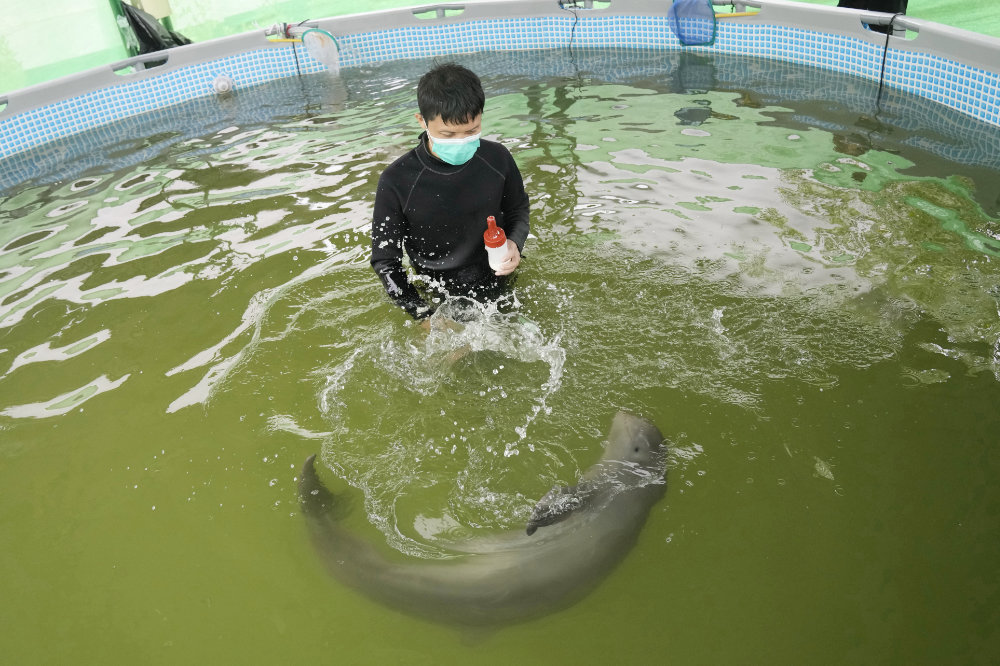


A volunteer Tosapol Prayoonsuk takes care of a baby dolphin nicknamed Paradon at the Marine and Coastal Resources Research and Development Center in Rayong province in eastern Thailand, Friday, Aug. 26, 2022. (AP)

Officials from the marine research center believe around 400 Irrawaddy dolphins remain along the country’s eastern coast, bordering Cambodia.
Since Paradon was found by the fishermen July 22, dozens of veterinarians and volunteers have helped care for him at the center in Rayong on the Gulf of Thailand.
“We said among ourselves that the chance of him surviving was quite low, judging from his condition,” Thanaphan Chomchuen, a veterinarian at the center, said Friday. “Normally, dolphins found stranded on the shore are usually in such a terrible condition. The chances that these dolphins would survive are normally very, very slim. But we gave him our best try on that day.”
Workers placed him in a seawater pool, treated the lung infection that made him so sick and weak, and enlisted volunteers to watch him round the clock. They have to hold him up in his tank to prevent him from drowning and feed him milk, initially done by tube, and later by bottle when he had recovered a bit of strength.
A staff veterinarian and one or two volunteers stay for each eight-hour shift, and other workers during the day handle the water pump and filter and making milk for the calf.
After a month, Paradon’s condition is improving. The calf believed to be between 4 and 6 months old can swim now and has no signs of infection. But the dolphin that was 138 centimeters long (4.5 feet) and around 27 kilograms (59 pounds) on July 22 is still weak and doesn’t take enough milk despite the team’s efforts to feed him every 20 minutes or so.
Thippunyar Thipjuntar, a 32-year-old financial adviser, is one of the many volunteers who come for a babysitting shift with Paradon.
Thippunya said with Paradon’s round baby face and curved mouth that looks like a smile, she couldn’t help but grow attached to him and be concerned about his development.
“He does not eat enough but rather just wants to play. I am worried that he does not receive enough nutrition,” she told The Associated Press on Friday as she fed the sleepy Paradon, cradled in her arm. “When you invest your time, physical effort, mental attention, and money to come here to be a volunteer, of course you wish that he would grow strong and survive.”
Sumana Kajonwattanakul, director of the marine center, said Paradon will need long-term care, perhaps as much as a year, until he is weaned from milk and is able to hunt for his own food.
“If we just release him when he gets better, the problem is that he he won’t be able to have milk. We will have to take care of him until he has his teeth, then we must train him to eat fish, and be part of a pod. This will take quite some time,” Sumana said.
Paradon’s caregivers believe the extended tender loving care is worth it.
“If we can save one dolphin, this will help our knowledge, as there have not been many successful cases in treating this type of animal,” said veterinarian Thanaphan. “If we can save him and he survives, we will have learned so much from this.”
“Secondly, I think by saving him, giving him a chance to live, we also raise awareness about the conservation of this species of animal, which are rare, with not many left.”


As an uncertain 2026 begins, virtual journeys back to 2016 become a trend

Updated 30 January 2026
Follow

As an uncertain 2026 begins, virtual journeys back to 2016 become a trend

  • Over the past few weeks, millions have been sharing throwback photos to that time on social media, kicking off one of the first viral trends of the year

LONDON: The year is 2016. Somehow it feels carefree, driven by Internet culture. Everyone is wearing over-the-top makeup.
At least, that’s how Maren Nævdal, 27, remembers it — and has seen it on her social feeds in recent days.
For Njeri Allen, also 27, the year was defined by the artists topping the charts that year, from Beyonce to Drake to Rihanna’s last music releases. She also remembers the Snapchat stories and an unforgettable summer with her loved ones. “Everything felt new, different, interesting and fun,” Allen says.
Many people, particularly those in their 20s and 30s, are thinking about 2016 these days. Over the past few weeks, millions have been sharing throwback photos to that time on social media, kicking off one of the first viral trends of the year — the year 2026, that is.
With it have come the memes about how various factors — the sepia hues over Instagram photos, the dog filters on Snapchat and the music — made even 2016’s worst day feel like the best of times.
Part of the look-back trend’s popularity has come from the realization that 2016 was already a decade ago – a time when Nævdal says she felt like people were doing “fun, unserious things” before having to grow up.
But experts point to 2016 as a year when the world was on the edge of the social, political and technological developments that make up our lives today. Those same advances — such as developments under US President Donald Trump and the rise of AI — have increased a yearning for even the recent past, and made it easier to get there.
2016 marked a year of transition
Nostalgia is often driven by a generation coming of age — and its members realizing they miss what childhood and adolescence felt like. That’s certainly true here. But some of those indulging in the online journeys through time say something more is at play as well.
It has to do with the state of the world — then and now.
By the end of 2016, people would be looking ahead to moments like Trump’s first presidential term and repercussions of the United Kingdom leaving the EU after the Brexit referendum. A few years after that, the COVID-19 pandemic would send most of the world into lockdown and upend life for nearly two years.
Janelle Wilson, a professor of sociology at the University of Minnesota-Duluth, says the world was “on the cusp of things, but not fully thrown into the dark days that were to come.”
“The nostalgia being expressed now, for 2016, is due in large part to what has transpired since then,” she says, also referencing the rise of populism and increased polarization. “For there to be nostalgia for 2016 in the present,” she added, “I still think those kinds of transitions are significant.”
For Nævdal, 2016 “was before a lot of the things we’re dealing with now.” She loved seeing “how embarrassing everyone was, not just me,” in the photos people have shared.
“It felt more authentic in some ways,” she says. Today, Nævdal says, “the world is going downhill.”
Nina van Volkinburg, a professor of strategic fashion marketing at University of the Arts, London, says 2016 marked the beginning of “a new world order” and of “fractured trust in institutions and the establishment.” She says it also represented a time of possibility — and, on social media, “the maximalism of it all.”
This was represented in the bohemian fashion popularized in Coachella that year, the “cut crease” makeup Nævdal loved and the dance music Allen remembers.
“People were new to platforms and online trends, so were having fun with their identity,” van Volkinburg says. “There was authenticity around that.”
And 2016 was also the year of the “boss babe” and the popularity of millennial pink, van Volkinburg says, indications of young people coming into adulthood in a year that felt hopeful.
Allen remembers that as the summer she and her friends came of age as high school graduates. She says they all knew then that they would remember 2016 forever.
Ten years on, having moved again to Taiwan, she said “unprecedented things are happening” in the world. “Both of my homes are not safe,” she said of the US and Taiwan, “it’s easier to go back to a time that’s more comfortable and that you felt safe in.”
Feelings of nostalgia are speeding up
In the last few days, Nævdal decided to hide the social media apps on her phone. AI was a big part of that decision. “It freaks me out that you can’t tell what’s real anymore,” she said.
“When I’ve come off of social media, I feel that at least now I know the things I’m seeing are real,” she added, “which is quite terrifying.”
The revival of vinyl record collections, letter writing and a fresh focus on the aesthetics of yesterday point to nostalgia continuing to dominate trends and culture. Wilson says the feeling has increased as technology makes nostalgia more accessible.
“We can so readily access the past or, at least, versions of it,” she said. “We’re to the point where we can say, ‘Remember last week when we were doing XYZ? That was such a good time!’”
Both Nævdal and Allen described themselves as nostalgic people. Nævdal said she enjoys looking back to old photos – especially when they show up as “On This Day” updates on her phone, She sends them to friends and family when their photos come up.
Allen wished that she documented more of her 2016 and younger years overall, to reflect on how much she has evolved and experienced since.
“I didn’t know what life could be,” she said of that time. “I would love to be able to capture my thought process and my feelings, just to know how much I have grown.”