

UN special envoy meets Bangladeshi officials as pressure to repatriate Rohingya grows

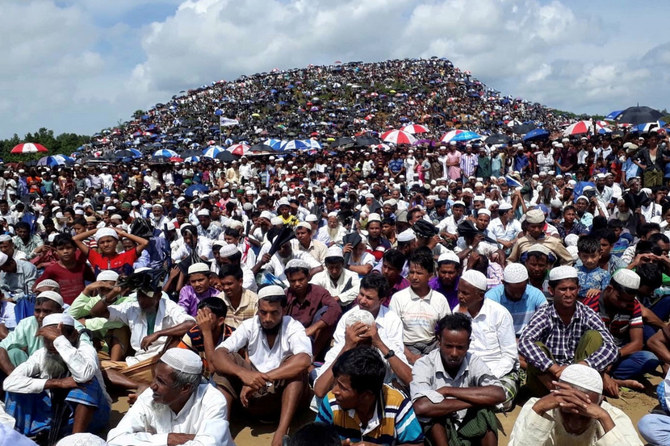
Rohingya refugees gather to mark the second anniversary of the exodus at the Kutupalong camp in Cox's Bazar, Bangladesh, on August 25, 2019. (REUTERS/File Photo)
Short Url
Updated 25 August 2022
Follow

UN special envoy meets Bangladeshi officials as pressure to repatriate Rohingya grows

  • Noeleen Heyzer’s trip to Bangladesh follows her visit to Myanmar
  • Bangladeshi PM called on UN last week to start repatriation of Rohingya refugees

DHAKA: The UN Special Envoy for Myanmar Noeleen Heyzer met with Bangladeshi officials on Wednesday amid growing pressure for the repatriation of Rohingya refugees.

Although Bangladesh is not a signatory to the 1951 UN Refugee Convention, it has been hosting and providing humanitarian support to 1.2 million Rohingya Muslims, most of whom fled neighboring Myanmar during a military crackdown in 2017.

A majority of the refugees live in squalid camps in Cox’s Bazar district, a coastal region in the country’s southeast and the world’s largest refugee settlement.

Despite multiple attempts from Bangladesh over the past years, a UN-backed repatriation process has been failing to take off.

Heyzer arrived in Bangladesh on Monday, after her visit to Myanmar last week.

“The UN envoy to Myanmar visited the Rohingya camps at Cox’s Bazar on Tuesday. She witnessed the facilities over there that Bangladesh has provided to the Rohingya refugees,” Shamsud Douza Nayan, additional commissioner of Bangladesh’s Refugee Relief and Repatriation Commission, told Arab News.

“Today’s meeting was to discuss the issues about the well-being of the Rohingyas.”

Heyzer inspected facilities provided to Rohingya refugees in the camps, where no work is available, sanitation is poor and access to education limited.

Her arrival in Bangladesh follows the visit of UN High Commissioner for Human Rights Michelle Bachelet, whom Bangladeshi Prime Minister Sheikh Hasina called upon to repatriate the Rohingya.

When Bachelet asked Hasina to increase opportunities for education and work for the Rohingya in Bangladesh, the prime minister said such initiatives would not be possible to implement in Cox’s Bazar but could be pursued in Bhasan Char, a remote camp island in the Bay of Bengal, where Bangladeshi authorities have shifted over 20,000 refugees since December 2020 to take pressure off Cox’s Bazar.

Before and during the relocation process, the UN High Commissioner for Refugees and rights groups criticized the camp island project on the grounds of safety and Bhasan Char’s livability, as the island, 68 km from the mainland, is prone to severe weather and flooding.

As international financial support for hosting the Rohingya has decreased since 2020, the pressure on Bangladesh has been also economic, multiplying the challenges the developing country battered by the COVID-19 pandemic is already facing. Hosting Rohingya refugees costs Bangladesh an estimated $1.2 billion a year.

Security in Rohingya settlements has come under the spotlight in recent weeks after two refugee community leaders were shot dead earlier this month, reportedly by an insurgent group active in the camps, which has been accused of killing scores of opponents and local community leaders since last year.

Reports of criminal organizations using refugees as drug traffickers have also been on the rise.

In an appeal to donors, the UN refugee agency said on Tuesday that international support for Rohingyas is “well short of needs.”

The UNHCR said its 2022 response plan sought $881 million for more than 1.4 million people, including Rohingya refugees and host communities, but so far was funded at only 49 percent.


French publisher recalls dictionary over ‘Jewish settler’ reference

Updated 17 January 2026
Follow

French publisher recalls dictionary over ‘Jewish settler’ reference

  • The entry in French reads: “In October 2023, following the death of more than 1,200 Jewish settlers in a series of Hamas attacks”
  • The four books are subject to a recall procedure and will be destroyed, Hachette said

PARSI: French publisher Hachette on Friday said it had recalled a dictionary that described the Israeli victims of the October 7, 2023 attacks as “Jewish settlers” and promised to review all its textbooks and educational materials.
The Larousse dictionary for 11- to 15-year-old students contained the same phrase as that discovered by an anti-racism body in three revision books, the company told AFP.
The entry in French reads: “In October 2023, following the death of more than 1,200 Jewish settlers in a series of Hamas attacks, Israel decided to tighten its economic blockade and invade a large part of the Gaza Strip, triggering a major humanitarian crisis in the region.”
The worst attack in Israeli history saw militants from the Palestinian Islamist group kill around 1,200 people in settlements close to the Gaza Strip and at a music festival.
“Jewish settlers” is a term used to describe Israelis living on illegally occupied Palestinian land.
The four books, which were immediately withdrawn from sale, are subject to a recall procedure and will be destroyed, Hachette said, promising a “thorough review of its textbooks, educational materials and dictionaries.”
France’s leading publishing group, which came under the control of the ultra-conservative Vincent Bollore at the end of 2023, has begun an internal inquiry “to determine how such an error was made.”
It promised to put in place “a new, strengthened verification process for all its future publications” in these series.
President Emmanuel Macron on Wednesday said that it was “intolerable” that the revision books for the French school leavers’ exam, the baccalaureat, “falsify the facts” about the “terrorist and antisemitic attacks by Hamas.”
“Revisionism has no place in the Republic,” he wrote on X.
Hamas’s October 7, 2023 attack on Israel resulted in the deaths of 1,221 people, with 251 people taken hostage, according to an AFP tally based on official Israeli figures.
Authorities in Gaza estimate that more than 70,000 people have been killed by Israeli forces during their bombardment of the territory since, while nearly 80 percent of buildings have been destroyed or damaged, according to UN data.
Israeli forces have killed at least 447 Palestinians in Gaza since a ceasefire took effect in October, according to the Hamas-run health ministry.