Rohingya crisis fund is ‘well short of needs’ – UN refugee agency

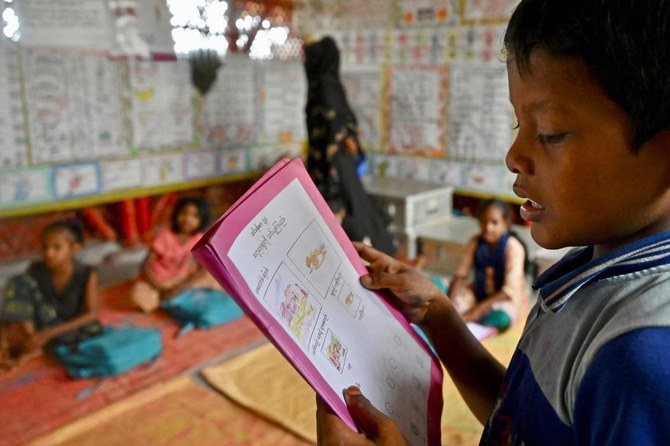
More than a million Rohingya are living in squalid camps in southern Bangladesh, comprising the world’s largest refugee settlement. (AFP)
Short Url
Updated 23 August 2022
Follow

Rohingya crisis fund is ‘well short of needs’ – UN refugee agency

  • More than a million Rohingya are living in squalid camps in southern Bangladesh
  • Rohingyas say they want guarantees of their safety and to be recognized as citizens before returning

An appeal to help Rohingya refugees in Bangladesh is “well short of needs,” the United Nations refugee agency (UNHCR) said on Tuesday, as refugees called on donors not to forget the crisis ahead of the fifth anniversary of their exodus from Myanmar.
More than a million Rohingya are living in squalid camps in southern Bangladesh comprising the world’s largest refugee settlement, with little prospect of returning to Myanmar, where they are mostly denied citizenship and other rights.
“For the almost 1 million stateless Rohingya refugees, conditions in Bangladesh are extremely overcrowded, and they remain fully reliant on humanitarian assistance for their survival, UNHCR said.
“The most commonly unmet needs include proper nutrition, shelter materials, sanitation facilities and livelihood opportunities,” a UNHCR statement said.
It said its 2022 response plan sought over $881 million for more than 1.4 million people, including Rohingya refugees and more than half a million most affected host communities. So far, it was funded at only 49 percent, with $426.2 million received.
“The support from the international community has been and is crucial in delivering lifesaving protection and assistance services for Rohingya refugees but funding is well short of needs.”
Refugees said it was crucial the world did not forget the plight of the Rohingya, who are unable to return to Myanmar, but have little future in Bangladesh, with no access to work.
“The global community should not forget our plight. They should help us as much as they can,” Mohammed Taher, a Rohingya refugee in Bangladesh, said.
“We are not allowed to work here. We must depend on aid agencies for food,” he added.
The Rohingya say they want guarantees of their safety and to be recognized as citizens before returning. The United Nations says conditions are not yet right for return.
The vast majority fled to neighboring Bangladesh during a military crackdown in 2017 that the United Nations has said was carried out with genocidal intent.
Myanmar denies genocide, saying it was waging a legitimate campaign against insurgents who attacked police posts.
Myanmar is facing charges of genocide at the International Court of Justice in the Hague over the violence.


US bars five Europeans it says pressured tech firms to censor American viewpoints online

Updated 58 min 35 sec ago
Follow

US bars five Europeans it says pressured tech firms to censor American viewpoints online

WASHINGTON: The State Department announced Tuesday it was barring five Europeans it accused of leading efforts to pressure US tech firms to censor or suppress American viewpoints.
The Europeans, characterized by Secretary of State Marco Rubio as “radical” activists and “weaponized” nongovernmental organizations, fell afoul of a new visa policy announced in May to restrict the entry of foreigners deemed responsible for censorship of protected speech in the United States.
“For far too long, ideologues in Europe have led organized efforts to coerce American platforms to punish American viewpoints they oppose,” Rubio posted on X. “The Trump Administration will no longer tolerate these egregious acts of extraterritorial censorship.”
The five Europeans were identified by Sarah Rogers, the under secretary of state for public diplomacy, in a series of posts on social media. They include the leaders of organizations that address digital hate and a former European Union commissioner who clashed with tech billionaire Elon Musk over broadcasting an online interview with Donald Trump.
Rubio’s statement said they advanced foreign government censorship campaigns against Americans and US companies, which he said created “potentially serious adverse foreign policy consequences” for the US
The action to bar them from the US is part of a Trump administration campaign against foreign influence over online speech, using immigration law rather than platform regulations or sanctions.
The five Europeans named by Rogers are: Imran Ahmed, chief executive of the Center for Countering Digital Hate; Josephine Ballon and Anna-Lena von Hodenberg, leaders of HateAid, a German organization; Clare Melford, who runs the Global Disinformation Index; and former EU Commissioner Thierry Breton, who was responsible for digital affairs.
Rogers in her post on X called Breton, a French business executive and former finance minister, the “mastermind” behind the EU’s Digital Services Act, which imposes a set of strict requirements designed to keep Internet users safe online. This includes flagging harmful or illegal content like hate speech.
She referred to Breton warning Musk of a possible “amplification of harmful content” by broadcasting his livestream interview with Trump in August 2024 when he was running for president.
Breton responded Tuesday on X by noting that all 27 EU members voted for the Digital Services Act in 2022. “To our American friends: ‘Censorship isn’t where you think it is,’” he wrote.
French Foreign Minister Jean-Noël Barrot said France condemns the visa restrictions on Breton and the four others. Also posting on X, he said the DSA was adopted to ensure that “what is illegal offline is also illegal online.” He said it “has absolutely no extraterritorial reach and in no way concerns the United States.”
Most Europeans are covered by the Visa Waiver Program, which means they don’t necessarily need visas to come into the country. They do, however, need to complete an online application prior to arrival under a system run by the Department of Homeland Security, so it is possible that at least some of these five people have been flagged to DHS, a US official said, speaking on condition of anonymity to discuss details not publicly released.
Other visa restriction policies were announced this year, along with bans targeting foreign visitors from certain African and Middle Eastern countries and the Palestinian Authority. Visitors from some countries could be required to post a financial bond when applying for a visa.