

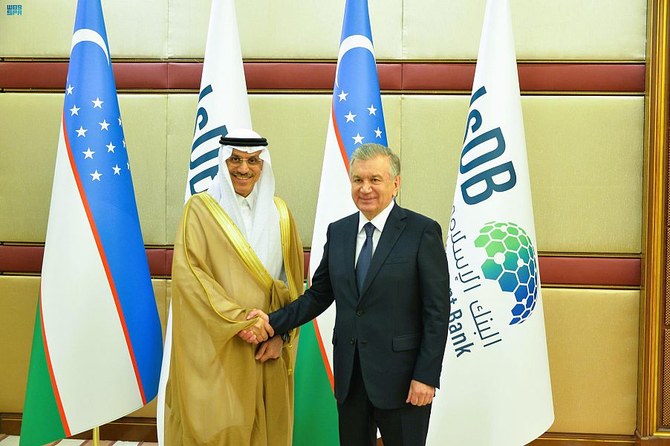
IsDB, Uzbekistan strengthen cooperation

Short Url
Updated 19 August 2022
Follow

IsDB, Uzbekistan strengthen cooperation

JEDDAH: Islamic Development Bank President Mohammed Al-Jasser met with Uzbekistan President Shavkat Mirziyoyev on August 18 to discuss strengthening cooperation between both parties, Saudi Press Agency reported.

A letter of intent was signed during the meeting to provide a framework for facilitating cooperation, promoting rapid processing and approval of projects and operations that are part of the work program of the IsDB Group for Uzbekistan in 2022.

The meeting comes on the second day of the Uzbek President's visit to the Kingdom.

Mirziyoyev stressed that his government has implemented comprehensive reforms with the aim of improving the business and investment environment, enhancing regional cooperation, improving the agricultural sector, and promoting innovation and entrepreneurship to reach the goal of achieving dignity for all people by 2026.

Both parties reviewed views on the National Development Strategy of Uzbekistan 2026, and agreed on the need to align the bank's country strategy with the national document, a task that will be worked on as a priority, according to Al-Jasser.

The two sides also emphasized the need to facilitate the joining of more co-financiers to participate in financing larger projects.


Oman money supply rises 6.4% to $68.6bn in November 

Updated 4 sec ago
Follow

Oman money supply rises 6.4% to $68.6bn in November 

JEDDAH: Oman’s money supply climbed 6.4 percent to 26.4 billion Omani rials ($68.6 billion) in November, signaling solid liquidity conditions and continued growth in bank deposits, official data showed.  

The increase in broad money — a measure that includes cash in circulation and bank deposits — was driven by a 12.2 percent rise in cash and demand deposits, alongside a 4.1 percent increase in savings and time deposits, the Oman News Agency reported. 

The latest reading follows steady gains earlier in 2025, with money supply up 6.1 percent in the three months through August. This was supported by a 6.9 percent rise in narrow money and a 5.8 percent increase in quasi-money. The trend reflects sustained liquidity conditions and stronger deposit growth across the banking system. 

The expansion in monetary aggregates points to continued liquidity and policy support for private-sector lending, as Oman advances fiscal and economic reforms under its Vision 2040 strategy. 

“During the same period, currency in circulation increased 1.9  percent, while demand deposits rose 14.1 percent,” the ONA report stated. 

At conventional commercial banks, the weighted average deposit rate in Omani rials declined to 2.50 percent in November from 2.73 percent a year earlier, while the weighted average lending rate eased to 5.45 percent from 5.67 percent over the same period. 

The overnight interbank lending rate averaged 3.92 percent in November, down from 4.56 percent a year earlier, reflecting a decline in the weighted average repo rate to 4.5 percent from 5.30 percent, influenced by US Federal Reserve policy shifts. 

Meanwhile, total assets of Islamic banks and windows reached about 9.3 billion Omani rials by the end of November, accounting for 19.4 percent of the Gulf state’s total banking sector assets.  

“This marks a 12.3 percent increase compared with the same period in 2024,” ONA reported, citing data from the Central Bank of Oman. 

Total financing by Islamic banking units rose 10.3 percent to around 7.5 billion rials, while deposits increased 10.9 percent to approximately 7.3 billion rials by the end of November. 

The November data follows the International Monetary Fund’s 2025 Article IV consultation report, released earlier this month, which highlighted the continued resilience of Oman’s economy amid global uncertainty. 

The IMF cited steady growth in non-hydrocarbon sectors, low inflation, and broadly sound fiscal and external positions, underscoring the effectiveness of Oman’s coordinated economic and financial policies.