

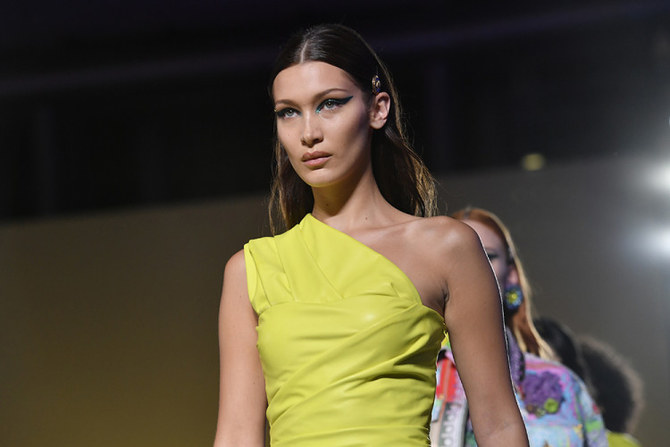

LONDON: The model Bella Hadid has spoken of her “sadness” that her “Muslim culture” was taken from her as a child following the divorce of her parents.
In an interview with GQ, ahead of her acting debut in the Hulu TV series “Ramy,” she said she had been “extracted” from her Palestinian father, real estate developer Mohamed Hadid, and his side of the family when her mother, Dutch model Yolanda Hadid, moved her and her siblings, Gigi and Anwar, from Washington, D.C. to Santa Barbara, California.
“I was with my Palestinian side (of the family) and I got extracted when we moved to California,” she said.
“I would have loved to grow up and be with my dad every day and studying and really being able to practice, just in general being able to live in a Muslim culture, but I wasn’t given that.”
Hadid, who was just four years old when she was forced to move, added she was the only Arab girl in her class at school in Santa Barbara and suffered racist discrimination.
“For so long I was missing that (Palestinian) part of me, and it made me really, really sad and lonely,” she said.
“Ramy” is a comedy-drama about a first-generation American Muslim, starring Hadid’s friend Ramy Youssef. She said the show had ignited her interest in discovering more about her Palestinian heritage and her faith.
She added that she “couldn’t handle” her emotions when crew members working on the show gave her a “Free Palestine” T-shirt as a gift.
“Growing up and being Arab, it was the first time that I’d ever been with like-minded people,” she said. “I was able to see myself.”
The 25-year-old star has become vociferous in her support for Palestine in recent years, attending protests and spreading awareness on social media.
In a post following a protest four years ago, she wrote: “It has always been #freepalestine. ALWAYS. I have a lot to say about this but for now, please read and educate yourself.
“This is not about religion. This is not about spewing hate on one or the other. This is about Israeli colonization, ethnic cleansing, military occupation and apartheid over the Palestinian people that has been going on for YEARS!”
Writing on Instagram after attending a protest in New York in 2021, she said: “The way my heart feels ... To be around this many beautiful, smart, respectful, loving, kind, and generous Palestinians all in one place ... It feels whole. We are a rare breed!”
In another post, following violence in Gaza later that year, she wrote: “You cannot allow yourself to be desensitized to watching human life being taken. Palestinian lives are the lives that will help change the world. And they are being taken from us by the second.”
In an Instagram post about her grandparents’ wedding in Palestine in 1941, she wrote: “I love my family, I love my heritage, I love Palestine.”
In the GQ interview, the model also opened up on issues surrounding body image and self-esteem. She said she had compared herself unfavorably to her older sister, and fellow model, Gigi, developed an eating disorder, and even been driven to plastic surgery at the age of only 14 years old when she had a nose job.
“I wish I had kept the nose of my ancestors,” she said as she reflected on the procedure. “I think I would have grown into it.”
She added: “I’ve had this impostor syndrome where people made me feel like I didn’t deserve any of this.
“People can say anything about how I look, about how I talk, about how I act. But in seven years I never missed a job, canceled a job, was late to a job. No one can ever say that I don’t work my a— off.”


