

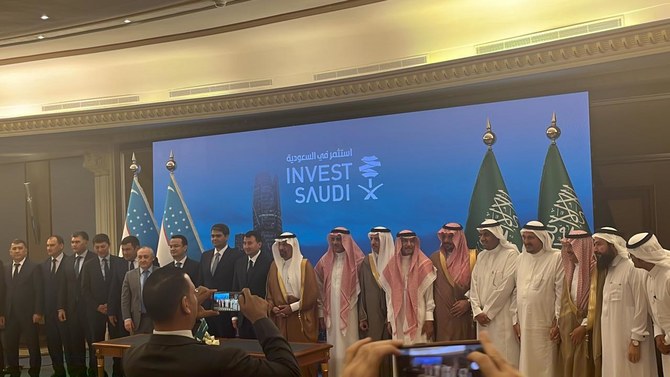

JEDDAH: Saudi Arabia and Uzbekistan have signed over 10 investment agreements, worth over SR45 billion ($12 billion), during a meeting of the Saudi-Uzbek Business Council in Jeddah on Wednesday.
The agreements cover various sectors and include a number of deals between the Ministry of Investment and Foreign Trade of the Republic of Uzbekistan, the Ministry of Energy of the Republic of Uzbekistan, and ACWA Power, a developer, investor, co-owner and operator of a portfolio of power generation and desalinated water production plants.
“Over 10 agreements were signed between the Kingdom and Uzbekistan in several sectors, with a value exceeding SR45 billion,” Saudi Minister of Investment Khalid Al-Falih said.
In a bourse filing, ACWA Power said it will sign a $2.4 billion deal with the government of Uzbekistan for a 1,500 MW wind project.
To be located in Karakalpakstan, Uzbekistan, the facility seeks to power 1.65 million households and offset 2.4 million tons of carbon emissions per year.
Expected to achieve a financial close by the end of 2023, the project is likely to be fully commissioned by the first quarter of 2026.
Speaking at the council’s 4th meeting, Al-Falih stressed the need for a direct import and export relationship between the Kingdom and Uzbekistan, as most of the trade between the two countries is happening through Turkey and the UAE.
He said Uzbekistan is a huge player in agriculture, real estate, hospitality, and human resources.
“We want to make this relationship one of the most important for Saudi Arabia. We are here to facilitate. We are here to serve,” said Al-Falih.
Al-Falih added that the relationship between Saudi Arabia and Uzbekistan has reached new heights with the involvement of ACWA Power.
He further added that Uzbekistan is a country full of opportunities, and ACWA Power is a firm that is exploring new horizons.
Jamshid Khodjaev, Uzbekistan’s deputy prime minister, and the minister of investments and foreign trade, said that Saudi Arabia is on a path of transformation, and the Kingdom is now a very dynamic and developed country.
He lauded ACWA Power and said that the firm is one of the best in the world. He further noted that Uzbekistan and Saudi Arabia are reliable partners, and made it clear that the country is committed to a long-term relationship with the Kingdom.
The mutual trade between Saudi Arabia and the Republic of Uzbekistan reached $95 million in the first half of 2022, a substantial increase considering that bilateral trade barely exceeded $17 million last year.
According to a joint news statement, the value is expected to grow rapidly by the end of 2022. The numbers assume significance in the aftermath of the pandemic.
In fact, the number of Uzbek companies running on Saudi funds increased from about nine to 38 in the last five years. Of the 38, 19 are sole proprietors, and the rest are joint ventures. The Kingdom has become one of the largest foreign investors in energy infrastructure and one of Uzbekistan’s most significant developers of green energy projects.
ACWA Power also signed an agreement to establish the 100MW Nokus wind farm project, the first renewable energy project to be implemented in partnership with Uzbekistan’s public and private sectors.
The power-generating company also won a $108 million wind contract after proposing a tariff of 2.56 cents per kilowatt-hour, the lowest in Uzbekistan.
Additionally, the Ministry of Energy of Uzbekistan signed a 25-year power purchase agreement with ACWA Power to establish a combined-cycle gas turbine power plant in Shirin, located in Syrdarya, Uzbekistan. The deal amounts to $1.2 billion.
According to the statement, these projects will contribute to achieving Uzbekistan’s national goal of raising the total renewable energy generation capacity to 30 percent by 2030.
Moreover, the Saudi Fund for Development has contributed to the implementation of many projects in Uzbekistan, including funding the Samarkand-Gozar Road project, with a total value of $30 million.
The fund also contributed to 20 projects in the republic, including building pumping stations and other projects involving sewage, chemicals, mining, building materials, water and agriculture.


